
Imagine a king so heartbroken by his wife's death that he builds the world's most beautiful tomb. White marble gleams under the sun, gardens whisper of lost love, and minarets touch the sky. That's the Taj Mahal—an Agra monument that captures timeless romance. Welcome to the full Taj Mahal history in English, where we'll uncover the Mughal history, stunning architecture, and secrets of Shah Jahan and Mumtaz Mahal.
This isn't just a building. It's a love letter carved in stone. Dive in to discover Taj Mahal facts, construction wonders, and why millions visit this wonder every year.
What is the Taj Mahal history in brief?
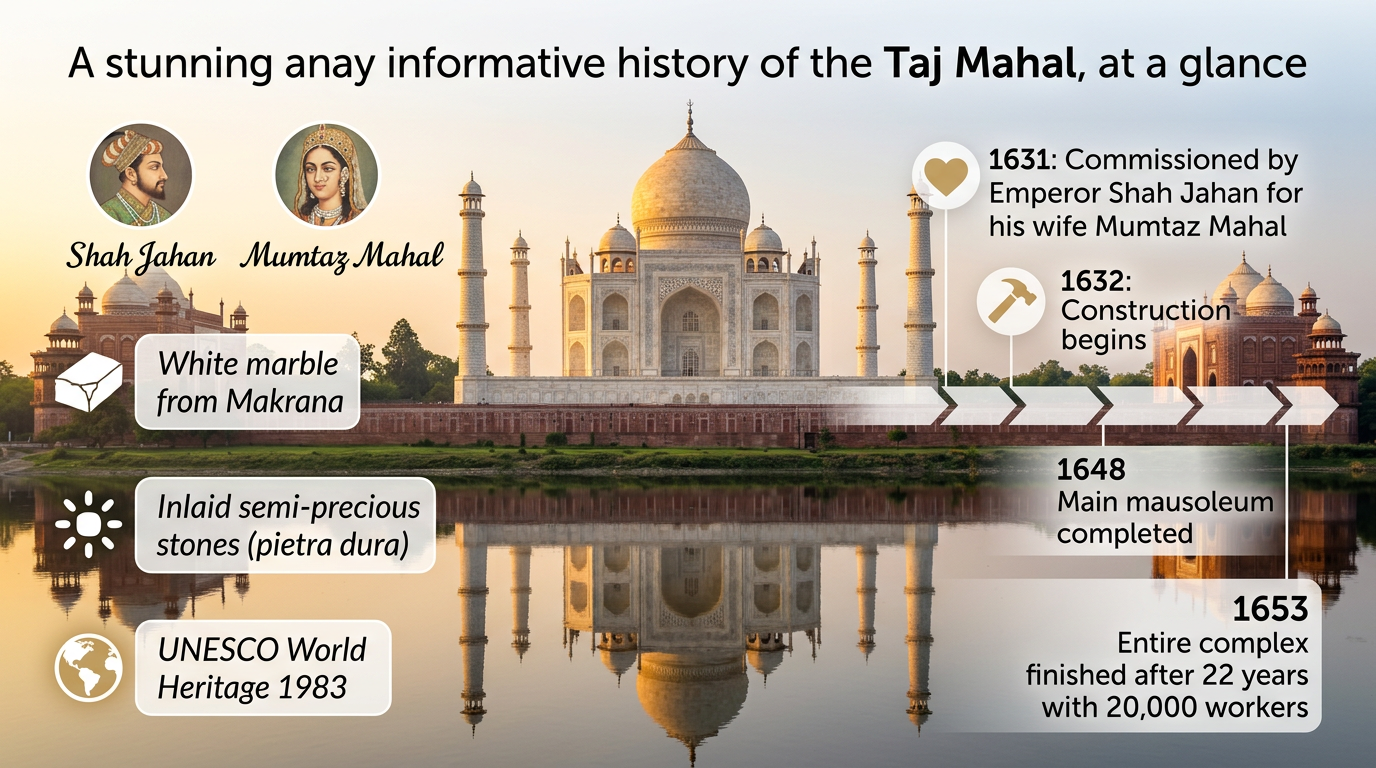
The Taj Mahal is a white marble mausoleum in Agra, India, built by Emperor Shah Jahan from 1632 to 1653 in memory of his wife, Mumtaz Mahal. It took 20,000 workers, 22 years, and materials from across Asia to create this UNESCO World Heritage Site, symbolizing eternal love in Mughal history. Key Taj Mahal facts: 288 columns, 28 domes, and gardens inspired by paradise.
The Heartbreaking Love Story of Shah Jahan and Mumtaz Mahal
Every great monument starts with a story. The Taj Mahal's begins with love.
Shah Jahan was a young prince named Khurram. In 1607, at age 15, he spotted Arjumand Banu Begum in a bustling market. She was 14, beautiful, with eyes like stars. They fell in love instantly. But politics delayed their wedding for five years. In 1612, they married under a moonlit sky.
They called her Mumtaz Mahal, "Jewel of the Palace." She wasn't just a queen—she was his advisor, companion, and strength. For 19 years, they traveled together on wars and hunts. Mumtaz bore him 14 children. Shah Jahan said she was his heartbeat.
Tragedy struck in 1631. During a battle in Burhanpur, Mumtaz died giving birth to their 14th child. Shah Jahan was shattered. He locked himself away for two years, his hair turning white from grief. Legends say he cried so much, his beard dripped tears onto his chest, staining it forever.
He vowed to build her the grandest tomb. "Let the world see our love," he declared. And so, the Taj Mahal rose from his sorrow.
This love story makes the Agra monument more than stone—it's a monument to devotion.
Timeline of Taj Mahal History: From Dream to Wonder
The Taj Mahal history in English unfolds like a epic tale. Here's the key timeline:
-
1607: Shah Jahan (then Prince Khurram) meets Mumtaz Mahal.
-
1612: They marry.
-
1628: Shah Jahan becomes Mughal Emperor.
-
1631: Mumtaz dies in Burhanpur.
-
1632: Construction starts on the banks of Yamuna River in Agra.
-
1632-1648: Main mausoleum and gardens built.
-
1648-1653: Minarets, mosque, and guest house finished.
-
1653: Taj Mahal declared complete.
-
1658: Shah Jahan imprisoned by his son Aurangzeb.
-
1666: French traveler sees it and calls it "a princely tomb."
-
1983: UNESCO World Heritage Site.
Over 22 years, it transformed a barren riverside into paradise. This timeline shows the dedication behind this Mughal history gem.
Construction Secrets: How 20,000 Workers Built a Marvel
Building the Taj Mahal was no small feat. Shah Jahan gathered 20,000 workers—stonemasons, jewelers, and artists from India, Persia, Turkey, and Europe.
They started by digging foundations 50 feet deep. The site was on soft soil near the Yamuna River, so engineers drove 13 massive stone pillars into the bedrock for stability.
Materials came from afar:
-
White marble from Makrana, Rajasthan (1,000 elephants hauled it).
-
Red sandstone from Fatehpur Sikri.
-
Jade from China, turquoise from Tibet, lapis lazuli from Afghanistan.
-
Over 28 gem types inlaid, like diamonds and sapphires.
Techniques amazed even today. Workers used scaffolding of bamboo and bricks. For the dome, they built a 70-foot scaffold tower—taller than the Taj itself. Gold pulleys lifted stones. A 3-km ramp let elephants drag heavy blocks.
The cost? A fortune—32 million rupees (about $1 billion today). Shah Jahan taxed India heavily, but the result was worth it.
One clever trick: To make marble shine, they rubbed it with sand from the Yamuna. No mortar needed—stones interlocked perfectly.
Tragically, after completion, Shah Jahan executed the chief architect, Ustad Ahmad Lahauri, fearing no one could match it. (A myth, but it adds drama.)
These construction details reveal the sweat and genius behind the Taj Mahal architecture.
[caption id="attachment_601" align="alignnone" width="300"] Taj Mahal History In English[/caption]
Taj Mahal Architecture Explained Simply
The Taj Mahal isn't just pretty—its design is genius.
At the center sits the mausoleum, 240 feet tall. Four minarets (towers) guard it, leaning slightly outward to protect from earthquakes. The main dome rises 200 feet, like a pearl on a plate.
Step inside: False cenotaphs of Shah Jahan and Mumtaz glow with jewels. Real tombs lie below. Calligraphy quotes the Quran, getting slightly larger as you go up to look straight.
The complex spans 42 acres:
-
Charbagh Gardens: Four quadrants like paradise gardens in Islam. Water channels reflect the Taj.
-
Mosque: For prayers, red sandstone.
-
Guest House (Mehman Khana): Balanced symmetry.
-
Gateway: Huge arch announces arrival.
Symmetry rules everything. Walk one side, it mirrors the other. Pietra dura inlay—semi-precious stones cut into flowers—sparkles like jewelry.
Sunrise paints it pink, noon white, sunset golden. Moonlight? Magical silver. No wonder it's called the "Crown of Palaces."
This Taj Mahal architecture blends Persian, Islamic, and Indian styles into pure beauty.
Interesting Facts About Taj Mahal
The Taj hides surprises. Here are top Taj Mahal facts:
-
It changes color with light—pink at dawn, milky white midday, golden at dusk.
-
Contains 288 pillars, but none touch the main dome for earthquake safety.
-
Shah Jahan planned a black Taj across the river for himself (never built).
-
Over 1,000 elephants transported materials.
-
The calligrapher's son finished the Quranic verses after his father died.
-
It has no straight lines from afar—curves create perfect illusion.
-
British soldiers nearly sold its marble for £1 million in 1830s (stopped just in time).
These nuggets make visits unforgettable.
Quick Facts Table
Why Taj Mahal is Famous
Fame comes from love, beauty, and mystery.
First, the romance. Hollywood calls it "the ultimate love symbol." Couples propose here.
Second, architecture. UNESCO ranks it top for harmony.
Third, Mughal history. It marks the empire's peak—wealth, art, power.
Myths add allure: Shah Jahan's hands chopped off? (False.) Black Taj? (Planned, ruined by war.)
Today, it's India's top Agra monument, drawing stars like Obama and Bieber. Fame ensures its story lives.
British Period: Looting, Loss, and Restoration
Mughal glory faded. In 1761, Agra fell. By 1857, British ruled India.
They eyed the Taj's riches. Lord William Sleeman noted soldiers chipped marble for souvenirs. In 1831, Governor-General Lord William Bentinck planned to auction it—break into parts for London.
Public outcry stopped it. Queen Victoria called it "beautiful."
Post-1857, they whitewashed it during independence riots to hide bloodstains.
After India freed in 1947, restoration began. 1908: Viceroy Curzon fixed gardens. 1942: Protected monument.
Today, Archaeological Survey of India (ASI) leads efforts. Lasers clean pollution. It's back to glory.
Shah Jahan's Sad End and the Taj's Legacy
Shah Jahan watched his Taj from afar. In 1658, son Aurangzeb jailed him in Agra Fort. For 8 years, he gazed at Mumtaz's tomb, dying in 1666.
Buried beside her, his tomb is off-center—last imperfection in perfect symmetry.
Aurangzeb neglected it. Later Mughals looted gems. But the Taj endured.
Modern Importance and Tourism Value
Today, the Taj is India's crown jewel. 7-8 million visitors yearly pump ₹5 billion into Agra's economy.
It's a peace symbol—hosts weddings, yoga, lights festivals.
Tourism value: Jobs for guides, hotels, shops. Boosts handicrafts like marble inlay.
Global icon: On stamps, movies, ads. Represents India.
Best Time to Visit Taj Mahal
Timing matters for magic.
Ideal: October to March. Cool weather (10-25°C). Sunrise/sunset best for colors.
Avoid: June-August (monsoon, 40°C heat).
Tips:
-
Buy online tickets (Indians ₹50, foreigners ₹1100).
-
Weekdays mornings beat crowds.
-
Full moon nights (5/year) for lit views.
Dress modest, no shoes inside.
Environmental Issues and Preservation Efforts
The Taj faces threats.
Pollution: Factories spewed acid rain, yellowing marble since 1990s. Taj Trapezium Zone banned polluting industries—success!
Yamuna River: Dirty water erodes base. Cleaning drives ongoing.
Tourists: 40,000 daily feet wear stone. Limits now 40,000/day.
Climate: Bugs eat gardens. Monkeys mischief.
ASI uses mud packs (like facials) to whiten marble. Electric buses cut emissions. Drones monitor.
Future? Green tech preserves this wonder.
Myths and Legends of Taj Mahal
Stories swirl:
-
Black Taj: Shah planned obsidian twin. River shifted, wars stopped it.
-
Dead Workers: All killed to keep secrets. (False—many got pensions.)
-
Crying Stone: Marble "weeps" at night. Dew drops!
-
Treasure Below: Hidden Mughal jewels. (Guarded myth.)
These add romance.
FAQ: Common Questions on Taj Mahal History
1. Who built the Taj Mahal and why?
Shah Jahan built it for his wife Mumtaz Mahal, who died in 1631. It's a tribute to their love.
2. How long did Taj Mahal construction take?
22 years, from 1632 to 1653, with 20,000 workers.
3. What is special about Taj Mahal architecture?
Perfect symmetry, white marble inlay with 28 gems, huge dome, paradise gardens.
4. Is Taj Mahal open every day?
Yes, sunrise to sunset, closed Fridays (Muslim prayer).
5. Can you go inside the Taj Mahal tombs?
No, only cenotaphs visible. Real tombs closed since 1970s.
6. How does Taj Mahal look different times of day?
Pink dawn, white noon, orange sunset, silver moonlight.
7. What are threats to Taj Mahal today?
Air pollution, river silt, overtourism. ASI protects it.
Conclusion: Why Taj Mahal History Still Captivates
The Taj Mahal history in English is more than dates—it's a king's grief turned eternal beauty. From Shah Jahan and Mumtaz Mahal's romance to 22 years of toil, this Agra monument stands as love's proof.
Taj Mahal facts like color-changing marble and hidden symmetries amaze. Despite British threats and modern woes, preservation keeps it shining.
Visit, feel the story. In a busy world, the Taj whispers: True love lasts. What's your favorite part of this Mughal history tale?
Explore India's Tours: Luxury Taj Mahal Tours, Luxury Golden Triangle Tour Packages India, Same Day Agra Tour By Luxury Car From Delhi