
Overview - What Makes This Tour Special
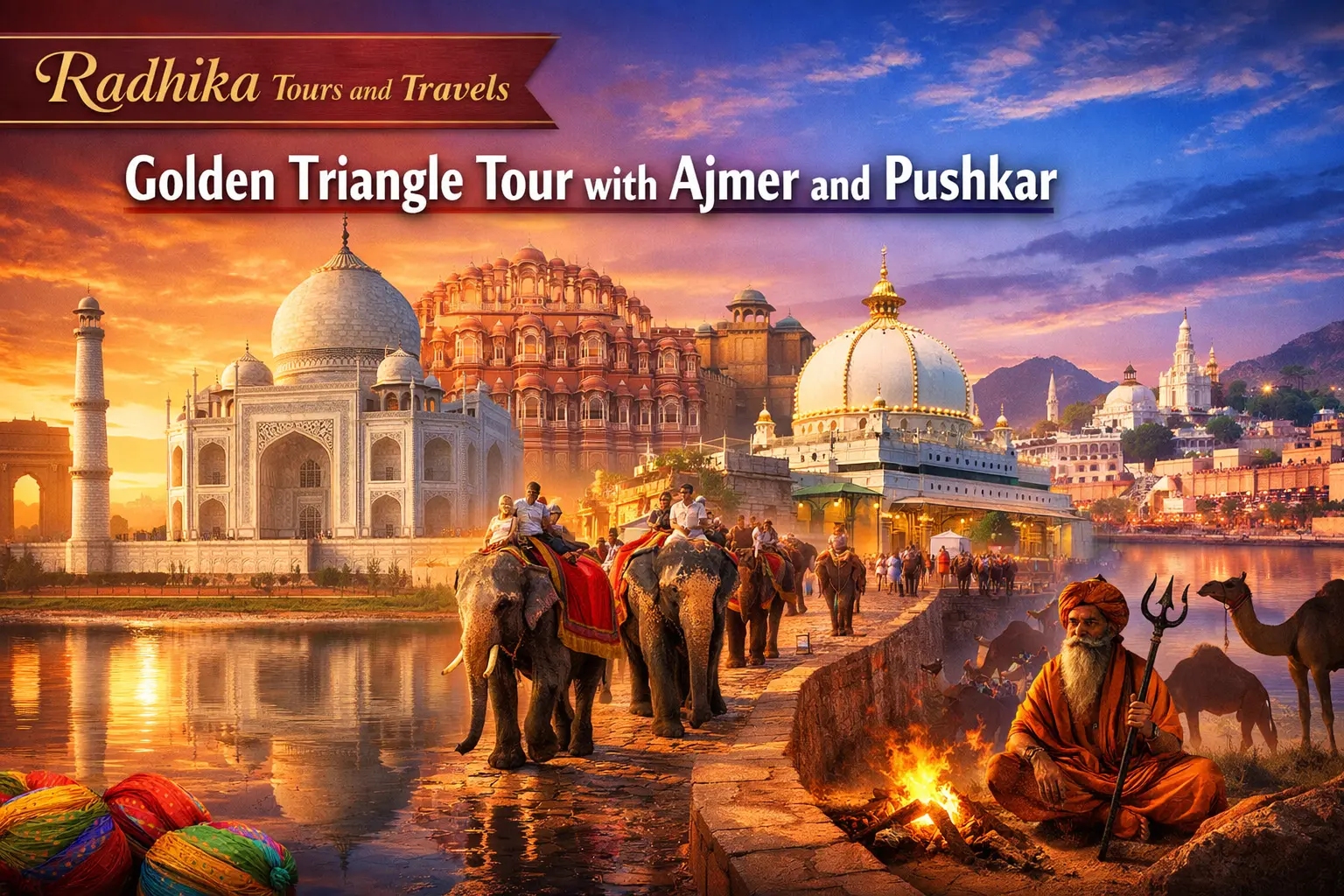
The Golden Triangle Tour With Ajmer And Pushkar by Radhika Tours And Travels is one of North India's most complete journeys. In just 7 days, you experience Delhi's living monuments, Agra's eternal Taj Mahal, Jaipur's pink-walled palaces, the Sufi devotion of Ajmer Sharif Dargah, and the ancient serenity of Pushkar Lake and the Brahma Temple.
What makes this route truly special is something no standard Golden Triangle Tours offers. In a single trip, you stand at the Ajmer Sharif Dargah — one of Islam's holiest pilgrimage sites in South Asia, drawing over 3 million visitors every year — and then, just 14 kilometres away, you visit the Brahma Temple at Pushkar, the only functioning temple in the world dedicated to Lord Brahma, the creator of the universe in Hinduism. Two faiths, two sacred spaces, one seamless journey. This is India's spiritual harmony in its most powerful form, and Radhika Tours puts it in one well-planned, easy-to-travel itinerary.
This tour is ideal for first-time visitors to India, families, couples, small groups, solo travellers, and anyone who wants to experience the real soul of Rajasthan without the stress of self-planning.
Tour Quick Facts
- Duration: 7 Days / 6 Nights
- Destinations Covered: Delhi, Agra, Jaipur, Ajmer, Pushkar
- Starting Price: ₹14,500 per person (group of 4) | ₹18,500 per person (couple)
- Transport: Private AC vehicle throughout (Sedan / SUV / Tempo Traveller based on group size)
- Guide: English-speaking, Ministry of Tourism approved
- Hotels: 3-star standard | 4-star comfort | 5-star luxury (your choice)
- Best Time to Visit: October to March
- Pickup Point: Delhi Airport / Delhi Railway Station / Your hotel
- Meals: Daily breakfast included
- Group Size: 1 to 20 people — all group sizes welcome
Pricing — Choose Your Package
Budget Package (3-Star Hotels)
- Solo traveller: ₹24,000 per person
- Couple (2 people): ₹18,500 per person
- Small group (4 people): ₹14,500 per person
- Family group (6 people): ₹12,500 per person
Comfort Package (4-Star Hotels)
- Solo traveller: ₹32,000 per person
- Couple (2 people): ₹26,500 per person
- Small group (4 people): ₹22,000 per person
- Family group (6 people): ₹19,000 per person
Luxury Package (5-Star Hotels)
- Solo traveller: ₹52,000 per person
- Couple (2 people): ₹44,000 per person
- Small group (4 people): ₹38,000 per person
- Family group (6 people): ₹34,000 per person
All prices include private AC vehicle, English-speaking guide, daily breakfast, all tolls, taxes, and driver charges. Monument entrance fees are paid separately at the site. Group discounts available for 8 or more travellers.
What Is Included
- Private AC vehicle for all transfers and sightseeing (Sedan for 1–3 people, SUV for 4–6 people, Tempo Traveller for 7–15 people)
- 6 nights hotel accommodation in your chosen category (Delhi 2 nights, Agra 1 night, Jaipur 2 nights, Pushkar 1 night)
- Daily breakfast at hotel
- English-speaking, Ministry of Tourism approved guide for all cities
- All fuel costs, driver allowance, toll taxes, and interstate permits
- Parking charges at all monuments and sightseeing locations
- Airport and railway station pickup and drop in Delhi
- All applicable GST and service taxes
- 24/7 customer support from Radhika Tours throughout the trip
What Is Not Included
- Monument entrance fees (paid directly at each site — see FAQ for current rates)
- Lunch and dinner (our guide recommends the best local restaurants in each city)
- Personal travel insurance
- Camera charges inside monuments where applicable
- Tips for guide and driver (optional but appreciated)
- Optional activities such as elephant ride at Amber Fort, camel ride in Pushkar, or boat ride at Pushkar Lake
- Flights or trains to and from Delhi
- Any personal expenses such as laundry, telephone calls, or mini-bar
Vehicle Options by Group Size
- Sedan (Swift Dzire / Toyota Etios): Best for 1 to 3 people, fully air-conditioned
- SUV (Toyota Innova / Maruti Ertiga): Best for 4 to 6 people, fully air-conditioned
- Tempo Traveller: Best for 7 to 15 people, fully air-conditioned
- Luxury Coach: Best for 16 to 30 people, fully air-conditioned
Complete Day-by-Day Itinerary
Day 1 — Arrival in Delhi | Welcome to India's Capital
Upon your arrival at Indira Gandhi International Airport or New Delhi Railway Station, a Radhika Tours representative will greet you with a personalised name board. After a warm welcome, you are transferred in your private air-conditioned vehicle to your hotel.
In the afternoon, begin your Delhi sightseeing tour covering the city's most iconic landmarks.
Red Fort (Lal Qila): This UNESCO World Heritage Site was built by Mughal Emperor Shah Jahan in 1638. The massive red sandstone walls stretch over 2 kilometres and once housed the Mughal court at its most powerful. The Lahori Gate, Diwan-i-Am, and Diwan-i-Khas are the highlights inside.
Jama Masjid: India's largest mosque, built between 1644 and 1656, can hold 25,000 worshippers at one time. Its three marble domes and two minarets rising 40 metres are among the finest examples of Mughal architecture anywhere in the world.
Raj Ghat: The serene memorial to Mahatma Gandhi, where the Father of the Nation was cremated on 31 January 1948. A simple black marble platform surrounded by manicured lawns — peaceful and deeply moving.
India Gate: The 42-metre war memorial stands at the heart of New Delhi and honours the 90,000 soldiers of the Indian Army who gave their lives during World War I.
Humayun's Tomb: Built in 1570, this UNESCO World Heritage Site was the first garden-tomb in the Indian subcontinent and directly inspired the design of the Taj Mahal. The Persian-style symmetrical architecture surrounded by formal Mughal gardens is extraordinary.
Qutub Minar: The world's tallest brick minaret at 72.5 metres, completed in 1220 AD. The surrounding complex contains India's oldest mosque and the famous Iron Pillar — over 2,000 years old and still entirely rust-free, a metallurgical mystery that puzzles scientists to this day.
Evening: Free time to explore Connaught Place, Khan Market, or Chandni Chowk's famous street food lanes. Overnight stay in Delhi.
Day 2 — Delhi to Agra (210 km | approx. 3.5 hours) | City of Eternal Love
After breakfast, check out from your hotel and drive to Agra — the city that gave the world the Taj Mahal. En route, you may stop at Sikandra to visit the Tomb of Emperor Akbar, a striking mausoleum that blends Hindu, Buddhist, Jain, and Islamic architectural elements in one structure.
Taj Mahal: One of the Seven Wonders of the World and a UNESCO World Heritage Site, the Taj Mahal was built by Emperor Shah Jahan between 1632 and 1653 in memory of his beloved wife Mumtaz Mahal. More than 20,000 artisans worked on it for over 20 years. The white marble changes colour throughout the day — pale blue at dawn, brilliant white at noon, and golden pink at sunset. Your guide will share the stories behind the intricate inlay work using 28 types of precious and semi-precious stones, and explain the engineering genius that keeps the four minarets slightly tilted outward to protect the main dome in case of earthquake. We recommend visiting at sunrise for the best light and fewer crowds.
Agra Fort: A second UNESCO World Heritage Site located just 2.5 kilometres from the Taj Mahal. This red sandstone fort served as the main residence of the Mughal emperors from Akbar to Aurangzeb. Inside you will find the Diwan-i-Am (Hall of Public Audience), Diwan-i-Khas (Hall of Private Audience), the stunning Sheesh Mahal or Mirror Palace, and the Musamman Burj — the octagonal tower from which the imprisoned Emperor Shah Jahan spent his final years gazing at the Taj Mahal, only able to see it reflected in a small gem.
Mehtab Bagh: Across the Yamuna River from the Taj Mahal, this Mughal-era garden offers the finest sunset and moonrise views of the Taj without the entrance queues. Most tour groups miss this hidden gem entirely.
Fatehpur Sikri (optional, 40 km from Agra on the way to Jaipur): Emperor Akbar built this magnificent red sandstone city in 1569 as his new capital, only to abandon it just 15 years later due to water scarcity. The Deserted City remains remarkably intact. The Buland Darwaza gateway at 54 metres is the tallest gateway in the world, and the Panch Mahal palace is one of the most unusual structures in Mughal architecture.
Overnight stay in Agra.
Day 3 — Agra to Jaipur (240 km | approx. 4.5 hours) | The Pink City of Rajasthan
After an early breakfast, drive to Jaipur — the Pink City and capital of Rajasthan. The city was founded in 1727 by Maharaja Sawai Jai Singh II and was painted entirely in terracotta pink in 1876 to welcome the visiting Prince of Wales. By law, this colour is still maintained across the entire old city today.
Amber Fort (Amer Fort): Perched on a hill 11 kilometres from Jaipur city centre, Amber Fort is widely considered Rajasthan's finest fort-palace. The drive up through the Aravalli hills is spectacular. Inside, the Sheesh Mahal (Hall of Mirrors) is breathtaking — in the era before electricity, just two candles placed inside would illuminate the entire hall a million times through the tiny mirror tiles covering every surface of the ceiling and walls. Also visit the Ganesh Gate, the Diwan-i-Khas, and enjoy panoramic views over Maota Lake below.
City Palace: The magnificent residence of the Jaipur royal family — still occupied by the royal family today — contains the Chandra Mahal, Mubarak Mahal, and the famous pair of giant silver pots known as the Gangajali. At 340 litres each, these are the largest sterling silver objects in the world, used in 1901 to carry Ganges water for Maharaja Sawai Madho Singh's visit to England.
Hawa Mahal (Palace of Winds): The iconic five-storey pink sandstone palace with 953 small latticed windows was built in 1799 so the royal ladies could observe street festivals and processions below without being seen themselves. The front facade looks like a honeycomb crown and is one of the most photographed structures in India.
Jantar Mantar: A UNESCO World Heritage Site and the world's largest stone astronomical observatory, built by Maharaja Sawai Jai Singh II in 1734. The 19 architectural astronomical instruments — some as tall as a four-storey building — can measure time to within two seconds, predict solar and lunar eclipses, and track the positions of stars and planets, all without any electronic instruments.
Jal Mahal (Water Palace): Drive past this stunning 18th-century palace rising from the middle of Man Sagar Lake. While entry inside is currently restricted, the lake view is one of Jaipur's most photographed sights.
Evening: Explore Jaipur's famous bazaars — Johari Bazaar for gemstones and jewellery, Bapu Bazaar for textiles and block-print fabrics, Tripolia Bazaar for traditional Rajasthani handicrafts. Optional: visit Chokhi Dhani cultural village for a traditional Rajasthani dinner with live folk music and dance performances.
Overnight stay in Jaipur.
Day 4 — Jaipur Full Day | Royal Forts and Local Life
A second full day in Jaipur lets you explore at a comfortable, unhurried pace — one of the key advantages of this 7-day itinerary over shorter packages.
Nahargarh Fort (Tiger Fort): Built in 1734 overlooking the Pink City, Nahargarh offers the most sweeping panoramic views of Jaipur and the surrounding Aravalli hills. It is particularly spectacular at sunrise or sunset.
Albert Hall Museum: Rajasthan's oldest museum, built in 1887 in Indo-Saracenic style, houses an exceptional collection of carpets, ivory, crystal, coins, weapons, and the prized Egyptian mummy — the only one on public display in India.
Galtaji Temple (Monkey Temple): A beautiful series of ancient Hindu temples and sacred bathing pools nestled inside a narrow mountain pass in the hills outside Jaipur. Hundreds of rhesus macaques live freely around the temple complex, giving it its popular nickname.
Shopping: Jaipur is India's leading gem and jewellery centre. Blue pottery, Bandhani tie-dye textiles, Kundan jewellery, and handblock-print fabrics are the most sought-after souvenirs. Our guide will take you to reliable, government-certified shops.
Overnight stay in Jaipur.
Day 5 — Jaipur to Ajmer to Pushkar (150 km | approx. 2.5 hours) | The Sacred Corridor
This is the spiritual heart of your journey. Today you visit two of India's most profound religious sites — separated by just 14 kilometres, representing two entirely different faiths — in a display of India's extraordinary capacity for spiritual coexistence.
AJMER — The Sufi Capital of India
Ajmer, nestled in the Aravalli hills 135 km southwest of Jaipur, is one of the most historically significant cities in the Indian subcontinent. It became the spiritual centre of Sufi Islam in South Asia after the arrival of the great saint Khwaja Moinuddin Chishti in 1192 AD.
Ajmer Sharif Dargah: This is the holiest Muslim pilgrimage site in India and one of the most important Sufi shrines in the entire world. It houses the tomb of Hazrat Khwaja Moinuddin Hasan Chishti — also known as Garib Nawaz, meaning the Benefactor of the Poor — who devoted his entire life to spiritual practice and service to the destitute. The Chishti order of Sufism that he established preached a message of love, equality, and devotion that transcended all religious boundaries.
Over 3 to 4 million pilgrims visit every year — Hindus, Muslims, Sikhs, Christians, and people of every faith — all drawn by the same spiritual energy. Mughal Emperors Akbar, Jahangir, and Shah Jahan were devoted visitors. Emperor Humayun completed the marble shrine; Shah Jahan added the white marble mosque with its 11 arches and intricate Persian inscription running the full length of the building. The qawwali devotional music that fills the courtyard in the evenings is among the most powerful musical experiences in India.
Dress code: Cover your head (scarves and caps available at the entrance), dress modestly, remove shoes before entering the main shrine area.
Ana Sagar Lake: A beautiful 12th-century artificial lake created by Maharaja Anaji. Emperor Shah Jahan added the elegant white marble pavilions (Baradari) along the eastern bank — a favourite spot for quiet reflection.
Adhai Din Ka Jhonpra: One of India's oldest surviving Islamic monuments, built in just two-and-a-half days in 1198 AD (hence the name) on the site of an ancient Sanskrit college. The intricately carved arches and calligraphy remain extraordinary after more than 800 years.
PUSHKAR — India's Holiest Town
Just 14 km from Ajmer, Pushkar is one of Hinduism's most sacred pilgrimage sites. According to legend, Lord Brahma dropped a lotus flower from the sky, and where it landed a lake appeared. The town grew around this sacred water over thousands of years and is today home to more than 500 temples and 52 bathing ghats along the lake.
Brahma Temple: The only functioning temple in the world dedicated to Lord Brahma, the creator of the universe in Hindu cosmology. According to ancient scripture, Brahma personally chose Pushkar as the site for a sacred yajna (fire ritual), and this is where he is believed to have performed it. The temple's red spire rises over the rooftops of the old town. The hans (sacred goose symbol of Brahma) marks the entrance gateway. Dress code: Remove footwear before entry, dress modestly, no leather items inside the inner sanctum.
Pushkar Lake and the 52 Ghats: The sacred lake is considered one of the five holiest tirthas (pilgrimage sites) in Hinduism. The 52 ghats along its banks are used for ritual bathing, morning prayers, and the floating of marigold garlands at sunset — one of the most visually stunning and spiritually moving experiences in all of Rajasthan. Varah Ghat, Brahma Ghat, and Gandhi Ghat (where Mahatma Gandhi's ashes were immersed in 1948) are the most significant.
Savitri Temple: Reached by a ropeway up Ratnagiri Hill, this temple dedicated to Brahma's consort offers a bird's-eye view over the entire town, the lake, and the surrounding desert — particularly spectacular at sunset.
Pushkar Bazaar: A fragrant, colourful market street lined with rudraksha bead sellers, silver jewellery shops, handmade incense stalls, and tie-dye clothing. Pushkar is famous throughout India for its rose products — pure rose water, rose essential oil, and rose-petal incense made from the roses grown in the surrounding fields.
Overnight stay in Pushkar.
Day 6 — Pushkar Morning | Drive Back to Delhi (400 km | approx. 6.5 hours)
Begin your final morning with an early walk to the lake ghats for sunrise. The sound of temple bells, the scent of incense smoke rising over the water, and the golden morning light reflecting on Pushkar Lake create a sensory experience that travellers consistently describe as one of the most memorable moments of their entire India journey.
Pushkar Camel Fair Ground: Visit the famous fairground that comes alive every November during the Pushkar Camel Fair. Outside of fair season, the open sand dunes around it offer excellent camel rides and clear desert views at sunset.
Rose Garden and local market: Pushkar is known as the Rose Garden of Rajasthan. Stop at a local producer for pure rose water and rose essential oil — genuine, locally made products that are among the best souvenirs from the entire tour.
After lunch, your driver begins the journey back to Delhi. You arrive in Delhi in the late evening. Your Radhika Tours vehicle drops you directly at Delhi Airport, your hotel, or any location of your choice. End of the main tour.
Day 7 (Optional Extension) — Delhi Departure or Onward Journey
If your departure flight is in the afternoon or evening, use your Delhi morning for any remaining sightseeing — Lodhi Garden, the National Museum, Dilli Haat craft market, the Lotus Temple, or the grand Akshardham Temple complex. Your Radhika Tours vehicle will transfer you to the airport at your preferred time with no rush.
[caption id="attachment_700" align="alignnone" width="300"] Golden Triangle Tour With Ajmer And Pushkar[/caption]
Best Time to Visit — Month by Month Guide
October: Temperature 18 to 33°C. Post-monsoon freshness with clear skies and lush greenery. Excellent photography conditions across all five destinations. Crowds are manageable.
November: Temperature 12 to 28°C. The single best month for this tour. Weather is ideal — cool, dry, and clear. This is also when the Pushkar Camel Fair takes place (dates vary with the Hindu lunar calendar — typically early to mid-November). Book at least 2 to 3 months in advance if travelling during the fair, as all Pushkar hotels sell out completely.
December: Temperature 8 to 22°C. Peak tourist season. Delhi, Agra, and Jaipur are at their most vibrant with festive events and comfortable cool temperatures.
January: Temperature 7 to 20°C. Peak season. Republic Day celebrations (26 January) in Delhi add a special atmosphere. Expect morning fog in Delhi and Agra — which can create atmospheric photography but occasionally causes slight transport delays.
February: Temperature 10 to 25°C. Excellent. Very pleasant weather. Holi preparations begin in Pushkar and Jaipur. Spring flowers begin blooming across Rajasthan.
March: Temperature 15 to 32°C. Good. Holi festival falls in March and is celebrated with incredible energy in Jaipur, Pushkar, and across Rajasthan. Book well ahead if travelling during Holi.
April to June: Temperature 28 to 46°C. Hot season. Not recommended for this itinerary as the outdoor sightseeing is physically demanding in extreme heat.
July to September: Temperature 25 to 38°C. Monsoon season. Heavy rain is possible, particularly in Delhi and Jaipur. Pushkar Lake fills beautifully and the landscape turns green. Crowds are much smaller and prices are lower. A good option for experienced India travellers who do not mind the possibility of rain.
Pushkar Camel Fair Important Note: The Pushkar Camel Fair is one of the world's great cultural events — a 5-day festival held every November during Kartik Purnima (the November full moon). Over 50,000 camels, horses, and cattle are traded alongside folk performances, camel races, traditional wrestling, and a fairground atmosphere unlike anything else in India. If your travel dates can align with the fair, it transforms the Pushkar leg of this tour into something truly extraordinary.
The Story Only This Tour Can Tell
In a world often divided by religion, this itinerary places you at the meeting point of two of India's most sacred spaces in a single afternoon — and in doing so, it tells you something profound about this country.
At the Ajmer Sharif Dargah in the morning, you witness the Sufi tradition of love and devotion that has drawn pilgrims for over 800 years. The saint buried here preached that the love of God and the love of every human being are inseparable. Mughal emperors walked barefoot to this threshold. Today, Hindus, Muslims, Sikhs, and Christians all arrive at the same gate seeking the same thing — peace.
Fourteen kilometres away in Pushkar, the Brahma Temple sits at the edge of a lake that Hindu scripture describes as the navel of the universe. The morning hymns, the marigold garlands floating on the water, the ringing of temple bells across the ghats at dusk — it is a sensory and spiritual experience that stays with travellers for years.
No other package on this keyword places both of these experiences in a single day with the same seamlessness and depth. When you stand at Ajmer in the morning and at Pushkar in the evening, you understand something about India that no history book can fully teach. That is what Radhika Tours And Travels brings to this itinerary — not just a vehicle and a hotel room, but a carefully layered journey through the living soul of North India.
Frequently Asked Questions
Q1. How far is Ajmer from Jaipur, and how long does the drive take?
Ajmer is approximately 135 km from Jaipur. The drive takes around 2 to 2.5 hours on the well-maintained NH-48 highway. From Ajmer, Pushkar is just 14 km further — approximately 30 minutes by road. Both cities can be comfortably covered in a single day as we plan in this itinerary.
Q2. Is the Ajmer Sharif Dargah open to non-Muslims?
Yes, absolutely. The Dargah warmly welcomes visitors of all faiths and nationalities. It is a place of universal spiritual energy. You should cover your head with a scarf or cap (available at the entrance stalls), dress modestly, and remove your shoes before entering the main shrine. Our guide will explain the rituals, the saint's history, and help you navigate the space respectfully.
Q3. What is the dress code for Brahma Temple in Pushkar?
Visitors must remove footwear before entering the temple. Shoulders and knees should be covered. No leather items such as belts or bags are permitted inside the inner sanctum. Photography is allowed in the outer courtyard but restricted inside the main shrine. Our guide will brief you before entry.
Q4. When exactly is the Pushkar Camel Fair?
The Pushkar Camel Fair (Pushkar Mela) is held every year during the Hindu month of Kartik Purnima — typically falling in November. For 2025 it falls around 1 to 9 November. For 2026, expect early to mid-November. Dates shift slightly each year with the lunar Hindu calendar. If you are planning to attend, please book your Pushkar accommodation at least 2 to 3 months in advance as the entire town fills up completely.
Q5. Is this tour suitable for senior travellers?
Yes. The itinerary is paced comfortably for seniors. All travel is in a private air-conditioned vehicle — no public buses or shared transport. Wheelchair assistance at major monuments can be arranged on request. Hotels are selected with elevators and accessibility in mind. Please mention any mobility requirements or health conditions at the time of booking and we will customise the pace and hotel selection accordingly.
Q6. Is the Taj Mahal closed on any day of the week?
Yes. The Taj Mahal is closed every Friday for congregational prayers. It is open from sunrise to sunset every other day of the week. We plan your Agra visit to avoid Fridays. We strongly recommend arriving at the East Gate 30 minutes before opening for the sunrise visit — the light on the white marble at first light is unlike any other time of day, and the crowd is at its smallest.
Q7. What are the current monument entrance fees I should budget for?
Approximate rates (subject to government revision):
- Taj Mahal: ₹50 for Indian nationals | ₹1,300 for foreign nationals
- Agra Fort: ₹40 Indian | ₹550 foreign
- Qutub Minar: ₹40 Indian | ₹600 foreign
- Amber Fort Jaipur: ₹100 Indian | ₹500 foreign
- Humayun's Tomb Delhi: ₹40 Indian | ₹600 foreign
- Fatehpur Sikri: ₹50 Indian | ₹610 foreign
- Jantar Mantar Jaipur: ₹50 Indian | ₹200 foreign
- Brahma Temple Pushkar and Ajmer Dargah: Free entry (donations welcome)
Total budget estimate: ₹380 to ₹600 for Indian nationals | ₹4,000 to ₹5,000 for foreign nationals.
Q8. Can we customise the itinerary or add more destinations?
Yes. Radhika Tours specialises in custom itineraries built around your exact requirements. Popular extensions from this route include Ranthambore National Park (tiger safari, 3 hours from Jaipur), Udaipur (City of Lakes), Jodhpur (Blue City), Bikaner, or Varanasi. You can also shorten the tour to 5 or 6 days if needed. Contact us with your travel dates, group size, and preferences and we will send you a customised itinerary and quote within 24 hours.
Q9. What languages do your guides speak?
Our guides are fluent in English and approved by the Ministry of Tourism, Government of India. On advance request, we can arrange guides in French, German, Spanish, Italian, Japanese, and Mandarin Chinese — subject to availability and applicable supplementary charges.
Q10. Is this tour safe for solo female travellers?
Yes. This is one of the most well-travelled and monitored tourist circuits in India. All our drivers and guides are verified, experienced, and have a proven track record with solo female travellers from India and abroad. We provide 24/7 WhatsApp support throughout your trip. The Ajmer Dargah and Pushkar Brahma Temple are both heavily frequented public spaces with a significant security presence. As a general precaution applicable to all solo travel, we advise keeping your hotel's emergency number saved and avoiding deserted areas after dark.
Q11. What payment methods do you accept?
We accept UPI (Google Pay, PhonePe, Paytm), bank transfer (NEFT and IMPS), and credit or debit cards. For international travellers, we accept PayPal and bank wire transfer in USD, GBP, EUR, and AUD. A 25% advance deposit confirms your booking. The remaining balance is due 7 days before your tour start date.
Q12. What is the cancellation policy?
Cancellations made 30 or more days before departure: 90% refund. Cancellations 15 to 29 days before departure: 70% refund. Cancellations 7 to 14 days before departure: 50% refund. Cancellations less than 7 days before departure: no refund on non-refundable hotel bookings. Date changes and modifications can usually be accommodated subject to availability — please contact us as early as possible if your plans change.
Practical Travel Tips
Start sightseeing by 7:30 to 8:00 AM every day. Indian monuments become very busy after 10 AM, and the heat builds quickly in the late morning. An early start means better photographs, smaller crowds, and a far more comfortable experience.
Wear comfortable, closed-toe walking shoes. Amber Fort, Fatehpur Sikri, Taragarh Fort in Ajmer, and the Pushkar ghats all involve significant walking on uneven stone paths and steps.
Carry a lightweight scarf or stole. It is essential for temple and mosque visits, provides protection from the sun, and serves as a general modesty layer when needed.
At Ajmer Sharif Dargah: Cover your head, dress modestly, and remove shoes at the main gate. Scarves, caps, and disposable socks are all available from stalls at the entrance.
At Brahma Temple Pushkar: No leather items are allowed inside the inner sanctum. Dress to cover knees and shoulders.
Drink at least 1.5 litres of water per person throughout each day. Always choose sealed, commercially bottled water.
At Pushkar Lake ghats: Priests called pandas will approach you offering a Pushkar Puja (lake blessing ritual). This is a legitimate religious practice but the amount is negotiable — always confirm the offering amount clearly before agreeing to participate. Our guide will assist you.
Photography: Personal cameras and mobile phones are allowed at the Taj Mahal free of charge. Tripods require a separate permit. Photography is restricted inside many temple inner sanctums — always check with your guide before taking out your camera.
Shopping advice: Jaipur is India's gem and jewellery capital and is also a well-known location for gem-related scams. Buy only from government-certified emporiums or shops specifically recommended by your Radhika Tours guide.
Carry some Indian rupees in cash at all times. ATMs are available in all five cities on this route. Many monument ticket counters, small market vendors, and food stalls prefer cash or may not accept digital payment from foreign-issued cards.
Why Travel With Radhika Tours And Travels
Private, personalised service: No shared buses, no strangers, no fixed group schedule. The vehicle, the pace, and the priorities are entirely yours.
Ministry of Tourism approved guides: Trained, certified, and experienced with both domestic and international travellers across every city on this route.
Transparent pricing: The prices shown in this document are what you pay. There are no hidden charges, no surprise fees at pickup, and no on-tour upselling pressure.
Full customisation: Add a destination, change your hotel tier, extend the tour, or shorten it. We build every itinerary around the traveller, not around a fixed template.
24/7 support throughout your trip: Our operations team is always reachable on WhatsApp during your journey — for any question, change, or assistance you need.
Verified, experienced drivers: All Radhika Tours drivers are background-checked, hold valid interstate commercial licences, and know every road on this circuit in all seasons.
Complete hotel coordination: We handle all hotel bookings, early check-in and late checkout requests where possible, and any special arrangements — honeymoon room setup, accessibility requirements, specific dietary needs.
Book Your Tour
Ready to experience the Golden Triangle with the spiritual depth of Ajmer and Pushkar? Contact Radhika Tours And Travels today for a personalised quote based on your exact travel dates, group size, and preferred hotel category. We respond to all enquiries within 24 hours.
You May Also Like: Luxury Taj Mahal Tours, Luxury Golden Triangle Tour Pakages