
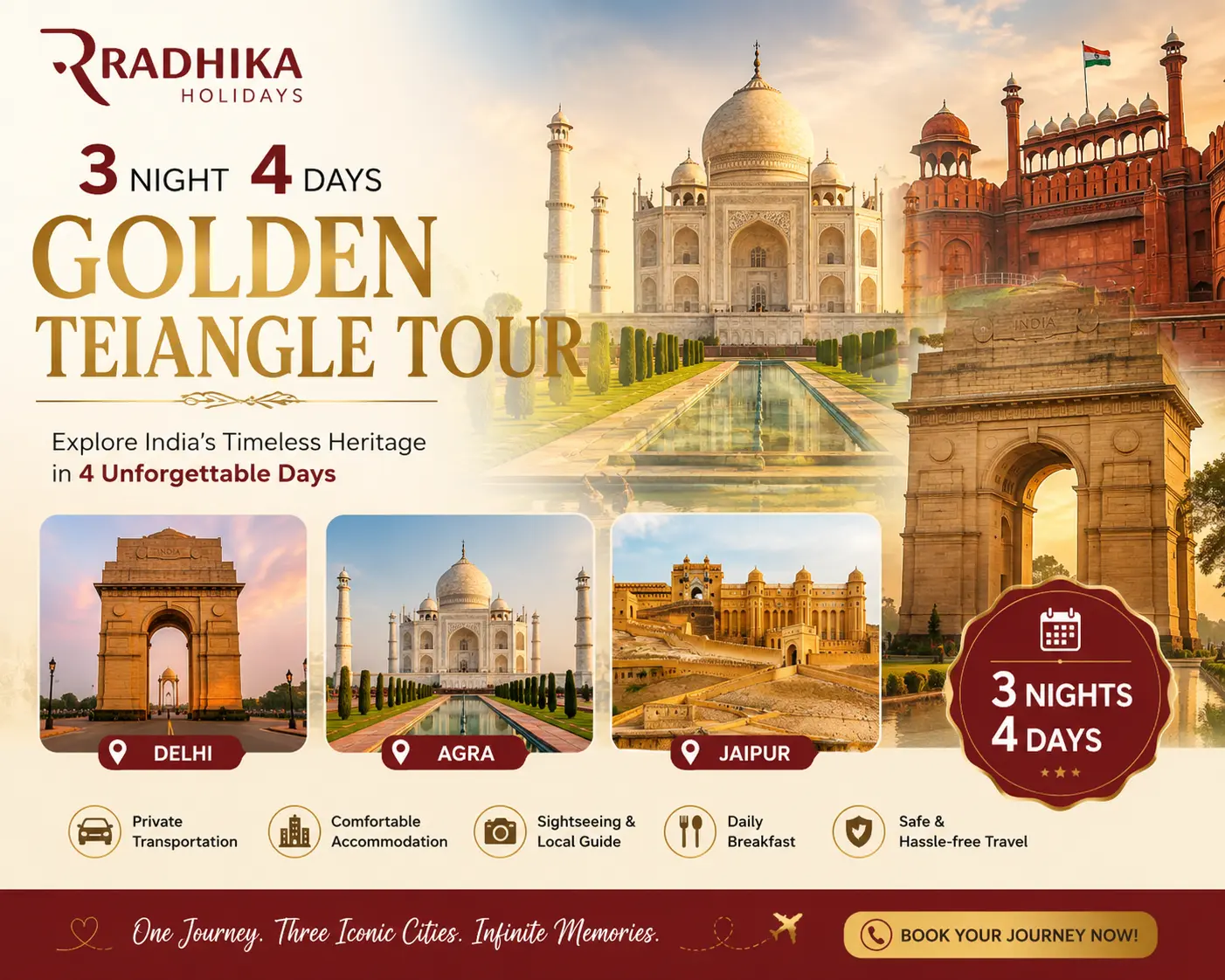
A 3 Nights 4 Days Golden Triangle Tour is one of the most efficient and rewarding ways for travelers from the United States to experience India’s historic grandeur, architectural masterpieces, and vibrant culture in a short span. The Golden Triangle — Delhi, Agra, and Jaipur — forms a compact circuit that delivers iconic landmarks, world-class photo opportunities, and genuine local experiences. Radhika Holidays has designed this itinerary to balance must-see attractions, comfortable travel, and a taste of India’s hospitality, making it ideal for first-time visitors or travelers with limited time. Below you’ll find a detailed day-by-day itinerary, practical travel tips, recommendations for dining and shopping, accessibility and safety advice, and an FAQ tailored for a US audience.
Quick Answer: What You'll See in 3 Nights 4 Days Golden Triangle Tour
If you only have four days in India, this is the fastest way to see its three most iconic cities:
| Day | City | Must-See Highlights |
|---|---|---|
| Day 1 | Delhi | Jama Masjid, Chandni Chowk, Humayun's Tomb, India Gate |
| Day 2 | Agra | Taj Mahal (sunrise), Agra Fort, Fatehpur Sikri en route to Jaipur |
| Day 3 | Jaipur | Amber Fort, City Palace, Hawa Mahal, Jantar Mantar |
| Day 4 | Delhi | Return travel, optional last-minute shopping, departure |
Typical cost: Private Golden Triangle tours for this route generally range from around $150–$400 per person depending on hotel category (budget, mid-range, or luxury) and group size — Radhika Holidays can quote an exact price once you share your travel dates and preferences.
Best time to go: October to March, when daytime temperatures are comfortable for sightseeing.
Why a 3 Nights 4 Days Golden Triangle Tour Works So Well
Travelers often ask whether four days is really enough to appreciate Delhi, Agra, and Jaipur. Each city could easily fill a week on its own, but a tightly planned 3 nights 4 days itinerary is built around the signature attractions and keeps transit time efficient. It's a format that works particularly well for:
- Business travelers extending a trip with a short cultural add-on
- Couples wanting a high-impact, romantic introduction to India (the Taj Mahal alone is worth the trip)
- Families or first-timers who want a taste of India without overcommitting on time
Radhika Holidays builds this route around private transport, English-speaking guides, and flexible pacing, so you're not locked into a rigid group schedule.
Day 1: Arrival in Delhi — Historical Layers and Modern Energy
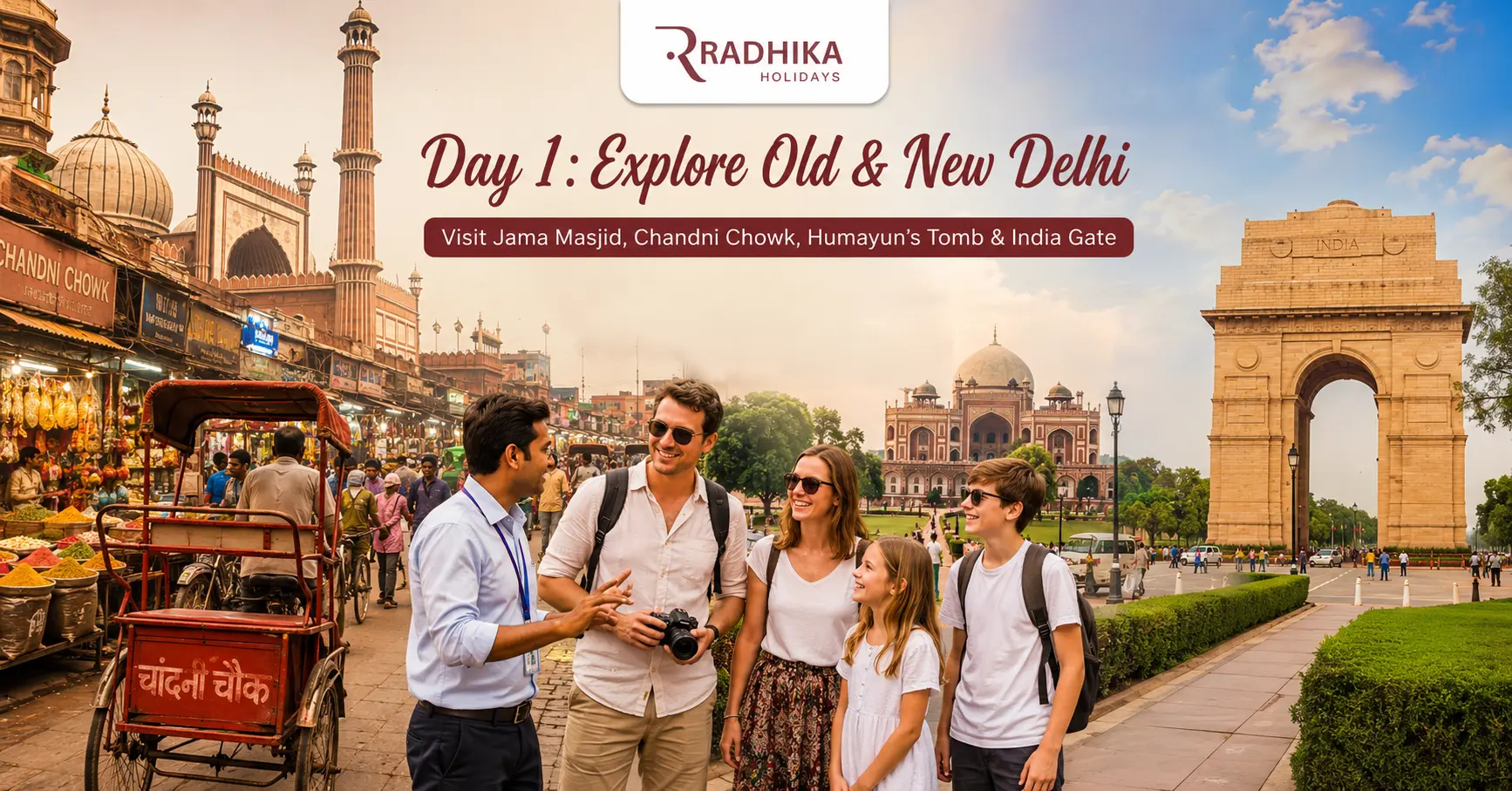
Your Golden Triangle experience begins in New Delhi, a city that layers Mughal-era monuments, colonial-era architecture, and modern government buildings on top of one another. If you're arriving from the US on a long-haul flight, build in a short rest before heading out — jet lag is real, and Delhi's pace can feel intense on arrival.
Old Delhi: Start with the Jama Masjid, one of India's largest mosques, built by Shah Jahan, with sweeping sandstone courtyards. From there, a short rickshaw ride through the narrow lanes takes you into Chandni Chowk, a centuries-old market famous for street food, spices, and textiles. Sampling snacks like parathas, jalebi, and samosas is a highlight for most first-time visitors — a local guide can point you to stalls that are both authentic and reliably clean.
New Delhi: In the afternoon, shift to the Raisina Hills area for a completely different feel. Visit India Gate, a war memorial set in wide lawns, then drive past the Rashtrapati Bhavan (President's House) and Parliament House. Humayun's Tomb, a UNESCO World Heritage Site and an early template for the Taj Mahal's design, is a quieter, garden-set stop worth lingering in. Many itineraries end the day with a drive past the Lotus Temple, a modern architectural landmark shaped like a blooming flower.
Why it matters: Together, Old and New Delhi show India's historical arc — from Mughal-era commerce to colonial planning to the modern republic — and set up the context you'll need for Agra and Jaipur.
Day 2: Agra — The Taj Mahal at Sunrise, Agra Fort, and Fatehpur Sikri
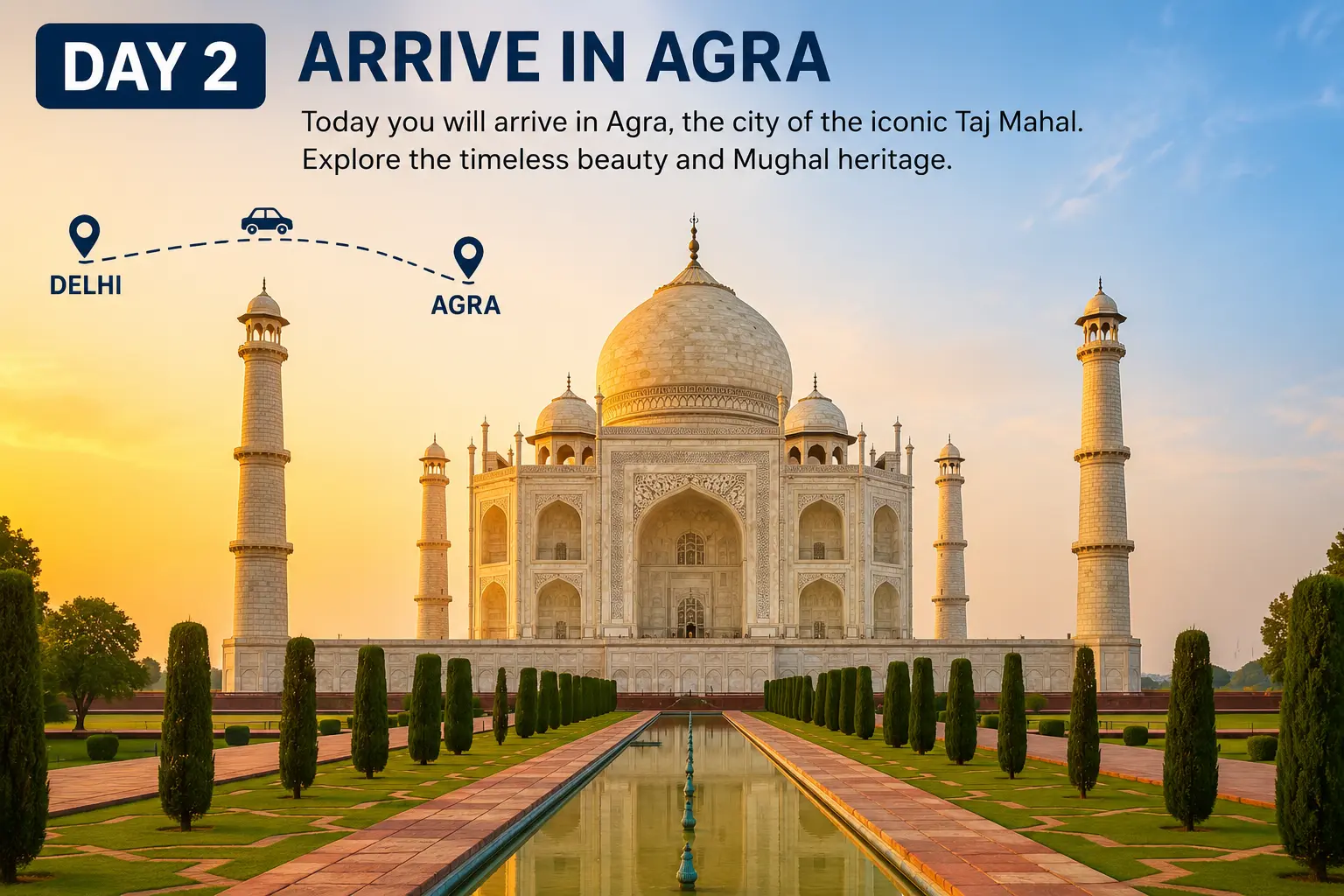
Travel from Delhi to Agra takes roughly 3–4 hours by road via the Yamuna Expressway (faster by train). Most guides recommend timing your arrival at the Taj Mahal around sunrise — the marble takes on a soft glow in early light, and the crowds are noticeably thinner. It's consistently rated the highlight of the entire tour.
The Taj Mahal isn't just a photogenic monument — it's a mausoleum built by Emperor Shah Jahan for his wife, Mumtaz Mahal, and a masterclass in Mughal inlay work and symmetry. A knowledgeable guide can walk you through the architectural symbolism most visitors miss on a self-guided walk.
From there, visit Agra Fort, a UNESCO World Heritage Site built from red sandstone, with palaces and audience halls that reveal the political side of Mughal life. If your schedule allows, the Tomb of Itimad-ud-Daulah — often nicknamed the "Baby Taj" for its delicate marble inlay — is a worthwhile smaller-scale detour.
Don't skip Fatehpur Sikri: On the drive from Agra to Jaipur, most well-planned itineraries stop at Fatehpur Sikri, a remarkably preserved 16th-century Mughal city built by Emperor Akbar and abandoned decades later due to water shortages. It's a UNESCO World Heritage Site and one of the most photogenic stops on the entire route, though it's frequently left off shorter or less-experienced itineraries — ask your operator to confirm it's included.
Why it matters: Taj Mahal, Agra Fort, and Fatehpur Sikri together trace the full arc of Mughal ambition — from imperial romance to political power to an entire abandoned capital city.
Travel tip: Agra is also known for marble inlay handicrafts and petha (a local sweet). A guide can steer you to shops with fair, transparent pricing.
Day 3: Jaipur — Royal Architecture and Colorful Bazaars
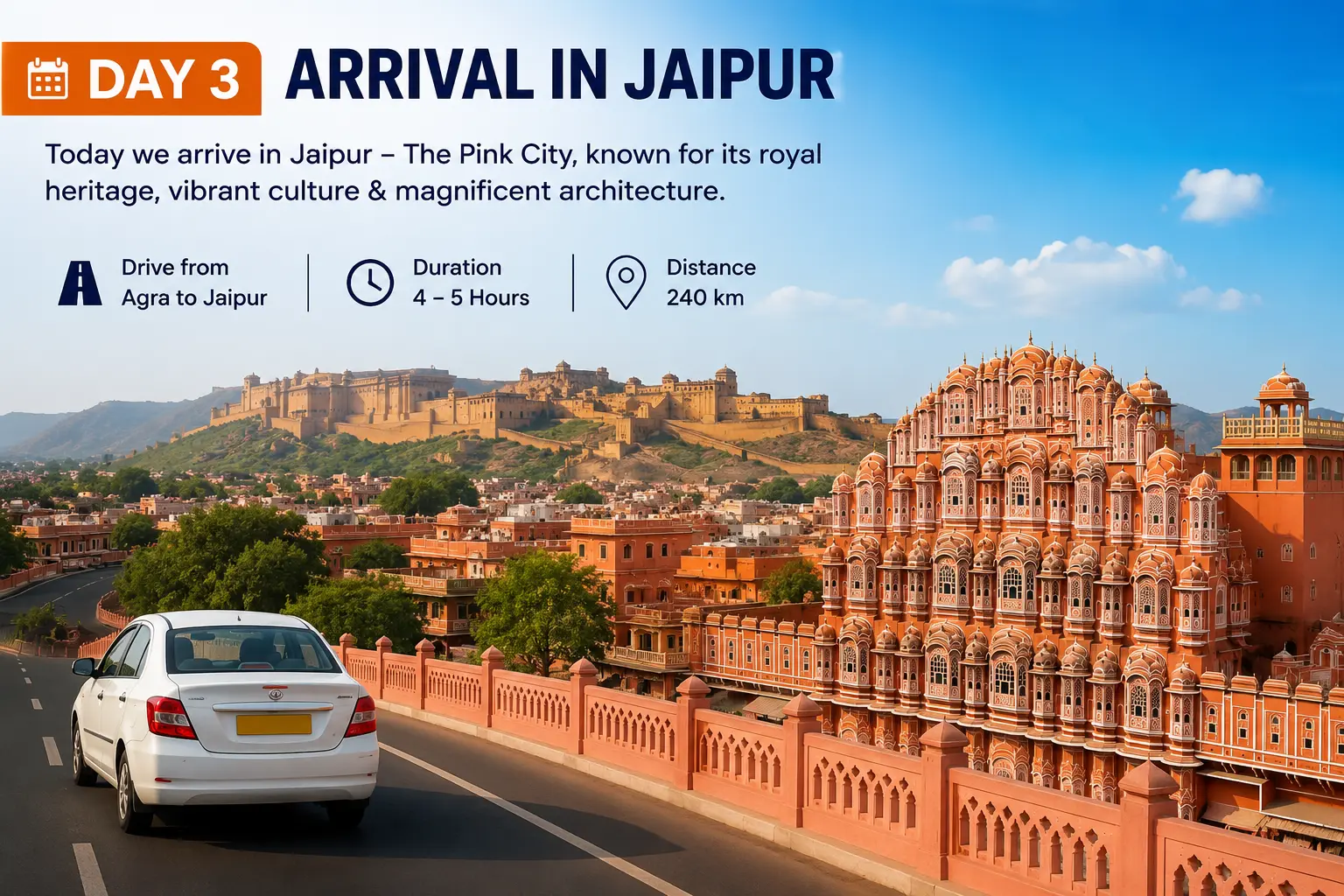
The drive from Agra to Jaipur (via Fatehpur Sikri) typically takes 4–5 hours. Jaipur, known as the Pink City for its warm sandstone facades, balances royal grandeur with lively markets.
- Hawa Mahal (Palace of Winds): A honeycomb facade of nearly 1,000 small windows, originally built so royal women could observe street life unseen.
- City Palace: A working complex blending Mughal and Rajput architecture, still partly home to the former royal family.
- Jantar Mantar: An 18th-century astronomical observatory with oversized, sculptural instruments — genuinely striking even if you're not an astronomy buff.
- Amber Fort: A hilltop fort-palace with mirror-work interiors and sweeping views over Maota Lake. Arriving before late afternoon avoids the heat and catches the best light. Note: elephant rides are offered here but raise animal-welfare concerns — jeep rides up to the fort are a widely available, more ethical alternative, and Radhika Holidays can arrange either based on your preference.
In the evening, explore Jaipur's bazaars — Johari Bazaar for jewelry, Bapu Bazaar for textiles and leather, and Nehru Bazaar for block-printed fabrics. If you have any flexibility in your schedule, a stop at Nahargarh Fort for sunset views over the city, or an evening at Chokhi Dhani, a Rajasthani cultural village with folk performances and traditional thali dinners, are both popular add-ons among travelers who've done this route.
Why it matters: Jaipur showcases Rajput royal culture and craftsmanship, giving you a very different visual and cultural register from Delhi's political history and Agra's romantic Mughal architecture.
Day 4: Departure from Delhi
Depending on your flight, you can drive back to Delhi (5–6 hours) or fly from Jaipur Airport for a faster connection. If time allows, use the morning for last-minute shopping or a relaxed lunch before heading to the airport.
Important: If you have an international flight the same evening, build in a generous buffer for traffic and check-in — many experienced travelers recommend scheduling your Jaipur–Delhi transfer at least a day ahead of an international departure rather than the same day.
Optional add-ons that don't require extra nights: a private cooking class, a heritage walk in Old Delhi, or a sunset photography session at Amber Fort. Radhika Holidays can arrange any of these without disrupting the core schedule.
3 Nights 4 Days vs. Longer Golden Triangle Options
A common question: is four days actually enough? Here's a quick comparison to help you decide:
| Itinerary | Best for | Trade-off |
|---|---|---|
| 3 Nights 4 Days | Time-constrained travelers, business trip add-ons, first tastes of India | Fast pace; less flexibility for rest days |
| 4 Nights 5 Days | Travelers who want one extra relaxed day in Jaipur or Agra | Slightly higher cost, more comfortable pacing |
| 5 Nights 6 Days | Travelers wanting Fatehpur Sikri, Chand Baori stepwell, and a day trip or two without rushing | Requires more vacation time |
If your schedule allows even one additional night, most repeat travelers suggest adding it in Jaipur, where there's simply more to see than a single afternoon allows.
Practical Travel Tips for US Travelers
- Visa: US passport holders need a visa to enter India. The e-Visa system is the most convenient option for short tourist visits — apply well in advance and carry both printed and digital copies.
- Health: Visit a travel health clinic before departure. Routine vaccines should be current, and your clinician may recommend hepatitis A and typhoid vaccines for this region. Drink bottled water and be selective with street food — Radhika Holidays' guides can point you to stalls with good hygiene track records.
- Currency: The Indian Rupee (INR) is the local currency. Carry cash for markets and street food; cards work at hotels and larger shops. Notify your bank of travel dates in advance.
- Safety and etiquette: India is generally safe for tourists with standard precautions — use authorized taxis, keep valuables secure, and dress modestly at religious sites.
- Packing: Breathable clothing for warmer months, layers for November–February (Delhi and Jaipur can get cool at night), comfortable walking shoes, and sun protection.
- Connectivity: A local SIM card at the airport, or an international roaming plan confirmed with your carrier before departure, will keep you connected throughout.
Accommodation and Transport Options with Radhika Holidays
- Luxury: Heritage hotels and 5-star properties with private guides and curated experiences.
- Mid-range: Clean, well-located hotels with reliable service.
- Budget-friendly: Value-focused hotels and guesthouses that don't compromise on safety.
Transport includes private air-conditioned vehicles with vetted drivers, premium train classes (Shatabdi/AC), and domestic flights between Jaipur and Delhi where time is tight.
Food and Shopping Along the Route
| City | Food to try | Shopping to look for |
|---|---|---|
| Delhi | Butter chicken, kebabs, street chaat | Handicrafts, spices, teas |
| Agra | Mughlai dishes, petha (local sweet) | Marble inlay work, leather goods |
| Jaipur | Dal baati churma, laal maas, ghevar | Gemstones, blue pottery, block-printed textiles |
Shopping with a guide, or at recommended stores, helps you avoid inflated "tourist price" markups, especially in Agra's marble workshops and Jaipur's gem markets.
Accessibility and Responsible Travel
Major sites like the Taj Mahal have wheelchair-accessible pathways, though some forts include stairs and uneven stone surfaces. Let Radhika Holidays know about any mobility needs in advance so they can arrange suitable transport and accommodations.
On responsible tourism: where animal-based experiences are offered (such as elephant rides at Amber Fort), ask about ethical alternatives like jeep transport — most operators, including Radhika Holidays, can arrange this without changing your schedule.
Frequently Asked Questions
Is 3 nights 4 days too rushed for a first visit to India?
It's compact but sufficient to see the top highlights if you want a high-impact introduction. If your schedule allows one extra day, most travelers add it in Jaipur or use it for a more relaxed Fatehpur Sikri visit.
Does the itinerary include Fatehpur Sikri?
It should — Fatehpur Sikri sits directly on the Agra-to-Jaipur route and is one of the most photogenic UNESCO sites on the whole circuit. Confirm with your operator that it's built into your day 2 transfer, as some budget itineraries skip it to save time.
What's the best time of year to go?
October through March, when temperatures are mild. April to June can be very hot, especially in Agra and Jaipur, and the July–September monsoon can disrupt road travel.
How much walking is involved?
Moderate — paved paths at the Taj Mahal, stone steps in forts, and market walking in the evenings. Comfortable shoes and reasonable fitness are enough; a private vehicle keeps distances between sites short.
Is this route safe for solo female travelers?
Yes, when booked through a reputable operator with vetted drivers and well-reviewed hotels. Female guides can be requested where available.
Can dietary restrictions be accommodated?
Yes — vegetarian, vegan, gluten-free, and halal needs can be arranged with advance notice to your operator.
Do I need travel insurance?
Comprehensive travel insurance covering medical care, trip interruption, and baggage loss is strongly recommended, along with emergency evacuation coverage for added security.
Is bargaining expected while shopping?
In open bazaars, yes — start below the asking price. In fixed-price shops and malls, prices are generally non-negotiable.
Packing Checklist
- Passport, visa, printed reservations, travel insurance documents
- Modest attire for religious sites, comfortable walking shoes
- Sun hat, sunglasses, reusable water bottle
- Prescription medications in original packaging
- Portable charger, universal plug adapter, local SIM or confirmed roaming plan
Why Book with Radhika Holidays
Radhika Holidays specializes in Golden Triangle itineraries built specifically for international travelers, especially guests from the USA who want smooth logistics, English-speaking guides, and a genuine cultural introduction to India — without the guesswork of planning it solo.
- Local expertise: Guides with deep historical knowledge and practical, on-the-ground safety guidance.
- Tailored pacing: Adjust hotel grade, dining, and daily rhythm to match how you like to travel.
- Transparent pricing: No surprise fees, and partnerships only with vetted hotels and drivers.
- Full logistical support: Visa guidance, airport transfers, and help with domestic connections.
Ready to plan your Golden Triangle tour? Contact Radhika Holidays to build your 3 Nights 4 Days Golden Triangle Tour itinerary — including Fatehpur Sikri, sunrise at the Taj Mahal, and a private guide throughout — tailored to your travel dates and budget.