
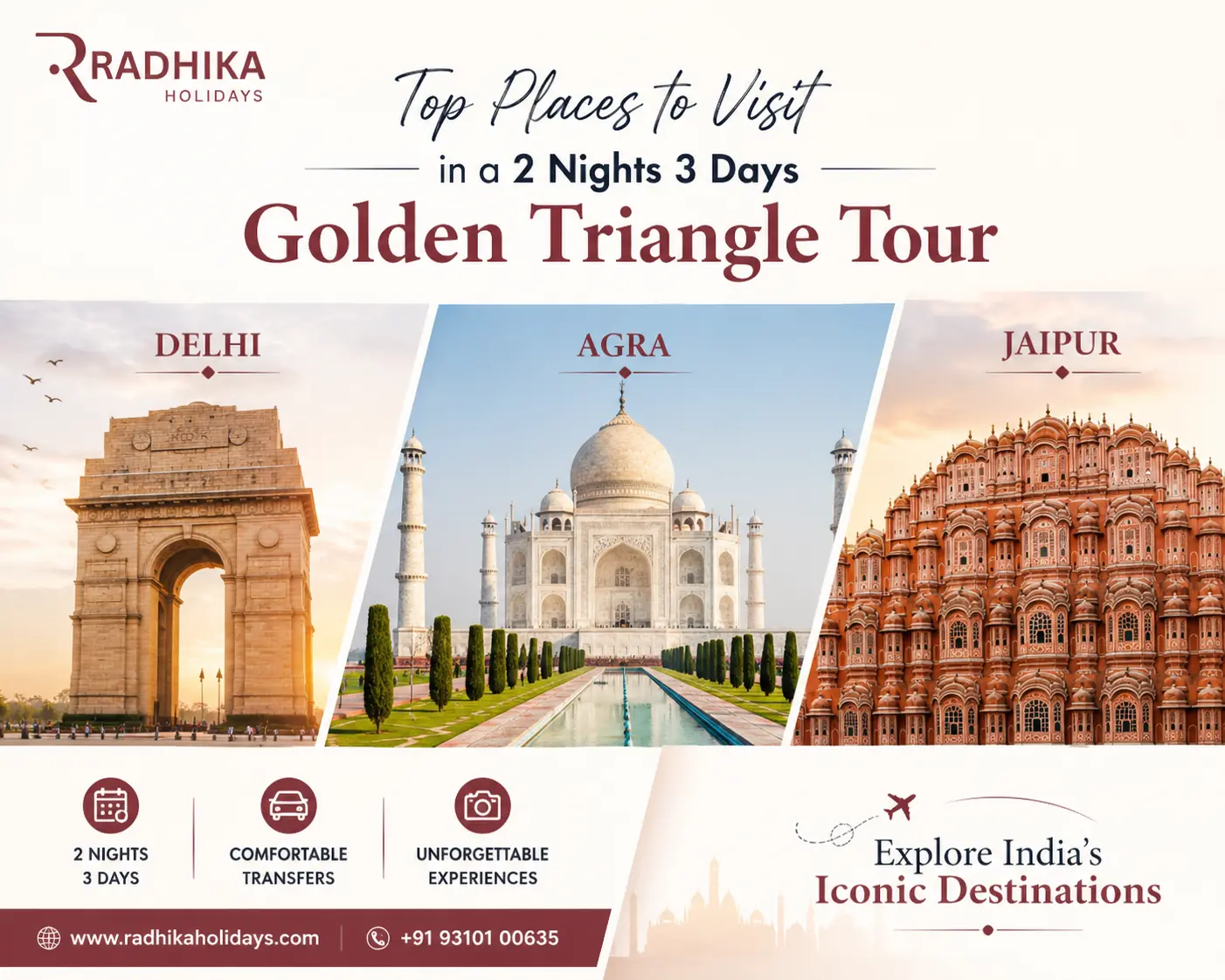
The 2 Nights 3 Days Golden Triangle Tour takes you through Delhi, Agra, and Jaipur — three cities that together hold more UNESCO World Heritage Sites, royal forts, and iconic monuments than almost any other short circuit in Asia. In just 72 hours, you stand before the Taj Mahal at sunrise, walk the halls of Mughal emperors in Agra Fort, ride up to a hilltop Rajput fortress in Jaipur, and explore the layered history of India's capital.
This guide covers every must-visit place across all three cities — with opening times, entry fees, insider tips, and honest notes on what's worth your limited time and what you can skip.
What Is the Golden Triangle Tour?
The Golden Triangle is a travel route connecting Delhi (India's capital), Agra (210 km south, home of the Taj Mahal), and Jaipur (260 km from Agra, capital of Rajasthan). The three cities form a rough triangle on the map, which is how the route earned its name.
The 2 nights 3 days version is the most popular format. Night 1 is spent in Agra. Night 2 is in Jaipur. You start and end in Delhi.
Quick Overview: Top Places City by City
Delhi: Humayun's Tomb, Qutub Minar, Red Fort, India Gate, Jama Masjid, Chandni Chowk
Agra: Taj Mahal, Agra Fort, Tomb of Itimad-ud-Daulah (Baby Taj), Mehtab Bagh
Agra to Jaipur en route: Fatehpur Sikri
Jaipur: Amber Fort, Jal Mahal, Hawa Mahal, City Palace, Jantar Mantar
Top Places to Visit in Delhi (Day 1)
[caption id="attachment_768" align="alignnone" width="300"]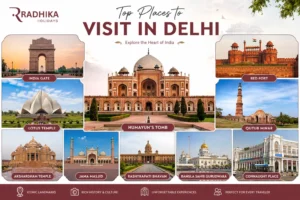 Top Places to Visit In Delhi[/caption]
Delhi is your starting point. Most tours spend a half-day here before the afternoon drive to Agra. Here are the places that genuinely deserve your time.
1. Humayun's Tomb
Built in 1570, Humayun's Tomb is the first garden-tomb in India and a direct architectural ancestor of the Taj Mahal. You can see the same red sandstone base, the white marble dome, and the Persian char-bagh garden layout that Shah Jahan later perfected in Agra. It is a UNESCO World Heritage Site and far less crowded than the Taj — which means you can actually absorb the architecture without jostling for space.
Why visit: If you want to understand why the Taj Mahal looks the way it does, Humayun's Tomb is where the story begins.
Timings: Sunrise to sunset, daily. Closed to visitors on no specific day.
Entry fee: ₹600 for foreign tourists / ₹40 for Indian nationals.
Time needed: 45 to 60 minutes.
2. Qutub Minar
At 73 metres, the Qutub Minar is the tallest brick minaret in the world. Construction began in 1199 under Qutb ud-Din Aibak and was completed by his successors. The surrounding Qutub complex includes the Quwwat-ul-Islam Mosque (the first mosque built in India after the Islamic conquest) and the Iron Pillar — a 7-metre column from the 4th century that has not rusted in over 1,600 years. Metallurgists still cannot fully explain it.
Why visit: This is where the history of medieval Delhi begins. The site rewards slow exploration.
Timings: 7 AM to 5 PM daily.
Entry fee: ₹600 for foreign tourists / ₹40 for Indian nationals.
Time needed: 60 to 75 minutes.
3. Red Fort (Lal Qila)
Shah Jahan built the Red Fort between 1638 and 1648 as the seat of Mughal power in Delhi. Its massive red sandstone walls run for 2.5 kilometres. Inside, the Diwan-i-Aam (Hall of Public Audiences) and Diwan-i-Khas (Hall of Private Audiences) give a vivid sense of the Mughal court at its peak. The fort is also where India's Prime Minister addresses the nation every Independence Day.
Why visit: It is one of the great Mughal fortresses and a UNESCO World Heritage Site. The scale of the walls alone is remarkable.
Timings: Sunrise to sunset. Closed on Mondays.
Entry fee: ₹600 for foreign tourists / ₹35 for Indian nationals.
Time needed: 60 to 90 minutes.
4. India Gate
India Gate is a 42-metre war memorial on Kartavya Path (formerly Rajpath), built to honour the 84,000 Indian soldiers who died in World War I. It sits at the centre of New Delhi's ceremonial axis and is one of the most recognisable landmarks in the country. The Eternal Flame (Amar Jawan Jyoti) burns at its base.
Why visit: Essential for photography, especially at sunrise or dusk. It also gives you a clear view of New Delhi's colonial-era urban planning.
Timings: Open 24 hours. Free entry.
Time needed: 20 to 30 minutes.
5. Jama Masjid
Built by Shah Jahan between 1644 and 1656, Jama Masjid is the largest mosque in India. It can accommodate 25,000 worshippers at one time. The courtyard, flanked by two red sandstone minarets each 40 metres tall, is one of the most atmospheric spaces in all of Delhi. It sits in the heart of Old Delhi, directly opposite the Red Fort.
Why visit: The mosque itself is magnificent, but the real experience is the surrounding area — the narrow lanes of Old Delhi, the Chandni Chowk market, and the street food culture are all within walking distance.
Timings: Open daily except during prayer times. Non-Muslims may enter outside prayer hours.
Entry fee: Free. Camera fee of ₹300 applies.
Time needed: 30 to 45 minutes.
6. Chandni Chowk — Rickshaw Ride Through Old Delhi
Chandni Chowk is a 17th-century market boulevard running from the Red Fort westward through the heart of Old Delhi. A cycle rickshaw ride through its lanes is one of the most vivid experiences on the entire Golden Triangle tour — narrow alleys branch off in every direction, each specialising in a different trade (silver, spices, wedding garments, electronics, sweets). The street food here is exceptional: try the stuffed parathas at Paranthe Wali Gali, or rabri from the old confectionery shops near Fatehpuri Mosque.
Why visit: This is living history. The lanes of Chandni Chowk have operated continuously since the 1650s.
Timings: Most shops open from 10 AM to 8 PM. Closed on Sundays in parts.
Entry: Free. Rickshaw ride costs approximately ₹100 to ₹200.
Time needed: 45 to 60 minutes including the rickshaw ride.
Top Places to Visit in Agra (Day 1 Evening + Day 2 Morning)
[caption id="attachment_767" align="alignnone" width="300"]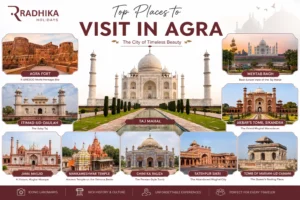 Top Places to Visit In Agra[/caption]
Agra was the capital of the Mughal Empire during its most powerful period (16th to 17th century). Every major monument here was built within 100 years of each other, by the same dynasty, from the same materials — which gives the city a remarkable architectural coherence.
7. Taj Mahal — At Sunrise
The Taj Mahal is the most visited monument in India and one of the Seven Wonders of the World. Shah Jahan commissioned it in 1632 as a mausoleum for his wife Mumtaz Mahal, who died in childbirth. Around 20,000 artisans worked on it for 21 years. The main structure, the four minarets, the reflection pool, and the mosque are all made from white Makrana marble — a stone that shifts colour through the day, from pale silver at dawn to warm gold at midday to pinkish cream at sunset.
The best time to visit is sunrise. Arrive 30 minutes before the gates open (6 AM in winter, 5:30 AM in summer) to be among the first inside. In the early morning light, the marble glows in a way that no photograph fully captures. Crowds build rapidly after 8 AM.
Important: The Taj Mahal is closed every Friday for prayers. Plan your itinerary around this — any reputable tour operator will check this automatically.
Timings: 6 AM to 6:30 PM (closed Friday).
Entry fee: ₹1,100 for foreign tourists / ₹50 for Indian nationals. An additional ₹200 is charged to enter the main mausoleum chamber.
Time needed: 90 to 120 minutes.
Insider tip: Walk to the far right corner of the garden (near the river side wall) for the best long-distance view of the main dome framed against the morning sky.
8. Agra Fort
Agra Fort is a UNESCO World Heritage Site that served as the primary residence of Mughal Emperors — Akbar, Jahangir, Shah Jahan, and Aurangzeb — for over a century. The outer walls, built from red sandstone, span 94 acres. Inside, the architecture transitions from Akbar's austere stonework to the lavish white marble additions of Shah Jahan. The most moving spot is the Musamman Burj — the octagonal tower where Shah Jahan was imprisoned by his son Aurangzeb in 1658 and spent his final 8 years with a view of the Taj Mahal across the Yamuna River.
Why visit: Agra Fort tells the story behind the Taj Mahal better than the Taj itself does. The human history here — power, betrayal, imprisonment — is extraordinary.
Timings: Sunrise to sunset daily. Closed on no specific day.
Entry fee: ₹650 for foreign tourists / ₹40 for Indian nationals.
Time needed: 90 minutes.
9. Tomb of Itimad-ud-Daulah (Baby Taj)
This is the monument that most Golden Triangle articles leave out — and that most experienced travellers say was one of their best discoveries. Built in 1628 by Empress Nur Jahan for her father, the Tomb of Itimad-ud-Daulah was the first Mughal monument built entirely in white marble, and the first to use pietra dura — the technique of inlaying coloured stone and semi-precious gems into marble to create intricate floral and geometric patterns. This is the exact same technique used in the Taj Mahal, built just four years later.
The Baby Taj is smaller, quieter, and admission costs less than the Taj. You can often have entire sections of the garden to yourself. The inlay work on the walls, when seen close up, is astonishing in its precision.
Why visit: It is the direct forerunner to the Taj Mahal's defining decorative technique. Architecturally, it belongs in every serious itinerary.
Timings: Sunrise to sunset daily.
Entry fee: ₹310 for foreign tourists / ₹20 for Indian nationals.
Time needed: 45 minutes.
10. Mehtab Bagh (Moonlight Garden)
Mehtab Bagh is a garden on the opposite (north) bank of the Yamuna River, directly across from the Taj Mahal. It was originally laid out by the Mughal Emperor Babur in the 16th century. Shah Jahan later used it as the viewing point for the Taj from across the river. Today, it offers the best unobstructed view of the entire Taj complex — the four minarets, the main dome, and the river foreground — without paying Taj Mahal entry prices.
Why visit: The view from Mehtab Bagh at sunset, with the Taj Mahal glowing across the river, is one of the most beautiful sights on the entire Golden Triangle tour. It is best visited in the late afternoon as you leave Agra.
Timings: Sunrise to sunset daily.
Entry fee: ₹310 for foreign tourists / ₹25 for Indian nationals.
Time needed: 30 minutes.
Top Places to Visit En Route — Fatehpur Sikri (Day 2, Agra to Jaipur)
[caption id="attachment_766" align="alignnone" width="300"]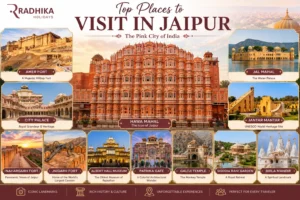 Top Places to Visit In Jaipur[/caption]
Fatehpur Sikri is a 16th-century Mughal city built by Emperor Akbar in 1571 to serve as his new capital. He abandoned it 14 years later — most likely due to water scarcity — and the city has remained largely intact ever since. The entire complex is built in red sandstone and represents Mughal architecture at its most ambitious and experimental.
11. Buland Darwaza
The Buland Darwaza (Gate of Magnificence) is the main entrance to the Jama Masjid at Fatehpur Sikri. At 54 metres, it is one of the tallest gateways in the world, built to commemorate Akbar's military campaign in Gujarat. The scale is genuinely staggering — you do not expect it until you are standing at its base.
12. Jama Masjid and Salim Chishti's Tomb
The mosque at Fatehpur Sikri is one of the finest in India. Inside its courtyard stands the white marble Tomb of Salim Chishti, the Sufi saint whose blessing Akbar credited with the birth of his son (later Emperor Jahangir). Visitors tie strings of thread to the tomb's marble lattice screens as an act of prayer — a tradition that has continued uninterrupted for over 400 years.
13. Panch Mahal
The Panch Mahal is a five-storey open pavilion with 176 columns, each carved differently. Its design draws on Buddhist and Hindu architectural traditions, reflecting Akbar's policy of religious inclusivity. It offers elevated views across the Fatehpur Sikri complex.
Practical note on Fatehpur Sikri: Allow 90 minutes to explore the site properly. Hire a licensed guide at the entrance — the stories behind each building are what make the site come alive. Entry is ₹610 for foreign tourists / ₹40 for Indian nationals.
Top Places to Visit in Jaipur (Day 3)
Jaipur was founded in 1727 by Maharaja Sawai Jai Singh II and is the only planned city of its era in India. It is called the Pink City because most of its old city buildings are painted in terracotta pink — a colour chosen in 1876 as a gesture of welcome for the visiting Prince of Wales. The contrast with Mughal Agra and medieval Delhi is striking: Jaipur feels royal, colourful, and alive.
14. Amber Fort
Amber Fort (also spelled Amer Fort) sits on a ridge 11 kilometres north of central Jaipur, overlooking Maota Lake. It was the seat of the Kachwaha Rajput rulers for centuries before Jaipur was founded. The approach from below — fort walls climbing the hillside against a clear Rajasthan sky — is one of the most dramatic views on the Golden Triangle tour.
Inside, the defining space is the Sheesh Mahal (Hall of Mirrors). Thousands of tiny convex glass pieces are embedded in the ceiling and walls, positioned so that a single candle flame would once illuminate the entire chamber with reflected light. Today, even in daylight, the effect is extraordinary.
You can reach the main gate by jeep (shared or private), or on foot via a stepped path. Elephant rides are also available but have been subject to ethical concerns around animal welfare — most travellers now choose jeeps.
Timings: 8 AM to 5:30 PM daily.
Entry fee: ₹500 for foreign tourists / ₹100 for Indian nationals.
Time needed: 90 minutes.
Arrive early. Amber Fort gets very crowded by mid-morning. Arriving before 8:30 AM makes a significant difference.
15. Jal Mahal (Water Palace)
Jal Mahal sits in the middle of Man Sagar Lake on the road between Amber Fort and central Jaipur. The palace is not open to visitors — you view it from the lakeside road — but the sight of a five-storey pink sandstone palace rising from the middle of a lake, surrounded by the Aravalli hills, is genuinely unlike anything else on the tour.
Why visit: It takes five minutes and produces the most striking photograph of Jaipur. Do not skip it.
Entry: Free (exterior view only).
16. Hawa Mahal (Palace of Winds)
Hawa Mahal was built in 1799 by Maharaja Sawai Pratap Singh as an extension of the City Palace. Its five-storey pink sandstone facade has 953 small latticed windows (jharokas), designed so that the women of the royal court could observe street life and festivals below without being seen from outside. The entire front facade was created for looking out — which is why, from inside, it resembles a honeycomb more than a palace.
From the street, the facade is one of the most photographed buildings in Rajasthan. You can also enter and climb to the upper levels for elevated views of Jaipur's old city.
Timings: 9 AM to 4:30 PM daily.
Entry fee: ₹200 for foreign tourists / ₹50 for Indian nationals. Exterior photography from the street is free.
Time needed: 30 to 45 minutes.
17. City Palace
City Palace is the royal palace complex of Jaipur's Maharajas, begun by Sawai Jai Singh II when he founded the city in 1727. Remarkably, part of the palace is still the private residence of the current royal family. The public sections include the Chandra Mahal, the Mubarak Mahal (now a textile museum with royal costumes), and the Sileh Khana (weapons museum).
The unmissable exhibit is the pair of enormous silver urns in the Diwan-i-Khas. Each urn holds 4,000 litres and was made from 14,000 melted-down silver coins. Maharaja Sawai Madho Singh II had them made to carry Ganges water on his 1901 voyage to England, unwilling to use water from any other source. They are certified by the Guinness World Records as the largest sterling silver objects in the world.
Timings: 9:30 AM to 5 PM daily.
Entry fee: From ₹700 for foreign tourists / ₹100 for Indian nationals (varies by section).
Time needed: 60 to 90 minutes.
18. Jantar Mantar
Jantar Mantar is an open-air astronomical observatory built by Maharaja Sawai Jai Singh II in 1728. It contains 19 architectural instruments — stone and marble structures designed to measure time, track planets, and predict eclipses with precision visible to the naked eye. The largest instrument, the Samrat Yantra, is a 27-metre-tall sundial that can calculate time accurate to two seconds.
What makes Jantar Mantar remarkable is that it works. The Samrat Yantra still tells the correct time. Hire a guide here — without explanation, many of the instruments look like abstract sculpture. With explanation, they become one of the most intellectually impressive things on the entire Golden Triangle tour.
Timings: 9 AM to 4:30 PM daily.
Entry fee: ₹200 for foreign tourists / ₹50 for Indian nationals.
Time needed: 45 to 60 minutes.
Places Worth Visiting If You Have Extra Time
Nahargarh Fort, Jaipur: A hilltop fort above the city with panoramic views of Jaipur and the Aravalli Hills. Less visited than Amber Fort, more atmospheric at dusk. Entry ₹200 for foreign tourists.
Birla Mandir, Jaipur: A white marble Hindu temple built in 1988 at the base of Moti Dungri hill. Clean, quiet, and open to all visitors. Free entry.
Agra's local markets: The Kinari Bazaar (near Jama Masjid in Agra) sells marble inlay souvenirs — the craft Agra is famous for. Buy directly from artisan workshops where possible and check for quality carefully.
What to Eat: City-by-City Food Guide
Delhi: Try stuffed parathas at Paranthe Wali Gali in Chandni Chowk — a lane that has been serving these since the 1870s. For a full meal, look for Chole Bhature (spiced chickpeas with fried bread) at any busy local dhaba.
Agra: Petha is the sweet Agra is famous for — a translucent candy made from white pumpkin, available in dozens of varieties. Panchi Petha near the Taj Mahal is the most well-known shop. For a meal, try Mughlai cuisine — rich gravies, kebabs, and biryani that reflect the Mughal-era cooking traditions of the city.
Jaipur: Dal Baati Churma is the definitive Rajasthani dish — hard wheat balls (baati) baked in a clay oven, served with lentil curry (dal) and a sweet crumbled wheat dessert (churma). Laal Maas (slow-cooked mutton in red chilli gravy) is Rajasthan's most famous non-vegetarian dish. Kachori — deep-fried pastry filled with spiced lentils — is the standard Jaipur breakfast street food.
Shopping Guide: What to Buy and Where
Agra is famous for marble inlay art (pietra dura) — jewellery boxes, tabletops, and decorative plates with semi-precious stone inlay. Buy from registered artisan workshops rather than roadside stalls for quality assurance.
Jaipur is one of the best places in India to buy gemstones and silver jewellery. The city is a major gem-cutting centre. For textiles, block-printed cotton and Sanganeri prints are the local speciality. Johari Bazaar (jewellery market) and Bapu Bazaar (textiles and handicrafts) are the two most useful markets.
Bargain politely. Ask for receipts. For gemstone purchases above a certain value, ask for a quality certificate from a registered gemologist.
Entry Fees: Complete Table for Foreign Tourists (2025–2026)
| Monument | Foreign Tourist Fee | Indian Tourist Fee |
|---|---|---|
| Taj Mahal | ₹1,100 | ₹50 |
| Taj Mahal inner chamber | ₹200 extra | ₹200 extra |
| Agra Fort | ₹650 | ₹40 |
| Itimad-ud-Daulah (Baby Taj) | ₹310 | ₹20 |
| Mehtab Bagh | ₹310 | ₹25 |
| Fatehpur Sikri | ₹610 | ₹40 |
| Humayun's Tomb | ₹600 | ₹40 |
| Qutub Minar | ₹600 | ₹40 |
| Red Fort | ₹600 | ₹35 |
| Amber Fort | ₹500 | ₹100 |
| City Palace Jaipur | From ₹700 | From ₹100 |
| Hawa Mahal | ₹200 | ₹50 |
| Jantar Mantar | ₹200 | ₹50 |
Total estimated entry fees for a foreign tourist on the full circuit: ₹5,000 to ₹5,500 per person. Budget accordingly — entry fees are almost never included in the base tour package price and are paid on-site in cash.
Best Time to Visit the Golden Triangle
October to March is the ideal window. Temperatures across all three cities range from 8°C to 25°C, skies are clear, and the light is excellent for photography. November to February is peak season — the most popular months for international visitors.
April to June is hot. Delhi regularly exceeds 42°C. Outdoor sightseeing is uncomfortable, though all driving is done in air-conditioned vehicles and hotel prices are significantly lower.
July to September is the monsoon. Heat eases, crowds thin dramatically, and monuments like Amber Fort and the Taj Mahal look spectacular in moody overcast light. The Taj Mahal's white marble appears soft and luminous in diffused cloud light. This is an underrated time to visit if you are comfortable with occasional rain.
Practical Tips for the Golden Triangle Tour
The Taj Mahal is closed every Friday. This is the single most important practical fact about the Golden Triangle tour. Any reputable tour operator will plan your itinerary around this automatically. If yours has not mentioned it, ask.
Arrive at monuments early. Amber Fort and the Taj Mahal both become significantly more crowded after 9 AM. An early start makes a large difference to your experience.
Hire licensed guides in each city. Archaeological Survey of India (ASI) licensed guides carry photo ID. The stories behind Mughal monuments — who commissioned them, why, and what happened to the people inside them — are what separate a good visit from a great one.
Carry cash. Entry fees at most monuments are cash only. Keep small denominations for rickshaws, tips, and street food.
Dress conservatively. Shoulders and knees should be covered when visiting mosques (Jama Masjid in Delhi and Agra, the mosque at Fatehpur Sikri). Most sites provide scarves or cloth wraps at the entrance for a small fee.
Confirm the Taj Mahal gate you are using. There are three gates (East, West, South). Most tours use the East Gate. The queue at the East Gate is generally the shortest in the early morning. Your guide will confirm this on the day.
Frequently Asked Questions
How many places can you visit in a 2 nights 3 days Golden Triangle tour?
On a well-planned itinerary, you can visit 15 to 18 monuments and attractions across all three cities — roughly 5 to 6 per day including Delhi, Agra, and Jaipur.
Which is the best place to visit first in the Golden Triangle — Delhi, Agra, or Jaipur?
The standard route starts in Delhi and ends with the return drive from Jaipur to Delhi. This allows you to visit the Taj Mahal at sunrise on Day 2, which is the highlight of the entire trip. Starting in Delhi also works logistically because most international flights land at Delhi's Indira Gandhi International Airport.
Is the Taj Mahal the most important place to visit in the Golden Triangle?
Yes, for most travellers. But Agra Fort and the Baby Taj (Itimad-ud-Daulah) are often the ones people talk about most afterwards, precisely because they are less expected. Amber Fort in Jaipur is a close rival in terms of impressiveness.
Which place is most missed on the Golden Triangle tour?
The Tomb of Itimad-ud-Daulah (Baby Taj) in Agra and Mehtab Bagh (the garden across the river from the Taj) are routinely left off budget itineraries. Both are exceptional and neither should be skipped.
Can you visit Fatehpur Sikri in 2 nights 3 days?
Yes. Fatehpur Sikri is on the road between Agra and Jaipur, making it a natural stop on Day 2. Allow 90 minutes at the site. If your itinerary does not include it, ask your operator to add it — it adds very little driving time and is one of the most remarkable sites on the entire circuit.
What is the best time to visit the Taj Mahal?
Sunrise is the best time to visit the Taj Mahal — the light is softest, the marble glows most beautifully, and the crowds are smallest. Sunset is the second best. Midday is the least rewarding time.
Is 2 nights 3 days enough for the Golden Triangle?
It is enough to cover the essential highlights at a good pace. Travellers who want to go deeper into any city, or add Ranthambore National Park or Pushkar to the route, should consider a 4-night or 5-day version.
Conclusion
The 2 Nights 3 Days Golden Triangle Tour covers more world-class monuments per kilometre than almost any other short itinerary on earth. Delhi's Mughal ruins, Agra's white marble masterpieces, the Rajput hilltop fortresses of Jaipur — each city is distinct in architecture, food, and character. Three days is not long, but with a good guide, an early start each morning, and a route that includes the lesser-known gems alongside the icons, it is genuinely enough to understand why this circuit has been India's most iconic travel route for over 50 years.