
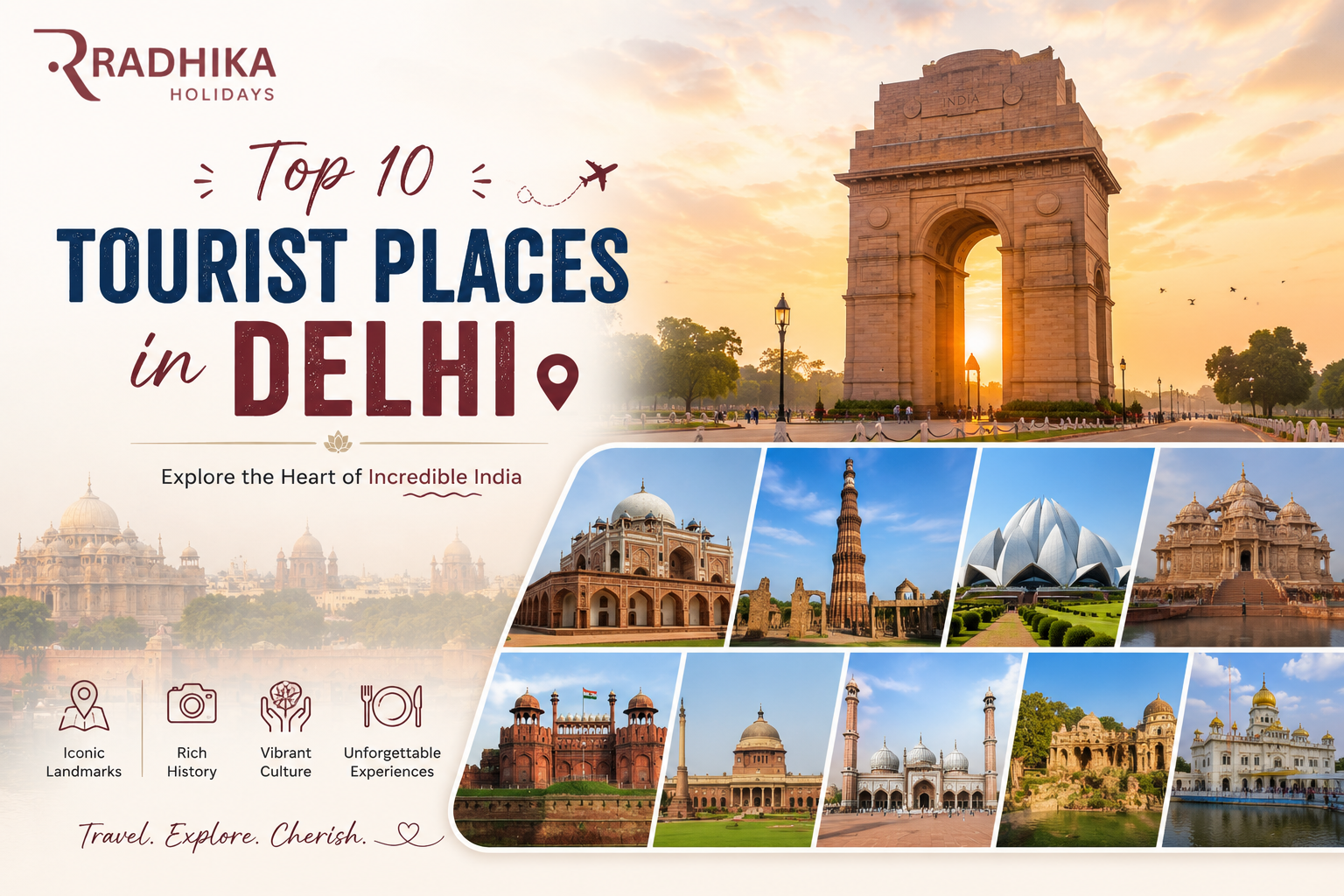
The top 10 tourist places in Delhi are the Red Fort, Qutub Minar, India Gate, Humayun's Tomb, Lotus Temple, Akshardham Temple, Jama Masjid, Chandni Chowk, Rashtrapati Bhavan & Rajpath, and the National Museum. Together they cover Mughal-era forts and tombs, a UNESCO minaret, modern architectural landmarks, a bustling old-city bazaar, and the seat of India's government — enough to fill 2–3 full days of sightseeing.
Delhi, India's capital, blends over 1,000 years of history with modern city life. Whether you have a single day layover or a full week, this list ranks the ten places most worth your time, with up-to-date timings, entry fees, and practical tips.
Top 10 Tourist Places in Delhi at a Glance
| # | Place | Best For | Timings | Entry Fee (Indian / Foreigner) |
|---|---|---|---|---|
| 1 | Red Fort | Mughal history | 9:30 AM–4:30 PM, closed Mon | ₹35 / ₹550 |
| 2 | Qutub Minar | UNESCO architecture | 7:00 AM–5:00 PM, daily | ₹35–40 / ₹550 |
| 3 | India Gate | War memorial, evenings | Open 24 hours | Free |
| 4 | Humayun's Tomb | Pre-Taj Mahal architecture | 6:00 AM–6:00 PM, daily | ₹40 / ₹600 |
| 5 | Lotus Temple | Peaceful reflection | 9:30 AM–5:30 PM, closed Mon | Free |
| 6 | Akshardham Temple | Modern temple complex | 9:30 AM–8:00 PM, closed Mon | Free (exhibitions ~₹170–250) |
| 7 | Jama Masjid | India's largest mosque | 7:00 AM–12:00 PM, 1:30–6:30 PM | Free (camera fee ~₹300) |
| 8 | Chandni Chowk | Street food & shopping | Most shops 10 AM–8 PM | Free to walk around |
| 9 | Rashtrapati Bhavan & Rajpath | Government architecture | Forecourt viewable most days; Mughal Gardens seasonal | Free (forecourt); Bhavan tour needs online booking |
| 10 | National Museum | Art & artefacts | 10:00 AM–6:00 PM, closed Mon | ₹20 / ₹650 |
Entry fees and hours change periodically — always confirm on the official ASI (asi.nic.in) or site website before you travel.
1. Red Fort (Lal Qila)
The Red Fort is the massive red-sandstone fortress Emperor Shah Jahan built in 1648 as the seat of Mughal power, and it's still where India's Prime Minister hoists the flag every Independence Day. Inside, don't miss the Diwan-i-Khas (Hall of Private Audience) and the Rang Mahal.
- Timings: 9:30 AM–4:30 PM, Tuesday to Sunday (closed Monday)
- Entry fee: ₹35 (Indians), ₹550 (foreign nationals); free for children under 15
- Nearest metro: Chandni Chowk / Lal Qila (Yellow Line)
- Don't miss: The evening Light & Sound Show narrating the fort's history
- Time needed: 2–3 hours
2. Qutub Minar
At 72.5 metres, Qutub Minar is the tallest brick minaret in the world, built in 1199 AD by Qutb-ud-din Aibak and completed by Iltutmish. The complex also holds the mysterious rust-resistant Iron Pillar and some of India's earliest mosque ruins.
- Timings: 7:00 AM–5:00 PM, open all days
- Entry fee: ₹35–40 (Indians), ₹550 (foreign nationals); free for children under 15
- Nearest metro: Qutub Minar (Yellow Line)
- Note: Climbing the interior staircase is no longer permitted for safety reasons
- Time needed: 1.5–2 hours
3. India Gate
This 42-metre war memorial honours over 70,000 Indian soldiers who died in World War I and the Third Anglo-Afghan War. It anchors one end of Rajpath and is especially popular in the evening, when families gather, food carts open up, and the monument is lit.
- Timings: Open 24 hours (best visited early morning or evening)
- Entry fee: Free
- Nearest metro: Central Secretariat (short walk/auto ride)
- Time needed: 30–45 minutes
4. Humayun's Tomb
Commissioned in the 1560s by Empress Bega Begum for her husband, Emperor Humayun, this UNESCO World Heritage Site is often called the "pre-Taj Mahal" because its charbagh garden layout and red sandstone-and-marble design directly influenced the Taj Mahal.
- Timings: 6:00 AM–6:00 PM, open all days
- Entry fee: ₹40 (Indians), ₹600 (foreign nationals); free for children under 15
- Nearest metro: JLN Stadium or Jangpura
- Time needed: 1.5–2 hours
5. Lotus Temple
Shaped like a blooming lotus flower with 27 marble "petals," this Bahá'í House of Worship welcomes visitors of all faiths for silent reflection. It's one of the most photographed modern buildings in India.
- Timings: 9:30 AM–5:30 PM, closed Monday
- Entry fee: Free
- Nearest metro: Kalkaji Mandir (Magenta/Violet Line)
- Note: Photography isn't allowed inside the prayer hall
- Time needed: 45 minutes–1 hour
6. Akshardham Temple
Opened in 2005, this sprawling temple complex was built without steel and is fully earthquake-resistant. Beyond the main monument, it houses exhibitions, gardens, and an evening musical fountain show.
- Timings: 9:30 AM–8:00 PM (last entry 6:30 PM), closed Monday
- Entry fee: Free for the temple; exhibition halls and boat ride cost extra (roughly ₹170–250)
- Nearest metro: Akshardham (Blue Line)
- Note: Phones, cameras, and bags aren't allowed inside — cloakroom facilities are provided
- Time needed: 3–4 hours
7. Jama Masjid
Built by Shah Jahan and completed in 1656, Jama Masjid is India's largest mosque and can hold over 25,000 worshippers. Climb the southern minaret for panoramic views over Old Delhi.
- Timings: 7:00 AM–12:00 PM and 1:30 PM–6:30 PM (closed to tourists during prayer times)
- Entry fee: Free; a camera fee (roughly ₹300) applies, and minaret access has a separate small charge
- Nearest metro: Jama Masjid (Violet Line) or Chawri Bazar
- Dress code: Shoulders and knees covered; robes available at entry
- Time needed: 1 hour
8. Chandni Chowk
One of India's oldest and busiest markets, Chandni Chowk was designed in the 17th century by Shah Jahan's daughter, Jahanara Begum. Today it's a maze of lanes famous for street food (parathas, jalebis, chaat), wedding-wear shops, and spice markets.
- Timings: Most shops open 10 AM–8 PM; the food scene runs into the evening
- Entry fee: Free (you only pay for food and shopping)
- Nearest metro: Chandni Chowk (Yellow Line)
- Tip: Take a cycle-rickshaw ride through the narrow lanes for the full experience
- Time needed: 2–3 hours
9. Rashtrapati Bhavan & Rajpath
The official residence of India's President, Rashtrapati Bhavan is a 340-room palace designed by Edwin Lutyens. The forecourt and the ceremonial Rajpath boulevard leading to India Gate are open to the public, and the Mughal Gardens open for limited weeks each year (usually Feb–March).
- Timings: Forecourt viewable most days from a distance; guided Rashtrapati Bhavan tours require advance online booking
- Entry fee: Free to view the forecourt/Rajpath; the guided palace tour is free but ticketed online
- Nearest metro: Central Secretariat
- Time needed: 1–2 hours (longer with a booked tour)
10. National Museum
Home to over 200,000 artefacts spanning 5,000 years of Indian history — from Harappan civilisation relics to Mughal miniature paintings and Buddhist manuscripts — this is Delhi's best stop for a deep dive into Indian art and history.
- Timings: 10:00 AM–6:00 PM, closed Monday
- Entry fee: ₹20 (Indians), ₹650 (foreign nationals); audio guides available for an extra charge
- Nearest metro: Udyog Bhawan
- Time needed: 2–3 hours
Best Time to Visit Delhi
The ideal window is October to March, when daytime temperatures are mild (15–25°C) and comfortable for walking between monuments. Summers (April–June) get extremely hot, and the monsoon (July–September) brings heavy, unpredictable rain.
How Many Days Do You Need for Delhi's Top Attractions?
- 1 day: Red Fort, Jama Masjid, Chandni Chowk (Old Delhi) or India Gate, Qutub Minar, Lotus Temple (New Delhi/South Delhi)
- 2 days: Split Old Delhi (Red Fort, Jama Masjid, Chandni Chowk) from New Delhi/South Delhi (India Gate, Rashtrapati Bhavan, Humayun's Tomb, Qutub Minar, Lotus Temple)
- 3+ days: Add Akshardham Temple, the National Museum, and a slower pace with time for markets and food
Frequently Asked Questions
What are the top 10 tourist places in Delhi?
Red Fort, Qutub Minar, India Gate, Humayun's Tomb, Lotus Temple, Akshardham Temple, Jama Masjid, Chandni Chowk, Rashtrapati Bhavan, and the National Museum.
Which Delhi monuments are free to enter?
India Gate, Lotus Temple, Akshardham Temple (main shrine), Jama Masjid, Chandni Chowk, and the Rashtrapati Bhavan forecourt are all free.
Which Delhi attractions are closed on Mondays?
The Lotus Temple, Akshardham Temple, and the National Museum are typically closed on Mondays. The Red Fort's Monday closure has varied by year, so it's worth confirming before you go.
How many days do I need to see Delhi's main attractions?
Two full days cover the essentials comfortably; three days allows a relaxed pace with markets and a couple of extra stops.
Is the Red Fort worth visiting?
Yes — it's a UNESCO World Heritage Site and one of India's most historically significant monuments, being both a former Mughal palace and the site of India's Independence Day flag-hoisting ceremony.