
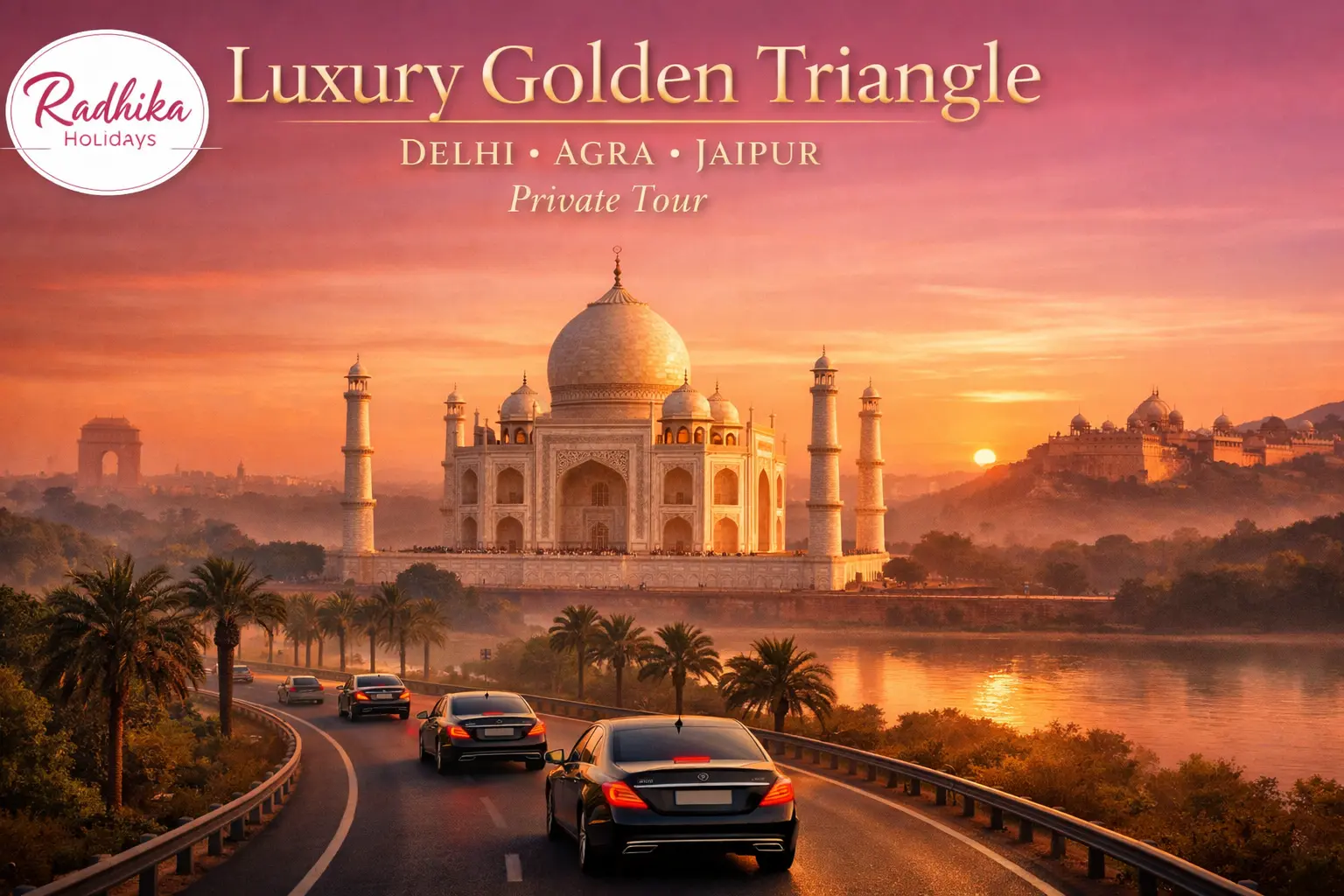
Planning your first trip to India — or your tenth? The Luxury Golden Triangle Delhi Agra Jaipur Private Tour remains the single most rewarding journey you can take. Three cities. Three UNESCO World Heritage Sites. Centuries of history, royalty, and culture packed into one unforgettable road trip. This guide by Radhika Tours And Travels covers everything you need to know before you book: what the Golden Triangle is, the ideal itinerary, what to see in each city, what your package includes, the best time to visit, practical travel tips, and honest answers to the most common traveller questions.
Explore our Luxury Golden Triangle Tour Packages India for more curated experiences. Ready to explore Delhi's bustle, Agra's Taj Mahal, and Jaipur's forts? Let's dive in.
What Is the Golden Triangle Tour?
The Golden Triangle connects three cities that form a rough triangle on the map of northern India:
- Delhi — India's capital city, blending ancient Mughal monuments with a modern, cosmopolitan energy
- Agra — home of the Taj Mahal, one of the seven wonders of the world and a UNESCO World Heritage Site
- Jaipur — the Pink City of Rajasthan, famous for its hill forts, royal palaces, colourful bazaars and Rajput heritage
Each city sits approximately 200 to 250 kilometres from the next, making the route extremely convenient to cover by private road transfer. The total driving circuit from Delhi to Agra to Jaipur and back to Delhi covers roughly 750 kilometres — manageable and deeply rewarding over five to six days.
Why Choose a Private Tour Over a Group Tour?
This choice shapes your entire experience. Radhika Tours And Travels exclusively offers private tours, and the reasons are straightforward.
On a group tour, you share a coach with strangers, follow a fixed schedule, and wait at every stop for the rest of the group. You have no flexibility. Wanting to spend an extra hour at the Taj Mahal? A group tour will not allow it. Someone falling ill and slowing the group down? Everyone suffers.
A Golden Triangle Delhi Agra Jaipur Private Tour with Radhika Tours And Travels gives you your own air-conditioned vehicle, your own licensed guide, and full control over the pace. Want to leave for Agra at 5 AM to catch the sunrise? Done. Prefer to skip one monument and spend more time at a spice market in Old Delhi instead? No problem. Your tour adapts to you — not the other way around.
Delhi — Where Old India Meets New India
Delhi is not just a starting point for the Golden Triangle. It is a destination in its own right — a city of extraordinary contrasts where a 12th-century mosque stands minutes from a glass-and-steel shopping mall, and where the chaotic lanes of Old Delhi give way to the broad, tree-lined boulevards of New Delhi.
Radhika Tours And Travels recommends spending at least one and a half to two full days in Delhi before heading to Agra.
Old Delhi: The Mughal Heart of the City
Emperor Shah Jahan built Old Delhi in the 17th century as the new capital of the Mughal Empire. Walking its narrow lanes delivers one of the most sensory-rich experiences in all of travel. Spices, incense, and street food fill the air. Rickshaws weave between pedestrians and shopkeepers. Around every corner, something unexpected catches your eye.
The centrepiece of Old Delhi is the Red Fort (Lal Qila), built between 1638 and 1648 in red sandstone. Mughal emperors called it home for nearly 200 years, and today it holds UNESCO World Heritage status. Just a short walk away, Jama Masjid stands as one of the largest mosques in India — its courtyard holds up to 25,000 worshippers. Your Radhika Tours And Travels guide will take you inside and bring its Persian and Mughal architectural details to life.
A traditional rickshaw ride through Chandni Chowk — Delhi's oldest and busiest market street — ranks among the most memorable moments on the entire Golden Triangle tour. Traders have operated here since the 1650s, selling everything from saris and jewellery to electronics and street food.
New Delhi: The Imperial Capital
British architects Edwin Lutyens and Herbert Baker designed New Delhi in the early 20th century as the new administrative capital of British India. Its wide, tree-lined avenues and grand colonial buildings feel entirely different from the medieval density of Old Delhi.
India Gate is a 42-metre-tall war memorial honouring the 84,000 Indian soldiers who lost their lives in World War I. Dawn and dusk offer the best light for photographs. Nearby, Humayun's Tomb — the garden tomb of Mughal Emperor Humayun, completed in 1570 — is widely considered the architectural blueprint for the Taj Mahal. You can already see the same red sandstone, white marble inlay and geometric garden symmetry that Shah Jahan would later perfect in Agra. Humayun's Tomb also holds UNESCO World Heritage status.
Qutub Minar: Delhi's Oldest Monument
Standing 73 metres tall, Qutub Minar holds the title of the world's tallest brick minaret. Builders completed it in 1193, marking the beginning of Muslim rule in India. The surrounding ruins include Delhi's very first mosque — the Quwwat-ul-Islam — making this complex one of the most historically significant sites on the entire Golden Triangle private tour.
Agra — The City of the Taj Mahal
Nothing on your Golden Triangle journey — nothing in India, arguably nothing in the world — prepares you for your first sight of the Taj Mahal. Radhika Tours And Travels has guided thousands of travellers to Agra over the years. Without exception, every single one reports the same feeling afterwards: the monument surpassed every expectation.
The Taj Mahal: A Monument to Eternal Love
Mughal Emperor Shah Jahan commissioned the Taj Mahal in 1632 as a mausoleum for his beloved wife Mumtaz Mahal, who died during childbirth. Construction took over 20 years and brought together more than 20,000 artisans from across the Mughal Empire, Persia and Central Asia. The result — a building of perfect mathematical symmetry and pure white marble craftsmanship — earned UNESCO World Heritage status in 1983 and a place among the New Seven Wonders of the World in 2007.
Radhika Tours And Travels always schedules the Taj Mahal visit at sunrise. The monument opens at dawn, and that first hour is the most magical of the day. The light shifts the white marble from pale blue to soft gold to brilliant white as the sun climbs. Crowds remain thin, and the complex feels entirely your own. Plan to spend at least two to three hours inside.
Note that the Taj Mahal closes every Friday for prayers. Radhika Tours And Travels plans your itinerary around this detail so you never waste a visit day.
Agra Fort: The Emperor's Prison
Just 2.5 kilometres from the Taj Mahal, Agra Fort is a massive red sandstone fortress and a UNESCO World Heritage Site. Mughal emperors occupied it as their primary residence until 1638. Inside, you will find palaces, audience halls, mosques and gardens spanning successive Mughal reigns.
Your Radhika Tours And Travels guide will share one of history's most poignant stories here. Shah Jahan spent his final years as a prisoner in the Musamman Burj tower of this very fort — locked away by his own son Aurangzeb, yet close enough to see the Taj Mahal across the river. He died in the fort in 1666, never returning to the monument he built for love.
Fatehpur Sikri: The Abandoned Mughal Capital
Emperor Akbar built Fatehpur Sikri in 1571, just 37 kilometres from Agra, to honour the Sufi saint Salim Chishti. For 14 years it served as the Mughal capital — then Akbar abandoned it, most likely because the water supply could not sustain the city. Today the entire complex stands remarkably intact and holds UNESCO World Heritage status. Walking through its palaces, courtyards and the enormous Buland Darwaza gateway transports you directly into the 16th-century Mughal court.
Jaipur — The Pink City of Rajasthan
Jaipur is the capital of Rajasthan and one of the most visually spectacular cities in India. Maharaja Sawai Jai Singh II founded the city in 1727. In 1876, the entire old city received a coat of pink paint to welcome the Prince of Wales — and much of it remains that warm pink shade today, giving Jaipur a look unlike any other Indian city.
Radhika Tours And Travels recommends a full day in Jaipur, though two days suits those who love unhurried exploration.
Amber Fort: Jaipur's Crown Jewel
Amber Fort sits on a rocky hilltop 11 kilometres from Jaipur city centre and ranks among the most magnificent forts in all of Rajasthan. The Kachwahas — the Rajput rulers who later allied with the Mughals — built and expanded it over centuries as their ancient capital. A stunning blend of Rajput and Mughal architecture greets you at every turn: palaces, courtyards, temples, and sweeping views over the surrounding hills and Maota Lake.
Radhika Tours And Travels offers the choice of reaching the fort by jeep (the most popular option) or by elephant ride for a traditional experience. Inside, your guide leads you through Sheesh Mahal — the Hall of Mirrors — where tiny convex mirrors cover every wall and ceiling. Light a single candle, and the room explodes into what looks like thousands of stars.
City Palace and Jantar Mantar
Maharaja Sawai Jai Singh II also built the City Palace complex in the heart of Jaipur, and the royal family still occupies part of it today. The palace houses a fascinating museum of royal costumes, weapons, paintings and artefacts. Its Diwan-i-Khas contains two enormous silver urns that the Guinness Book of World Records recognises as the largest silver objects in the world.
Adjacent to the City Palace, Jantar Mantar is an open-air astronomical observatory containing 19 massive geometric instruments. Maharaja Jai Singh II built it in the early 18th century to measure time, predict eclipses and track celestial bodies with extraordinary accuracy. This UNESCO World Heritage Site is one of the most intellectually fascinating stops on the entire Golden Triangle private tour.
Hawa Mahal and Jaipur's Famous Bazaars
Jaipur's most photographed landmark, the Hawa Mahal (Palace of Winds), is a five-storey pink sandstone facade with 953 carved windows and screens. Builders completed it in 1799 so that royal ladies in purdah could observe street festivals below without anyone seeing them. The intricate lattice-work covering the entire front elevation stands as a masterpiece of Rajput craftsmanship.
After sightseeing, Jaipur's bazaars deserve at least an hour or two. The city holds world fame for its gemstones, handmade jewellery, blue pottery, block-printed textiles, leather shoes and miniature paintings. Radhika Tours And Travels guides know the most reputable shops and workshops — and, crucially, which ones to avoid.
Recommended Itinerary: 6 Days / 5 Nights
Radhika Tours And Travels recommends a six-day private itinerary to explore each city comfortably without rushing.
Day 1 — Delhi Arrival and Old Delhi
Your private transfer meets you at the airport and takes you directly to your hotel. After freshening up, your guide leads you through Old Delhi: Jama Masjid, Chandni Chowk by rickshaw, Red Fort and Raj Ghat. Spend the evening at leisure.
Day 2 — New Delhi Sightseeing and Drive to Agra
Start your morning with New Delhi's landmarks: India Gate, Humayun's Tomb and Qutub Minar. After lunch, your private driver takes you to Agra on the Yamuna Expressway (approximately 3.5 hours). That evening, visit Mehtab Bagh for a sunset view of the Taj Mahal glowing across the Yamuna river.
Day 3 — Taj Mahal, Agra Fort and Fatehpur Sikri
Arrive at the Taj Mahal before the gates open at sunrise. After spending time inside the complex, move on to Agra Fort. Your afternoon takes you 37 kilometres away to the ghost capital of Fatehpur Sikri. Return to Agra for the night.
Day 4 — Drive to Jaipur via Abhaneri
Your morning drive from Agra to Jaipur takes approximately 4.5 hours. Along the way, stop at Abhaneri Stepwell (Chand Baori) — one of the largest and most beautiful stepwells in India, dating to the 9th century. After arriving in Jaipur, take an evening stroll through Johari Bazaar.
Day 5 — Full Day Jaipur Sightseeing
Begin the morning at Amber Fort (jeep or elephant ride to the top). The afternoon covers City Palace, Jantar Mantar and Hawa Mahal. Finish your day with shopping in the bazaars. An optional cultural dinner with Rajasthani folk music and dance makes for a memorable evening.
Day 6 — Departure
An optional morning visit to Nahargarh Fort gives you panoramic views across Jaipur. Your private transfer then takes you to Jaipur Airport or back to Delhi (approximately 5.5 hours) for your onward journey.
Radhika Tours And Travels also offers 4-day, 5-day, 8-day and 10-day versions of this tour. Longer tours add Ranthambore National Park (tiger safari), Pushkar, Udaipur or Varanasi.
What Your Private Tour Package Includes
Every Golden Triangle Delhi Agra Jaipur Private Tour from Radhika Tours And Travels covers the following:
Included in your package:
- Private air-conditioned vehicle (Toyota Innova Crysta or Tempo Traveller for larger groups) with a professional driver
- Experienced, English-speaking, government-licensed guide at each city
- Monument entry fees for all major sites: Taj Mahal, Red Fort, Amber Fort, Agra Fort, Humayun's Tomb, Qutub Minar and more
- Daily breakfast at your hotel
- Hand-picked hotel accommodation (3-star, 4-star or 5-star — your choice)
- All transfers: airport pickups, hotel-to-hotel drives and city sightseeing
- All applicable government taxes (GST)
- 24/7 support from the Radhika Tours And Travels team throughout your trip
Not included (stated clearly for full transparency):
- International or domestic airfare
- Personal travel insurance (strongly recommended — ask us for advice)
- Lunches and dinners, unless you specifically book them as part of your package
- Camera fees inside certain monuments
- Tips for guides and drivers (customary but entirely at your discretion)
- Optional activities such as elephant rides, cooking classes or hot-air balloon flights over Jaipur
- Personal shopping expenses
Best Time to Visit the Golden Triangle
October to March: The Ideal Season
October to March offers the best conditions for a Golden Triangle private tour. Daytime temperatures stay between 10°C and 25°C — cool, dry and perfect for long hours at outdoor monuments. December and January bring the coldest mornings, occasionally dropping to 5°C, so pack a light jacket for early Taj Mahal visits.
March to April: A Good Shoulder Season
Temperatures start climbing through March and April, reaching up to 35°C by mid-April. Some haze appears, but monuments see fewer crowds than in peak winter and hotels charge lower rates. Travellers on a budget who want comfortable conditions often find this period a sweet spot.
May to June: Avoid If Possible
Delhi and Agra regularly hit 44°C to 48°C between May and June. Sightseeing outdoors in this heat is genuinely uncomfortable and can pose health risks for elderly travellers and children. Radhika Tours And Travels strongly advises avoiding these months unless you have no other option.
July to September: The Monsoon Option
The monsoon breaks the heat and turns the landscape a vivid green. Hotel prices fall considerably during this period. Heavy rains can disrupt travel plans, however, and haze sometimes partially obscures the Taj Mahal. Budget travellers who can adapt to changing conditions often find the monsoon Golden Triangle tour a unique and beautiful experience.
Top tip from Radhika Tours And Travels: Time your Agra visit around a full moon and request a moonlit Taj Mahal viewing. The Archaeological Survey of India opens the monument for night viewing on the full moon night and the two days before and after it. Seeing the Taj Mahal glow silver against a dark sky is one of the most extraordinary sights on earth.
Practical Travel Tips for the Golden Triangle
Money and Payments
India still runs largely on cash outside major hotels and restaurants. Carry Indian Rupees for rickshaws, street food, market shopping and tips. ATMs are available throughout Delhi, Agra and Jaipur, but Radhika Tours And Travels recommends withdrawing cash at international ATMs inside airports — these machines tend to be more reliable than street ATMs.
Clothing and Dress Code
Mosques and temples require covered shoulders and knees, so dress modestly when visiting them. Women should carry a light scarf or dupatta for convenience. At the Taj Mahal and most fort complexes, comfortable walking shoes are essential — you will cover several kilometres on foot at each monument.
Water, Food and Health
Drink only bottled or filtered water throughout your trip. Radhika Tours And Travels provides water in the vehicle, but carrying extra is always wise. Avoid ice in drinks unless you know the water source is safe.
Before travelling, consult your doctor about recommended vaccinations and carry a basic medical kit with oral rehydration salts, anti-diarrhoeal medication and antihistamines. Travel insurance is strongly recommended for all travellers.
Photography, SIM Cards and Tipping
Photography is permitted at most monument complexes, but videography sometimes needs a separate permit. Inside the Taj Mahal, photographing the interior tombs is not allowed — your guide will remind you of the specific rules at each site.
Buy a local SIM card at Indira Gandhi International Airport on arrival. Both Airtel and Jio offer affordable tourist data plans with strong coverage across all three cities. Download offline maps before you travel as a reliable backup.
Tipping is customary in India but never compulsory. A fair guide: Rs 500 to 1,000 per day for your private guide and Rs 300 to 500 per day for your driver, depending on your experience.
Frequently Asked Questions
What is the Golden Triangle tour in India?
The Golden Triangle tour connects Delhi, Agra and Jaipur — three cities that form a near-triangular route on the map of northern India. Together, they offer a comprehensive introduction to India's history, architecture, culture and food. First-time visitors find it the ideal way to experience the country, while repeat travellers keep returning for the depth each city offers.
How many days do I need for the Golden Triangle private tour?
Radhika Tours And Travels recommends five to six days for a comfortable experience. Four days covers the highlights if your time is very limited. Eight to ten days opens up extensions to Ranthambore for a tiger safari, or onward travel to Udaipur, Pushkar or Varanasi.
Can I customise the itinerary?
Yes — completely, and at any time. Every private tour from Radhika Tours And Travels is personalised to your group. Choose your start city, set your own pace, add or remove destinations, adjust hotel categories, or change departure times. You remain in full control throughout.
Is the Golden Triangle suitable for families with children?
Absolutely. Radhika Tours And Travels has extensive experience designing these tours for families. The team selects family-friendly hotels, ensures child-appropriate food options are available, and plans the pace around younger travellers. Children particularly love the elephant ride at Amber Fort, the rickshaw ride through Old Delhi and a hands-on cooking class in Jaipur.
Is the tour suitable for senior travellers?
Yes. Many Golden Triangle private tour guests choose Radhika Tours And Travels specifically because the private format suits older travellers so well. The pace is entirely yours to set. The team selects accessible hotels and can arrange wheelchairs or mobility assistance at monuments wherever needed.
Is the Golden Triangle safe to travel?
Delhi, Agra and Jaipur welcome millions of international tourists every year. Travelling with a reputable, licensed operator like Radhika Tours And Travels makes the experience safe and comfortable. Your private guide and driver stay with you throughout the tour, providing both local knowledge and an added sense of security.
What is the best hotel in each Golden Triangle city?
Radhika Tours And Travels personally evaluates every hotel it recommends and can suggest excellent options across all budgets. Heritage properties in Lutyens' Delhi work beautifully in the capital. In Agra, rooms with a Taj Mahal view create an unforgettable experience. In Jaipur, staying in a heritage haveli or royal palace hotel adds a layer of magic to the Pink City. Share your preferences and budget, and the team will find the right match.
How much does the Golden Triangle private tour cost?
The cost depends on the number of days, group size, hotel category and specific inclusions. Radhika Tours And Travels provides fully transparent, all-inclusive pricing with no hidden charges. Contact the team with your requirements and expect a detailed personalised quote within a few hours.
Why Book Your Golden Triangle Tour with Radhika Tours And Travels
Radhika Tours And Travels is a specialist private tour operator with years of experience creating bespoke travel experiences across Delhi, Agra, Jaipur and beyond. Unlike booking platforms and aggregators, the team personally plans and operates every single tour it sells.
A Tour Built Around You
Every Golden Triangle private tour starts with one principle: your experience comes first. All guides hold a government licence and bring deep knowledge of history and culture to each site. Before your trip begins, each vehicle passes a thorough inspection. Hotels earn their place on the recommended list only through personal evaluation by the Radhika Tours And Travels team. Your itinerary, moreover, reflects your preferences, interests and travel pace — not a recycled template.
Trusted by Thousands of Travellers Worldwide
When you book with Radhika Tours And Travels, you travel as a guest — not as a reference number on a shared coach. The team treats every tour with genuine care and pride. Travellers from the United Kingdom, United States, Australia, Germany, France and dozens of other countries have trusted Radhika Tours And Travels with their India journeys. That trust drives everything the company does.
Contact Radhika Tours And Travels
Ready to plan your Luxury Golden Triangle Delhi Agra Jaipur Private Tour? Get in touch today. The team responds to all enquiries within a few hours and will put together a personalised, no-obligation itinerary and quote based on your travel dates, group size and preferences.
And Explore our Luxury Golden Triangle Tour Packages India for more curated experiences. Ready to explore Delhi's bustle, Agra's Taj Mahal, and Jaipur's forts? Let's dive in.