
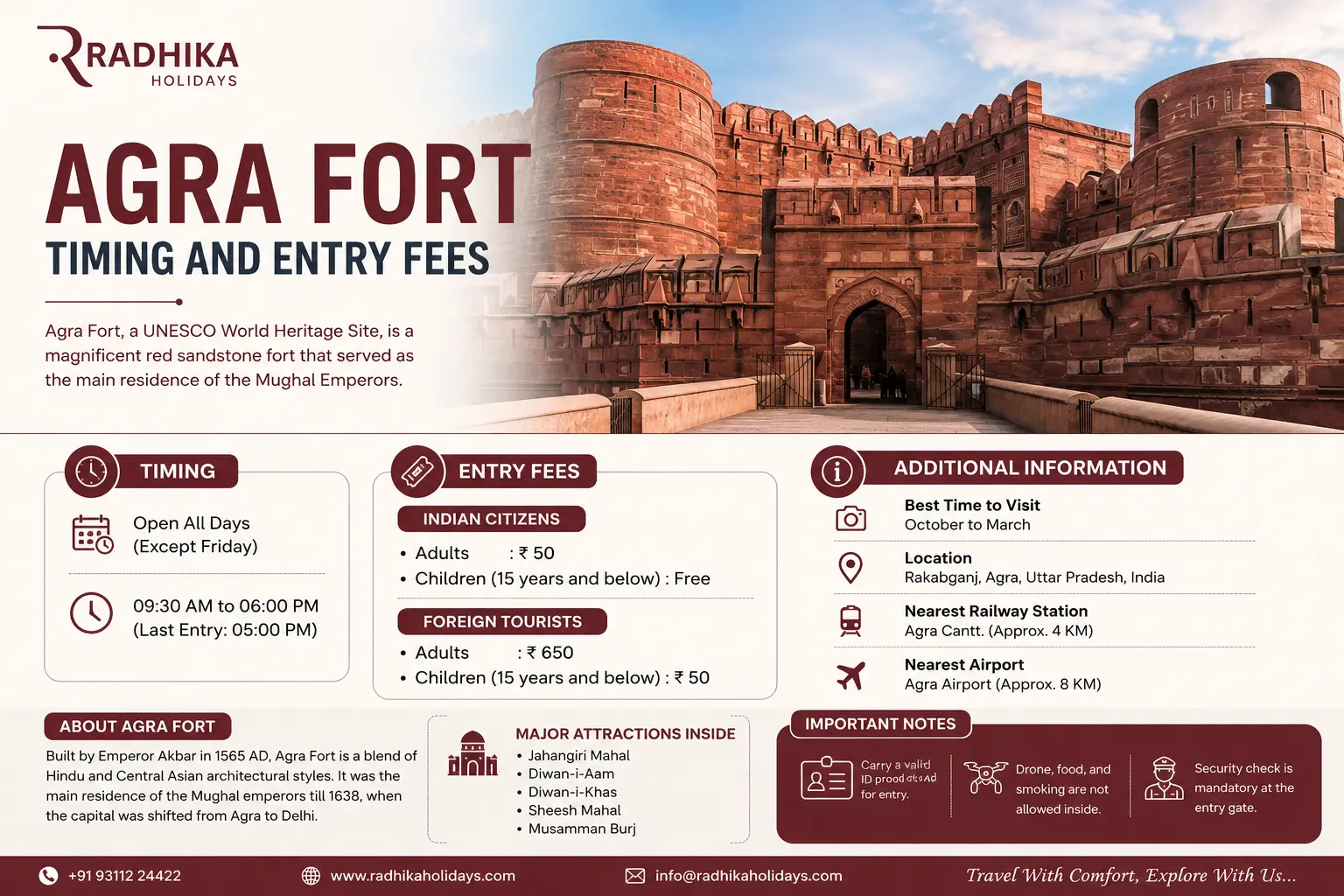
Agra Fort is open every day from 6:00 AM to 6:00 PM (last entry at 5:00 PM). Indian visitors pay ₹50, and foreign tourists pay ₹650. Children under 15 enter free.
That's the quick answer. But if you want to make the most of your visit — avoid the crowds, save money on Friday fees, catch the brand-new light show, and see the Taj Mahal from Shah Jahan's prison window while planning your Luxury Taj Mahal Tours — keep reading.
Quick Reference: Agra Fort at a Glance
| Detail | Information |
|---|---|
| Timings | 6:00 AM – 6:00 PM (daily) |
| Last Entry | 5:00 PM |
| Entry for Indians | ₹50 (weekdays/weekends), ₹40 (Fridays) |
| Entry for Foreigners | ₹650 (weekdays/weekends), ₹600 (Fridays) |
| Children under 15 | Free (all nationalities) |
| Days Open | All 7 days, including public holidays |
| Entry Gate | Amar Singh Gate only |
| UNESCO Status | World Heritage Site since 1983 |
| Best Season | October to March |
| Time Needed | 3 to 4 hours |
Agra Fort Timing: Everything You Need to Know
Official Opening Hours
Agra Fort is open every single day of the year from sunrise to sunset — practically 6:00 AM to 6:00 PM. Unlike the Taj Mahal, which closes on Fridays, Agra Fort has no weekly closure. It stays open on national holidays too.
One detail most guides miss: the last entry is at 5:00 PM, not 6:00 PM. If you arrive at 5:30 PM expecting to walk in, you will be turned away. Plan accordingly.
Best Time of Day to Visit
Early Morning (6:00 AM – 9:00 AM) is the best window. The red sandstone glows warmly in soft morning light, the temperature is comfortable, and the fort is at its quietest. Serious photographers should aim for 6:30 AM when the light hits the Amar Singh Gate at a perfect angle.
Late Afternoon (3:00 PM – 5:00 PM) is the second-best option. The golden hour turns the sandstone walls amber, and the white marble of Khas Mahal and Musamman Burj catches the light beautifully. Sunset views of the Taj Mahal from Musamman Burj during this window are genuinely unforgettable.
Avoid 11:00 AM to 2:00 PM if you can. The fort covers 94 acres with limited shade. In summer, this midday stretch is brutal. Even in winter, it's the most crowded period.
Best Season to Visit
October to March is the ideal season. Temperatures range from 8°C to 25°C, the skies are clear, and the morning mist over the Yamuna River adds a cinematic quality to your visit.
April to June is manageable only if you visit before 9:00 AM. Temperatures regularly cross 42°C by midday, and the fort's stone surfaces radiate heat.
July to September (monsoon) brings lush greenery and fewer tourists, but sudden downpours can disrupt your visit. The pathways can get slippery. If you visit during this season, carry an umbrella and wear non-slip shoes.
Special dates to note: The fort gets extremely crowded during Taj Mahotsav (held in February each year near Shilpgram), Holi (March), and Republic Day (January 26). On these dates, arrive by 7:00 AM or expect long queues.
Agra Fort Entry Fees 2025–2026: Complete Breakdown
Standard Entry Fees
| Visitor Category | Regular Days | Friday |
|---|---|---|
| Indian Citizens / OCI Cardholders | ₹50 | ₹40 |
| Foreign Tourists | ₹650 | ₹600 |
| SAARC / BIMSTEC Citizens | ₹90 | ₹40 |
| Children under 15 (all nationalities) | Free | Free |
Fees are set by the Archaeological Survey of India (ASI) and are inclusive of both ASI and ADA (Agra Development Authority) charges. You do not pay anything extra at the gate beyond this.
Additional Services and Their Costs
Most visitors don't know about these extras, but they can significantly improve your experience:
Audio Guide — ₹150 per person. Available in English, Hindi, French, and German. You collect the device at the entrance and return it before leaving. If you don't want to hire a human guide, this is a worthwhile investment.
Battery-Operated Vehicle — ₹20 per person. The fort covers 94 acres. If you're visiting with elderly family members, young children, or simply don't want to walk the entire complex, this vehicle ferries you between key sections.
Professional Photography Permit — ₹5,000 to ₹25,000. Personal photography with a phone or camera is completely free. Tripods and drones are strictly prohibited. If you need a professional shoot (commercial or editorial), you need prior permission from ASI.
Human Guide — ₹300 to ₹500 for 1–2 hours. Licensed guides wait near the Amar Singh Gate. They speak multiple languages and bring the fort's history to life in ways no signboard can.
How to Buy Tickets
Online (Recommended): Book through the official ASI website at asi.nic.in or the ASI Monument Mitra app (available on Android and iOS). Pay via UPI, debit/credit card, or net banking. You receive a QR-code e-ticket. You can book up to 30 days in advance. During peak season (October to March), online booking saves you 30 to 45 minutes of queue time.
At the Gate: Ticket counters at Amar Singh Gate accept cash, cards, and UPI. Avoid anyone offering you "fast-track" tickets outside the official counters — they are touts.
Combo Tickets: ASI's unified portal offers bundled tickets for multiple sites. For example, a combined Indian ticket covering Agra Fort and other ASI monuments in Agra is available for around ₹100. Check asi.nic.in for current combo options.
Important: Tickets are valid for one-time entry only. Re-entry on the same ticket is not allowed.
Agra Fort History: From Military Fort to Mughal Palace
Before the Mughals
The site of Agra Fort has been strategically significant for centuries. The original structure, called Badalgarh Fort, existed here before the 11th century. Sikandar Lodi, the Delhi Sultanate ruler who moved the capital from Delhi to Agra in the early 16th century, used it as his stronghold.
After the First Battle of Panipat (1526), Babur's son Humayun seized the fort and discovered the famous Kohinoor diamond within its treasury. The fort changed hands several times before Akbar made the decisive move that transformed it into the monument you visit today.
Emperor Akbar Builds the Red Fort (1565–1573)
In 1565, Emperor Akbar ordered the demolition of the crumbling Badalgarh and the construction of an entirely new fort using red sandstone quarried from Rajasthan. Over 4,000 builders worked on the project for eight years. By 1573, what stood was one of the most formidable military fortresses in Mughal India.
Akbar's fort was primarily a military stronghold, built for strength and defence. The massive walls — 21 metres (70 feet) high and stretching 2.5 kilometres in perimeter — reflect this priority. The fort became the administrative capital of the Mughal Empire under Akbar.
Jahangir Adds Elegance (1605–1627)
Akbar's son Jahangir inherited the fort and made it his primary residence. He introduced more ornate decorations and built palatial sections, reflecting a shift from military austerity toward royal grandeur. The Jahangiri Mahal inside the fort blends Persian and Hindu architectural elements in a way that was unique for its time.
Shah Jahan's Marble Revolution (1628–1658)
Shah Jahan transformed Agra Fort most dramatically. He demolished several of Akbar's sandstone buildings and replaced them with white marble structures. The Khas Mahal, Sheesh Mahal (Palace of Mirrors), and Musamman Burj all date to his reign.
This was the same emperor who built the Taj Mahal. His eye for beauty and obsession with white marble left an unmistakable mark on the fort.
In a cruel twist of history, Shah Jahan was imprisoned by his own son Aurangzeb in 1658 inside the very fort he had beautified. He spent his final eight years in the Musamman Burj, gazing at the Taj Mahal — the monument he had built for his wife Mumtaz Mahal — until he died in 1666.
After the Mughals
After Aurangzeb's death, the fort was captured by the Marathas in the 18th century and later by the British during the colonial period. The last Mughal emperor, Bahadur Shah Zafar, was imprisoned here briefly before being exiled to Rangoon. Following Indian independence, the Archaeological Survey of India took over its management and conservation.
In 1983, UNESCO designated Agra Fort as a World Heritage Site, recognising it as one of the finest surviving examples of Mughal military and palatial architecture.
Agra Fort Architecture: What Makes It Extraordinary
Agra Fort is not one building. It is a walled city containing dozens of structures, each representing a different era and architectural sensibility. The total area is approximately 94 acres, enclosed within walls that rise 21 metres high with over 400 towers.
Two distinct architectural phases define the fort:
Akbar's Red Sandstone Phase emphasises strength and scale. The outer walls, the Amar Singh Gate, and the Jahangiri Mahal come from this period. The design draws from Central Asian, Persian, and indigenous Indian traditions.
Shah Jahan's White Marble Phase introduces refinement and ornamentation. The inner palaces — Khas Mahal, Sheesh Mahal, Musamman Burj — replace rough functionality with intricate inlay work, mirror mosaics, and geometric carvings. Walking from the outer walls to these inner chambers is a journey across 80 years of evolving Mughal taste.
The fort is roughly crescent-shaped, following the curve of the Yamuna River on its eastern side. This positioning was strategic: the river provided a natural defensive barrier and a ready water supply.
Top Attractions Inside Agra Fort
Amar Singh Gate — Your Entry Point
This is the only gate open to tourists. The gate's design is deliberately confusing from a military perspective — once you enter, the path curves sharply, slowing down any attacking force. Notice the giant studded iron doors and the intricate carvings overhead. Your tickets are checked here, and a security scan is conducted.
Jahangiri Mahal — The Oldest Surviving Palace
Built by Akbar for his son Jahangir, this is the largest palace within the fort and the only significant structure remaining from Akbar's original construction. It combines Hindu and Islamic architectural elements in a way that was deliberately syncretic. In the courtyard, you will find a massive stone bowl (Hauz-e-Jahangiri) that was once used to store rose water. Persian verses are carved on its sides.
Khas Mahal — The Emperor's Private Palace
Shah Jahan's private residence within the fort, built entirely of white marble. It faces the Yamuna River and the Taj Mahal. The central hall is flanked by two golden pavilions. On either side of the Khas Mahal are two coloured pavilions — one for each of Shah Jahan's daughters, Jahanara and Roshanara. The combination of marble, colour, and river views makes this one of the most photographed spots in the fort.
Sheesh Mahal — Palace of Mirrors
Also built by Shah Jahan, the Sheesh Mahal is famous for its mirror work. Thousands of tiny convex mirrors are embedded in the walls and ceilings. When a single candle was lit inside, the room shimmered as though filled with stars. Today, the mirrors still create a remarkable effect in natural light. The palace was used as a royal dressing room and bathhouse.
Note: The interior of Sheesh Mahal is generally not accessible to visitors, but you can view it clearly through the entrance.
Musamman Burj — The Most Emotionally Charged Spot
This octagonal tower is where the story of Agra Fort reaches its most poignant moment. Shah Jahan was imprisoned here by Aurangzeb and spent eight years looking out at the Taj Mahal until he died. The tower offers the clearest view of the Taj Mahal from anywhere inside the fort. Visit late afternoon for a sunset view that connects these two monuments — the emperor's prison and his wife's tomb — in one frame. It is genuinely moving.
Diwan-i-Aam — Hall of Public Audience
This large open hall was where the emperor met ordinary people, heard petitions, and dispensed justice. The emperor's throne — an elevated platform with a canopied seat — faces the courtyard where subjects would gather. The hall is open on three sides, designed so that large crowds could see and hear the emperor directly. The colonial-era British made modifications to this structure during their occupation.
Diwan-i-Khas — Hall of Private Audience
A more intimate setting used for meetings with nobles, foreign dignitaries, and senior court officials. This was where the legendary Peacock Throne was displayed — the priceless jewelled throne later looted by the Persian ruler Nadir Shah in 1739. The hall is decorated with elegant marble pillars and intricate floral carvings.
Moti Masjid — Pearl Mosque
Built by Shah Jahan for his personal use and that of his court, the Moti Masjid is constructed entirely of white marble. Its three domes and elegant arches make it one of the most beautiful mosques within any Mughal fort. It is generally not open to tourists, but you can view it clearly from nearby areas. The name "Pearl Mosque" comes from the pearlescent quality of its marble in sunlight.
Zenana Meena Bazar — The Royal Women's Market
This is a section that most guides overlook. The Zenana Meena Bazar was a marketplace exclusively for the women of the royal harem. Merchants who were permitted to sell here were exclusively women. The space gives insight into the complex social world of the Mughal court, where thousands of women lived in a self-contained royal household.
Nagina Masjid — Gem Mosque
A small, delicate mosque built in 1637 by Shah Jahan specifically for the women of the harem. It sits on a raised platform and features three white marble arches. Few visitors find this spot, which makes it unusually peaceful.
The New Light and Sound Show: Rang-e-Agra
In April 2025, UP Tourism launched a completely reimagined evening show at Agra Fort titled "Rang-e-Agra: Yugon Ka Safar" (Colours of Agra: Agra through the Ages). This replaces the older show and uses cutting-edge projection mapping technology, developed with World Bank funding under the Pro-Poor Tourism Development Scheme.
The show is staged in the fort's open-air courtyard after sunset, projecting animated visuals and narration directly onto the fort's red sandstone walls. It covers the full arc of Agra's history — from the Lodhi era through Mughal rule to British colonial times.
Show timings: Evening (show typically starts at 7:30 PM; English and Hindi versions available) Ticket prices: ₹70 for Indians, ₹200 for foreign tourists Booking: At the gate or through authorised tour operators
If you are in Agra for at least one full day, plan your daytime visit to the fort and return in the evening for the show. It is a genuinely different experience from the daytime visit and worth the separate ticket.
What You Cannot Bring Inside Agra Fort
The following items are prohibited inside the fort:
Food items, liquor, and tobacco products; headphones (except for the official audio guide device); knives or sharp objects; mobile chargers and power banks; wire and similar materials; large bags or luggage; drones and tripods; professional video equipment (without prior ASI permission).
Cameras and phones are permitted for personal photography.
Lockers are available near the entrance if you need to store items.
How to Reach Agra Fort
Address: Rakabganj, Taj Road, Agra, Uttar Pradesh 282003
Distance from key points:
- Taj Mahal: 2.5 km (10–12 minutes by auto-rickshaw)
- Agra Cantt Railway Station: 5.5 km (15–20 minutes)
- Agra Airport (Kheria): 13 km (25–30 minutes)
- Idgah Bus Stand: 4 km (10–15 minutes)
From Delhi: The Gatimaan Express (fastest, ~100 minutes) and Shatabdi Express are the most convenient trains to Agra Cantt. From the station, take an auto-rickshaw or app cab (Ola/Uber) to the fort.
Local transport options: Auto-rickshaws, e-rickshaws, and cycle rickshaws are readily available throughout Agra. App-based cabs (Ola, Uber) work well and are recommended for families. From the Taj Mahal, an auto-rickshaw to Agra Fort costs roughly ₹50 to ₹80.
Parking: Limited paid parking is available near the Amar Singh Gate. If you have a private vehicle, budget ₹20 to ₹50 for parking.
Practical Visitor Tips
Carry original ID proof. Aadhaar card or voter ID for Indians; passport for foreign nationals. Photocopies are not accepted at the gate.
Last entry is 5:00 PM. This catches many visitors off-guard. Do not aim to arrive after 4:30 PM — you will need at least an hour minimum inside.
Book online for peak season. Between October and March, queues at the ticket counter can stretch 30 to 45 minutes. The ASI Monument Mitra app and asi.nic.in let you book up to 30 days ahead.
Friday is cheaper. Indian visitors save ₹10, foreign visitors save ₹50 on Fridays. Not a huge difference, but worth knowing if you're planning around dates.
Re-entry is not permitted. If you leave the fort, your ticket is no longer valid. Plan your visit in one continuous session.
Wear comfortable footwear. The entire fort complex involves walking on uneven stone surfaces across nearly 94 acres. Sandals or heels will be a mistake.
Dress modestly. While there is no strict dress code like at religious sites, loose, comfortable clothing covering shoulders and knees is appropriate given the historical and cultural context.
Carry water. Water points inside the fort are limited. Bring at least one litre per person, more in summer.
Suggested Itinerary: How to Spend 3–4 Hours Inside
If you enter at 9:00 AM, here is a practical route:
9:00 AM – 9:15 AM: Enter through Amar Singh Gate, collect audio guide if desired, orient yourself with the fort map at the entrance.
9:15 AM – 10:00 AM: Jahangiri Mahal — explore the courtyard, the Hauz-e-Jahangiri, the carvings. This is the most authentically "Akbar-era" experience.
10:00 AM – 10:45 AM: Diwan-i-Aam and Diwan-i-Khas — understand the public and private courts of the Mughal emperor.
10:45 AM – 11:30 AM: Khas Mahal, Sheesh Mahal, and Nagina Masjid — the most ornate section of the fort.
11:30 AM – 12:15 PM: Musamman Burj — spend time here. The Taj Mahal view, Shah Jahan's story, and the architecture all deserve unhurried attention.
12:15 PM – 12:45 PM: Moti Masjid (exterior view), Zenana Meena Bazar, fort walls and gardens.
12:45 PM: Exit and head to lunch.
Combining Agra Fort with Other Agra Attractions
Agra Fort and the Taj Mahal are 2.5 km apart, which makes same-day visits entirely practical. The most popular sequence is:
Morning: Taj Mahal sunrise visit (gates open at 6:00 AM) — approximately 2 hours Late morning: Agra Fort visit — approximately 3 hours Afternoon: Fatehpur Sikri (40 km from Agra) or Itmad-ud-Daulah (Baby Taj) Evening: Return to Agra Fort for the Rang-e-Agra light and sound show
If you have only one day in Agra and must choose between the two, visit the Taj Mahal first. But both are genuinely different experiences — the Taj Mahal is a single monument of profound beauty, while Agra Fort is a complex of dozens of structures with layers of political, military, and personal history.
Agra Fort vs. Delhi Red Fort: Key Differences
Visitors to India's Golden Triangle often compare these two forts. Here is a clear breakdown:
| Feature | Agra Fort | Delhi Red Fort |
|---|---|---|
| Built by | Akbar (1565) | Shah Jahan (1638) |
| Primary material | Red sandstone + white marble | Red sandstone |
| UNESCO status | 1983 | 2007 |
| Size | 94 acres | 78 acres |
| Taj Mahal view | Yes (from Musamman Burj) | No |
| Entry — Indians | ₹50 | ₹35 |
| Entry — Foreigners | ₹650 | ₹600 |
| Evening show | Yes (Rang-e-Agra) | Yes |
Agra Fort is older, larger, more historically layered, and uniquely offers views of the Taj Mahal. Delhi Red Fort is more intact in terms of its gardens and defensive structures, and carries significance as the site of India's Independence Day address each year.
Frequently Asked Questions
What are Agra Fort's opening hours?
6:00 AM to 6:00 PM, every day of the week including Sundays and public holidays.
What is the last entry time at Agra Fort?
5:00 PM. Visitors who arrive after this will not be allowed in.
Is Agra Fort closed on any day?
No. Unlike the Taj Mahal (closed on Fridays), Agra Fort is open all seven days.
What is the entry fee for Agra Fort in 2025?
Indians pay ₹50 on regular days and ₹40 on Fridays. Foreign tourists pay ₹650 on regular days and ₹600 on Fridays. Children under 15 enter free regardless of nationality.
Which gate do I use to enter?
The Amar Singh Gate is the only entry point for tourists. The Delhi Gate is a historical entrance now under military use and is not accessible to the public.
Can I buy Agra Fort tickets online?
Yes, through asi.nic.in or the ASI Monument Mitra app. Online booking is strongly recommended during October to March to avoid long queues.
How much time should I spend at Agra Fort?
Allocate 3 to 4 hours for a thorough visit. A rushed visit of under 2 hours will leave you feeling you missed the most interesting sections.
Can I see the Taj Mahal from inside Agra Fort?
Yes. The best view is from Musamman Burj, the octagonal marble tower where Shah Jahan was imprisoned. Late afternoon is the best time for this view.
Is the Sheesh Mahal open to visitors?
The interior of Sheesh Mahal is generally closed to public entry, but you can clearly see and photograph it from the entrance.
Is Moti Masjid open to visitors?
It is usually closed to tourist entry but visible and photographable from nearby areas within the fort.
Is photography allowed inside Agra Fort?
Personal photography with phones and cameras is free. Tripods and drones are strictly prohibited. Professional shoots require prior ASI permission.
What is the Rang-e-Agra show?
It is a brand-new (April 2025) projection mapping light and sound show held at Agra Fort in the evenings. Tickets cost ₹70 for Indians and ₹200 for foreigners. It runs in both Hindi and English.
Is there a dress code for Agra Fort?
There is no strict enforced dress code, but modest, comfortable clothing is recommended. Covered shoulders and knees are appropriate.
What items are not allowed inside?
Food, liquor, tobacco, headphones (other than the official audio guide), knives, mobile chargers, power banks, wire, drones, and tripods.
How far is Agra Fort from the Taj Mahal?
2.5 km, approximately 10 to 12 minutes by auto-rickshaw.
Is the audio guide worth it?
Yes, at ₹150 per person it is excellent value. It provides context for each section of the fort in four languages and works better than trying to read signboards while walking.
Conclusion
Agra Fort deserves more than it typically gets. Most visitors treat it as a quick add-on to the Taj Mahal — an hour here, a glance at the walls, a photo from Musamman Burj. That is a mistake.
The fort is a 450-year record of an empire at its height, its turning point, and its slow dissolution. Akbar's sandstone strength, Jahangir's ornamentation, Shah Jahan's marble perfection, and then the heartbreaking imprisonment of the man who built the Taj Mahal — all of this is visible and walkable in a single afternoon.
Visit in winter. Arrive at 6:00 AM for the morning light. Stand at Musamman Burj at sunset. Come back in the evening for Rang-e-Agra. And for the perfect curated experience, consider booking our Luxury Golden Triangle Tour Packages — that is a day in Agra you will not forget.