
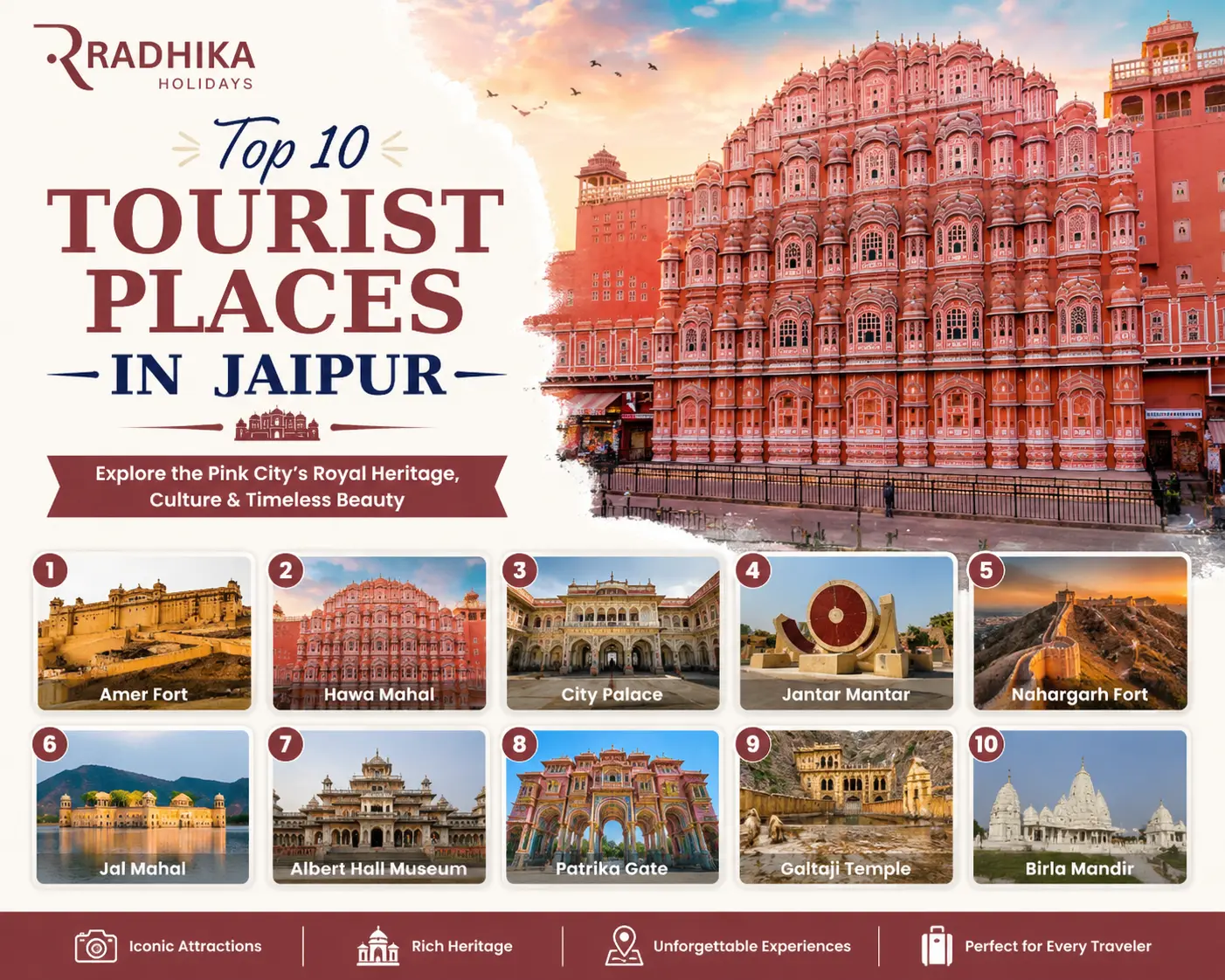
Jaipur, Rajasthan's "Pink City," is one of India's most visited destinations — and also one of the most confusing to plan for, thanks to conflicting entry fee and timing information scattered across the internet. This guide fixes that. Below are the 10 tourist places in Jaipur worth your time in 2026, with the practical details (fees, timings, duration) you actually need, plus honest notes on what's overrated and what isn't. If you're planning a longer Rajasthan itinerary, you can also explore our Luxury Golden Triangle Tour Packages to experience Jaipur along with Delhi and Agra in a premium, hassle-free journey.
Quick Answer: The top 10 tourist places in Jaipur are Amber Fort, Hawa Mahal, City Palace, Jantar Mantar, Nahargarh Fort, Jaigarh Fort, Jal Mahal, Albert Hall Museum, Patrika Gate, and Galtaji Temple (Monkey Temple). Amber Fort and Hawa Mahal are the two unmissable ones if you only have a single day.
Quick-Look Comparison Table
| Place | Best For | Ideal Duration | Entry Fee (Indian) | Timings |
|---|---|---|---|---|
| Amber Fort | Architecture, history | 2–3 hrs | ₹100–200* | 8:00 AM–5:30 PM |
| Hawa Mahal | Photography | 30–45 min | ₹50 | 9:00 AM–4:30 PM |
| City Palace | Royal heritage | 1.5–2 hrs | ₹200–300* | 9:30 AM–5:00 PM |
| Jantar Mantar | Astronomy, science | 1–1.5 hrs | ₹50–100* | 9:00 AM–4:30 PM |
| Nahargarh Fort | Sunset views | 1.5–2 hrs | ₹50 | 10:00 AM–5:30 PM |
| Jaigarh Fort | Cannons, panoramas | 1.5 hrs | ₹35–100* | 9:00 AM–4:30 PM |
| Jal Mahal | Photos (exterior only) | 20–30 min | Free (viewing) | 24 hours (viewing) |
| Albert Hall Museum | Art & artifacts | 1–1.5 hrs | ₹40 | 9:00 AM–5:00 PM |
| Patrika Gate | Photography | 20–30 min | Free | 24 hours |
| Galtaji Temple | Culture, monkeys | 1–1.5 hrs | Free | 5:00 AM–7:00 PM |
*Rajasthan revised several monument fees in January 2026, and figures still vary by source at the time of writing. Always confirm the exact price at the ticket counter or on the official Rajasthan Tourism site before you go — treat the numbers above as a close working estimate, not gospel.
1. Amber Fort (Amer Fort)
If you visit only one place in Jaipur, make it this one. Perched on a hilltop 11 km from the city, Amber Fort was built in 1592 by Raja Man Singh and served as the capital before Jaipur city existed. It's a UNESCO World Heritage Site, and it earns that status — the Sheesh Mahal (Hall of Mirrors) is genuinely breathtaking, designed so a single candle flame multiplies into what looks like a thousand stars.
- Why it's worth it: The scale is enormous — courtyards, secret passages, the Sukh Niwas cooling chamber, and sweeping views over Maota Lake.
- Getting there: 25–35 minutes by cab from central Jaipur.
- Insider tip: Arrive right at opening (8:00 AM). You'll get soft morning light for photos and beat the tour-bus crowds that arrive by 10 AM.
- Good to know: A composite ticket covering Amber Fort, Nahargarh, Hawa Mahal, Jantar Mantar, and Albert Hall is usually the better deal if you're seeing three or more sites — ask about it at any ticket counter.
2. Hawa Mahal (Palace of Winds)
The five-story pink sandstone facade with 953 small windows is Jaipur's most photographed landmark, built in 1799 so royal women could observe street life unseen.
- Why it's worth it: It's less about "going inside" (the interior is fairly modest) and more about the facade itself and the view from the top over the City Palace and Jantar Mantar.
- Insider tip: The best photo isn't from inside — it's from the rooftop café directly across the street. Go at sunrise when the light hits the pink sandstone and the street is quiet.
- Duration: 30–45 minutes is enough unless you linger for photos.
3. City Palace, Jaipur
Still partly a residence of the former royal family, City Palace blends Rajput and Mughal architectural styles across a sprawling complex of courtyards, gardens, and museums.
- Why it's worth it: The Peacock Gate, the Diwan-i-Khas (with two giant silver urns — reportedly among the largest silver objects in the world), and the royal costume and weapons museums.
- Insider tip: Pay the small extra fee for the "royal apartments" ticket if it's available on your visit — it grants access to sections most day-trippers skip.
4. Jantar Mantar
Right next to City Palace, this 18th-century astronomical observatory houses 19 stone and brass instruments, including the world's largest stone sundial, accurate to about two seconds.
- Why it's worth it: It sounds dry on paper but is genuinely fascinating in person — this is functional science, not just decoration.
- Insider tip: Hire the on-site guide (usually a modest fixed fee). Without one, most of the instruments just look like abstract stone sculptures; with one, they come alive.
5. Nahargarh Fort
Built in 1734 as a defensive extension of Amber Fort, Nahargarh sits on the Aravalli ridge overlooking the entire city — and it's the best sunset spot in Jaipur, hands down.
- Why it's worth it: The view. From the ramparts, you can see the whole Pink City laid out below you as the sun goes down.
- Insider tip: Time your visit for about 90 minutes before sunset. There's a café inside with a terrace that's perfect for watching the light change over the city.
6. Jaigarh Fort
Adjoining Amber Fort on the same ridge, Jaigarh is home to Jaivana, the world's largest cannon on wheels, and offers some of the best panoramic views in the region.
- Why it's worth it: Fewer crowds than Amber Fort, but similar sweeping views — a good add-on if you're already at Amber and want more without much extra travel.
- Insider tip: Combine Amber Fort, Jaigarh Fort, and Nahargarh Fort in one morning-to-afternoon loop since they sit on the same ridge — hire a car with a driver for the day rather than negotiating multiple autos.
7. Jal Mahal (Water Palace)
A striking red sandstone palace that appears to float in the middle of Man Sagar Lake, with four of its five floors submerged.
- Why it's worth it: It's purely a photo-and-view stop (the interior isn't open to the public), but it's one of Jaipur's most photogenic sights, especially at sunrise or sunset with the Aravalli hills as backdrop.
- Insider tip: The best viewpoint is the promenade directly across the lake, not the immediate roadside — walk a little further for a cleaner shot without traffic in frame.
8. Albert Hall Museum
Housed in an Indo-Saracenic building in Ram Niwas Garden, this is Rajasthan's oldest museum, holding paintings, sculptures, and an Egyptian mummy among its collections.
- Why it's worth it: The building itself, illuminated at night, is arguably as impressive as what's inside.
- Insider tip: Visit in the early evening — the museum lights up beautifully after dark, and the surrounding garden is pleasant for a post-visit walk.
9. Patrika Gate
One of the newer additions to Jaipur's landmark list, this vividly painted gate at the entrance to Jawahar Circle Garden has become an Instagram favorite for its intricate hand-painted depictions of Rajasthani culture.
- Why it's worth it: It's free, it's striking, and it's a good stop if you want a quick, colorful photo location without a long museum visit.
- Insider tip: Go in the late afternoon when the light isn't harshly overhead — it brings out the colors on the arches much better.
10. Galtaji Temple (Monkey Temple)
Tucked into a narrow gorge in the Aravalli hills just outside the city, this 18th-century temple complex includes natural springs, sacred water tanks, and — as the nickname suggests — resident troops of monkeys.
- Why it's worth it: It's as much a nature and culture experience as a religious one, with a genuinely different pace from the fort-and-palace circuit.
- Insider tip: Keep food out of sight and hands free — the monkeys are used to visitors and will investigate anything that looks like a snack bag.
Best Time to Visit Jaipur
October to March is the sweet spot — daytime temperatures are comfortable (roughly 15–25°C) and ideal for the walking-heavy monument circuit. April to June gets brutally hot (often above 40°C), and monsoon season (July–September) brings humidity and occasional flooding around lower-lying sights like Jal Mahal.
How Many Days Do You Need?
- 1 day: Amber Fort (morning) → City Palace → Hawa Mahal → Jantar Mantar → Jal Mahal or Nahargarh at sunset
- 2 days: Add Jaigarh Fort, Albert Hall Museum, and Galtaji Temple, with more breathing room between sites
- 3+ days: Comfortably cover all 10 places plus Jaipur's bazaars (Johari Bazaar for jewelry, Bapu Bazaar for textiles) without rushing
Frequently Asked Questions
What are the top 10 tourist places in Jaipur?
Amber Fort, Hawa Mahal, City Palace, Jantar Mantar, Nahargarh Fort, Jaigarh Fort, Jal Mahal, Albert Hall Museum, Patrika Gate, and Galtaji Temple (Monkey Temple).
Which is the most important place to visit in Jaipur if I only have one day?
Amber Fort, followed by Hawa Mahal. Between them, they cover Jaipur's architectural highlights and its most photographed landmark.
Is 1 day enough to see Jaipur?
You can cover the essentials — Amber Fort, City Palace, Hawa Mahal, and Jantar Mantar — in a packed single day, but 2–3 days lets you see everything without rushing and leaves time for the markets.
Are Jaipur's monuments within walking distance of each other?
City Palace, Hawa Mahal, and Jantar Mantar are all close together in the old city and walkable. Amber Fort, Nahargarh, and Jaigarh are outside the city center and require a cab or auto-rickshaw.
Do I need to pay separately at each monument, or is there a combined ticket?
Rajasthan Tourism offers a composite ticket covering several major monuments (typically Amber Fort, Nahargarh, Hawa Mahal, Jantar Mantar, and Albert Hall) that's usually cheaper than buying tickets individually if you're visiting three or more sites. Availability and pricing can change, so confirm at any monument ticket counter.
What is the best time of day to visit Amber Fort?
Right at opening, around 8:00 AM. You get softer light for photos and avoid the tour groups that arrive from 10 AM onward.