
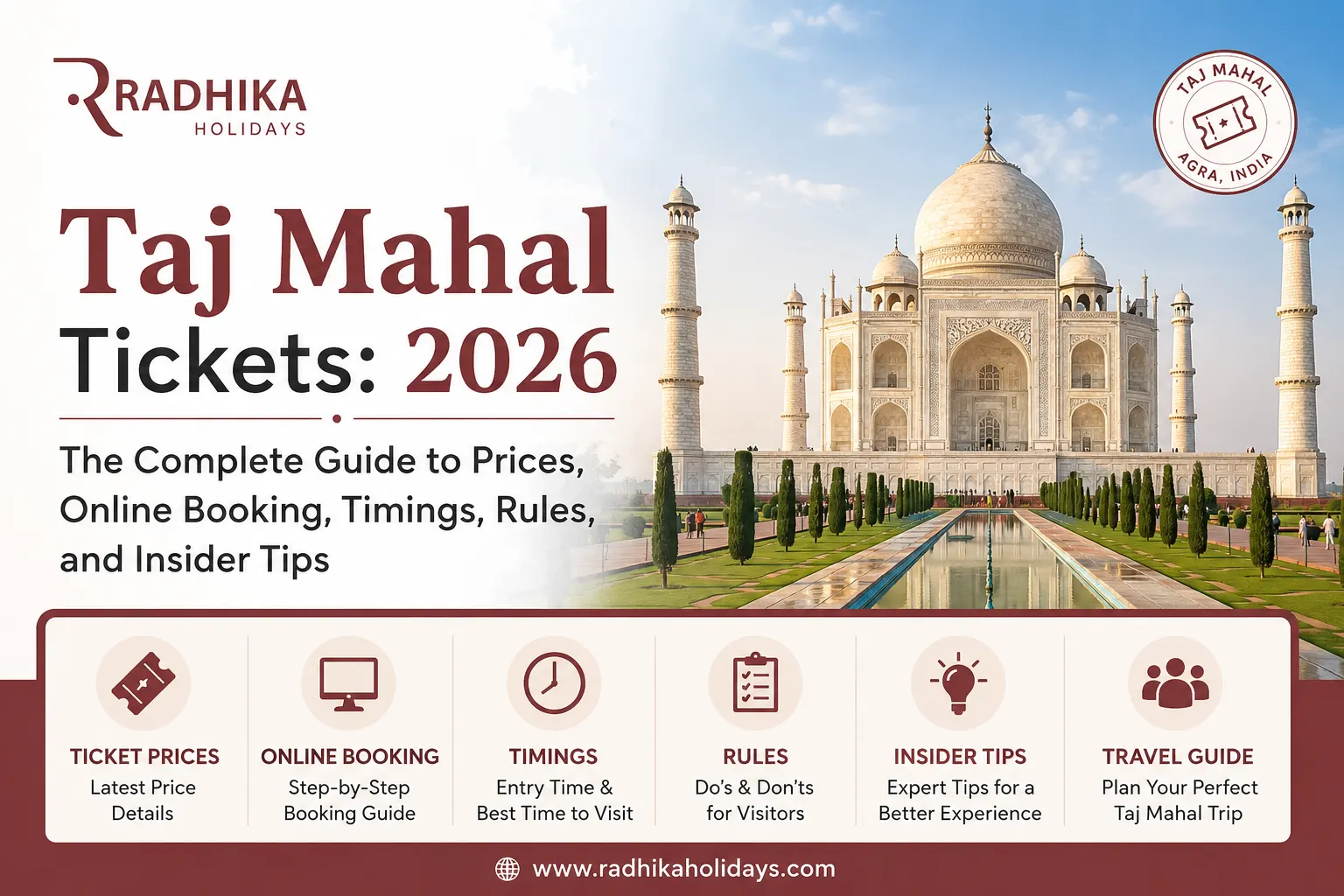
Planning a Taj Mahal visit involves more decisions than most travelers expect: which ticket category applies to you, whether to add the mausoleum, which gate to use, whether to chase a sunrise slot, and how to avoid the handful of mistakes that trip up thousands of visitors every month. This guide walks through all of it in one place, using the current official fee structure as its foundation and adding the practical details — accessibility, photography rules, seasonal timing, group bookings, refunds — that most ticket guides leave out.
Quick answer
- Entry fee: ₹50 (Indian/OCI), ₹540 (SAARC/BIMSTEC), ₹1,100 (foreign nationals). Children under 15 enter free.
- Main mausoleum add-on: ₹200 on top of any entry ticket.
- Closed: every Friday, for all general visitors.
- Hours: the monument opens 30 minutes before sunrise and closes 30 minutes before sunset; ticket counters open 1 hour before sunrise and close 45 minutes before sunset.
- Book online at: the official ASI-linked ticketing portals referenced on tajmahal.gov.in. Online buyers save ₹5 (Indian tickets) or ₹50 (foreign tickets) versus the counter price.
- Bring: a government photo ID that matches the name on your booking — passport for foreign visitors; Aadhaar, passport, driving licence, or voter ID for Indian visitors.
- Entry gates: Western and Eastern Gates both sell tickets and allow entry. The Southern Gate is exit-only.
Everything below expands on this — including ticket types most guides skip (night viewing, combo tickets), what actually happens at security, how accessible the site is for visitors with mobility needs, and a month-by-month view of the best time to go.
1. Taj Mahal ticket prices in 2026
The Taj Mahal uses a three-tier pricing system based on nationality, with an optional add-on for the inner mausoleum chamber.
| Visitor category | Base entry fee | Mausoleum add-on | Total with mausoleum |
|---|---|---|---|
| Indian citizen / OCI cardholder | ₹50 | ₹200 | ₹250 |
| SAARC & BIMSTEC nationals | ₹540 | ₹200 | ₹740 |
| Foreign tourist (all other nationalities) | ₹1,100 | ₹200 | ₹1,300 |
| Children under 15 (any nationality) | Free | Free | Free |
Why the price differs by nationality
Tiered pricing for heritage sites is common practice across India and many other countries, and it isn't unique to the Taj Mahal — Indian monuments generally charge domestic visitors a token fee while charging international visitors a market-rate fee that also helps fund conservation. The SAARC/BIMSTEC tier exists as a regional concession for nationals of neighboring countries, sitting between the domestic and international rates.
SAARC/BIMSTEC countries whose nationals qualify for the discounted rate typically include Bangladesh, Bhutan, Nepal, Sri Lanka, the Maldives, Pakistan, Afghanistan, Myanmar, and Thailand. If you're unsure which rate applies to you, select your nationality carefully at the booking stage — the system usually applies the correct tier automatically once you enter your passport country.
What the base ticket actually includes
The base entry ticket covers:
- Access to the outer gardens and the charbagh (four-quadrant Mughal garden)
- The raised marble platform and its four minarets
- Full exterior views of the main dome and the surrounding red sandstone structures (the mosque on one side, the guest house/jawab on the other)
- General photography from the gardens and platform (subject to the rules in Section 12)
The base ticket does not include entry into the inner chamber where the cenotaphs of Shah Jahan and Mumtaz Mahal sit. That requires the ₹200 mausoleum add-on, covered next.
The mausoleum ticket, explained properly
Many first-time visitors assume one ticket gets them everywhere, and this is the single most common point of confusion in Taj Mahal ticketing. There are effectively two "layers" to a visit:
- Outer visit — gardens, platform, exterior of the building. Covered by the base ticket.
- Inner visit — the mausoleum chamber, with the cenotaphs of the emperor and empress on the main floor. Requires the additional ₹200 ticket.
There's a further nuance worth knowing: the cenotaphs visitors see inside the main chamber are symbolic markers, not the actual graves. The real graves lie in a sealed basement chamber directly beneath, and that basement is not open to the public for most of the year — it briefly opens only during the Urs, the annual death-anniversary observance of Mumtaz Mahal, held according to the Islamic calendar. If your main reason for paying the mausoleum fee is to see the actual burial chamber, it's worth knowing in advance that what you'll see is the cenotaph room, not the crypt.
Approximate cost in other currencies
For travelers budgeting in a currency other than rupees, here's a rough conversion (these fluctuate with exchange rates, so treat them as ballpark figures, not fixed prices):
| Visitor category | Approx. entry fee (USD) | Approx. entry fee (EUR) | Approx. entry fee (GBP) |
|---|---|---|---|
| Foreign tourist | ~$13 | ~€12 | ~£10 |
| Mausoleum add-on | ~$2.50 | ~€2.30 | ~£2 |
Always confirm the actual rupee amount at checkout — that's the figure that's charged, and currency conversions on booking pages can vary.
2. Night viewing (full moon) tickets
Beyond the standard daytime visit, the Taj Mahal offers a separate night viewing experience tied to the lunar calendar.
Key facts about night viewing tickets:
- Available only around the full moon: the full moon night itself, plus two nights before and two nights after — five nights a month in total.
- Not available on Fridays, and typically suspended during the month of Ramadan.
- Visitors are let in in small, timed batches rather than freely wandering in and out, since night viewing has tighter crowd control than the daytime visit.
- Night tickets are usually bought in advance (commonly the day before) rather than picked up spontaneously at the gate, since slots are limited and demand is high around full moon periods.
- The viewing window is a short duration late at night — this is a very different experience from the sunrise/daytime visit, with a much smaller group of visitors and a distinctly quieter atmosphere.
Because slot numbers are limited and the schedule is tied to the moon calendar (which shifts every month), always check the exact dates for your travel month before finalizing an itinerary around night viewing — don't assume it lines up with your trip without confirming first.
3. Combo tickets and multi-monument passes
If your Agra trip includes more than just the Taj, a combined ticket can save both money and time versus booking each site separately.
- Taj Mahal + Agra Fort combo: the most common pairing, since both sites are UNESCO-recognized Mughal landmarks within a short drive of each other.
- Broader Agra circuit passes: some booking platforms bundle in Itimad-ud-Daulah (the "Baby Taj") or Fatehpur Sikri for visitors doing a fuller heritage circuit.
Combo tickets are worth it specifically when you already plan to see both/all sites — buying a combo you don't fully use isn't a saving. If you're only doing the Taj Mahal on this trip, skip the combo and buy the standalone ticket.
4. Skip-the-line tickets: official vs. third-party
"Skip-the-line" is one of the most searched add-on terms for Taj Mahal tickets, and it covers two genuinely different products:
| Official ASI ticket | Third-party skip-the-line ticket | |
|---|---|---|
| Price | Standard listed rate | Marked up, often bundled with a guide or transport |
| What you get | Entry only | Entry + guide/transport/other extras |
| Where to buy | Official ASI-linked portal | Tour operators, OTAs, resellers |
| Line-skipping benefit | Same entry process as any online ticket | Same entry process, sometimes with a dedicated meeting point |
The important thing to understand: buying online at all is what skips the line, regardless of which portal you use, because online tickets let you walk straight to the entry queue instead of first standing in the counter queue to buy a paper ticket. A third-party "skip-the-line" package doesn't get you through security any faster than an official e-ticket does — you're paying the markup for the bundled guide, transport, or convenience of one-stop booking, not for a genuinely faster gate. If you just want to walk in without paying extra, the official ticket achieves the same practical outcome for less money.
5. How to book Taj Mahal tickets online (step by step)
- Go to the official ASI-linked ticketing portal referenced from tajmahal.gov.in. Avoid resellers not linked from the official government site, especially ones charging noticeably more than the listed price for a plain entry ticket.
- Select your visitor category — Indian/OCI, SAARC/BIMSTEC, or foreign tourist — since this determines your price tier.
- Choose your visit date and time slot. Sunrise slots are the first to fill up in peak season (October–February and around major holidays).
- Decide whether to add the mausoleum ticket at this stage — it's easier to add it during booking than to queue separately for it on arrival.
- Enter visitor details, including an ID type and number for each person in the booking. Indian visitors can use Aadhaar, passport, driving licence, or voter ID; foreign visitors need a passport.
- Complete payment. A single booking is capped at a maximum of 20 adults and 10 children — larger groups need to split across multiple bookings.
- Save your e-ticket/QR code. A phone screenshot is generally accepted, but it's worth keeping a downloaded copy too in case of connectivity issues at the gate.
- Arrive at your chosen gate with your ticket and the same ID used at booking, and join the correct queue — domestic and foreign visitor queues are kept separate.
Booking apps and platforms
Tickets are available through the ASI's own online ticketing system as well as through established travel booking platforms that resell official tickets alongside guided tour packages. If you book through a third-party travel site, check exactly what's included — some list only the entry ticket at a markup, while others genuinely bundle a guide, hotel pickup, or transport that can be worth the extra cost if you'd otherwise book those separately anyway.
Payment methods
Most online booking portals accept major debit/credit cards and UPI for domestic transactions, and international cards for foreign visitors. If a payment fails partway through, wait for confirmation before re-attempting — duplicate charges from a failed booking are usually refunded automatically, but it's worth checking your booking confirmation email or SMS before retrying.
The online discount
Buying online rather than at the counter comes with a small built-in discount: ₹5 off per Indian ticket and ₹50 off per foreign ticket. It's a modest saving, but combined with the time saved by skipping the counter queue, it makes online booking the better default choice for almost every visitor.
6. Group bookings and booking limits
- A single online booking is capped at a maximum of 20 adults and 10 children.
- Larger tour groups (school trips, large family reunions, tour operator groups) need to split into multiple bookings, or coordinate through a registered tour operator who handles bulk bookings directly.
- Group leaders should carry a list of all group members' ID types and numbers in advance, since entering these accurately during booking avoids delays.
7. Cancellations, refunds, and rescheduling
- Tickets are issued for a specific date and time slot and generally can't be used on a different date if you miss your slot.
- Cancellation before your visit date is usually possible, with the refund processed according to the specific booking platform's cancellation policy — this can vary in terms of cutoff time and refund percentage, so check the terms shown at checkout before paying.
- If your plans are uncertain, look specifically for a portal that shows its cancellation window clearly (e.g., "free cancellation up to 24 hours before") rather than assuming a blanket refund policy applies everywhere.
- For weather disruptions or unexpected closures announced by the ASI, refund handling is typically addressed by the platform on a case-by-case basis — contact them directly rather than assuming an automatic refund.
8. Opening hours, seasonal timing, and the Friday closure
| Timing | |
|---|---|
| Monument opens | 30 minutes before sunrise |
| Monument closes | 30 minutes before sunset |
| Ticket counters open | 1 hour before sunrise |
| Ticket counters close | 45 minutes before sunset |
| Weekly closure | Friday (closed to all general visitors) |
Because the opening and closing times are pegged to sunrise and sunset rather than fixed clock times, they shift through the year:
| Season | Approx. sunrise (Agra) | Approx. sunset (Agra) | Practical effect |
|---|---|---|---|
| Winter (Dec–Feb) | ~6:45–7:15 AM | ~5:30–6:00 PM | Later opening, earlier closing — shorter visiting window, cool and comfortable |
| Spring/Autumn (Mar, Oct–Nov) | ~6:00–6:30 AM | ~6:00–6:15 PM | Balanced hours, moderate crowds |
| Summer (Apr–Sep) | ~5:15–5:45 AM | ~6:45–7:15 PM | Earliest opening, longest visiting window, but hot by mid-morning |
These are approximate and shift daily — always check the sunrise/sunset time for your exact travel date rather than relying on a seasonal average, since the visiting window can differ by 20–30 minutes even within the same month.
The Friday closure
The Taj Mahal is closed to all general visitors every Friday — no ticket type overrides this. It's the single most common planning mistake for first-time visitors, so build it into your itinerary from the start rather than discovering it after booking flights and hotels.
If Friday is your only free day in Agra: consider visiting Mehtab Bagh, a garden park directly across the Yamuna River, which offers a full view of the Taj Mahal from outside and typically stays open when the main complex is closed. It's also one of the better spots for sunset photography of the monument from a different angle.
9. Entry gates: which one to use
| Gate | Tickets sold here | Entry allowed | Notes |
|---|---|---|---|
| Western Gate | Yes | Yes | Closer to many hotels on the Fatehabad Road side; tends to be busier |
| Eastern Gate | Yes | Yes | Closer to Taj Ganj/Taj East Gate area hotels; has a wheelchair ramp |
| Southern Gate | No | Exit only | Do not plan entry here |
Choosing a gate: pick whichever is closer to your hotel or drop-off point — both the Western and Eastern Gates sell tickets and allow entry, with separate queues for domestic and foreign visitors at each. If accessibility is a concern, the Eastern Gate is generally the better choice (see Section 13).
Parking and the walk to the entrance: Vehicles are not permitted right up to the monument for conservation and pollution-control reasons. Parking areas sit roughly a kilometer from the gates, and the distance is usually covered on foot, by cycle-rickshaw, tanga (horse cart), or an electric battery bus/golf cart shuttle. Budget extra time for this leg, especially if you're traveling with young children, elderly relatives, or heavy camera gear.
10. ID and documentation requirements
| Visitor type | Accepted ID |
|---|---|
| Indian citizens | Aadhaar card, passport, driving licence, or voter ID |
| OCI cardholders | OCI card plus passport |
| Foreign nationals | Passport |
| Children under 15 | No ticket required, but carrying some proof of age is useful if asked |
The ID number entered at booking should match the ID you physically carry — mismatches (e.g., booking with a passport number but showing a driving licence at the gate) can cause delays. If you're booking on behalf of family members or a group, double-check every ID number before submitting the booking, since corrections after payment are often not possible.
11. Security checks and prohibited items
Security at the Taj Mahal is thorough, similar to airport-level screening, given the site's status as a protected monument. Expect:
- Bag checks and metal detector screening at the gate.
- Restricted items: tripods (in most general visiting circumstances), large bags, sharp objects, food items, tobacco and lighters, and any drone or remote-controlled flying device.
- Permitted items: small cameras, phones, and water bottles.
- Free cloakroom facilities at both the Western and Eastern Gates for storing bags, food, or other items not allowed inside.
- Free shoe covers provided near the main mausoleum entrance, since footwear generally needs to come off or be covered before stepping onto the marble platform.
If you're carrying medical equipment or mobility aids that might be flagged at security, it's worth contacting ASI authorities in advance to confirm what's allowed through, rather than risking a last-minute refusal at the gate.
12. Photography rules
- General photography is allowed in the gardens, on the platform, and around the exterior of the monument.
- Tripods are generally not permitted in standard visiting hours; visitors wanting tripod access for professional or specialized photography typically need separate permission arranged in advance with ASI.
- Drones are strictly prohibited anywhere on the premises — this is a hard rule with no visitor exceptions.
- Photography inside the mausoleum chamber itself is restricted in practice, given the confined space and crowd flow — check current signage on the day, since chamber-specific rules can be enforced more strictly than garden photography.
- Best photo spots without special permissions: the reflecting pool axis for the classic symmetrical shot, the marble platform corners for architectural detail, and — if the main complex is closed or overcrowded — Mehtab Bagh across the river for a different angle entirely.
13. Accessibility for visitors with mobility needs
The Taj Mahal has made real, if imperfect, progress on accessibility, and it's worth planning around the specifics rather than assuming full step-free access.
- Free wheelchairs are generally available at the entrance for visitors who need them; you can also bring your own.
- Ramp access exists at the Eastern Gate, making it the preferable entry point for wheelchair users — the other gates have historically relied more on steps.
- The parking-to-entrance walk (roughly a kilometer) can be the hardest part of the visit for wheelchair users, since not all the shuttle options (rickshaws, tangas, battery vehicles) are wheelchair-accessible. An electric/motorized wheelchair, if you have one, makes this stretch considerably easier than a manual chair.
- The mausoleum interior is the least accessible part of the site — reaching the inner chamber typically involves a flight of roughly 22 steps, and there's no ramp alternative for that specific climb. Visitors using wheelchairs can still fully experience the gardens, platform, and exterior, but should expect the inner chamber to be out of reach.
- Contact ASI or your tour operator in advance if you have specific accessibility needs — arranging assistance ahead of the visit tends to produce a much smoother experience than arriving unannounced.
14. Hiring a guide or using an audio guide
- Official licensed guides are available at the gates and can be hired on the spot or booked in advance through a tour operator; look for ASI/government accreditation rather than informal touts.
- Audio guide options exist through some third-party apps and rental services, offering a self-paced alternative to a live guide.
- A guide is most useful for visitors who want the history and architectural context explained on the spot — Shah Jahan's construction timeline, the symbolism of the garden layout, the inlay work techniques — details that aren't posted on signage inside.
- If budget is a concern, a well-researched visitor can get most of the historical context from pre-trip reading and skip the guide fee; if this is a once-in-a-lifetime visit, many travelers find the guide fee worthwhile for the context alone.
15. Best time to visit: month-by-month
| Months | Weather | Crowd level | Notes |
|---|---|---|---|
| Oct – Feb | Cool, comfortable | High (peak season) | Best overall weather; book sunrise slots well ahead |
| Mar, Sep | Warm, transitional | Moderate | Good balance of comfort and crowd levels |
| Apr – Jun | Very hot | Lower | Early morning or the last entry slot before sunset are far more bearable than midday |
| Jul – Aug | Hot, humid, monsoon rain | Lower | Dramatic skies for photography, but check rain forecasts |
Time of day: early morning, right at opening, is consistently the best window — cooler temperatures, softer light for photography, and a crowd that builds steadily through the late morning and peaks around midday. If photography is your main goal, a sunrise-slot ticket booked specifically in advance is worth the effort, since these slots are the first to sell out in peak season.
Temperature ranges to plan around
| Season | Typical daytime high | Typical morning low | What to pack |
|---|---|---|---|
| Winter (Dec–Feb) | ~20–23°C | ~7–10°C | A light jacket for early morning visits; it warms up quickly |
| Spring/Autumn (Mar, Oct–Nov) | ~28–34°C | ~15–20°C | Light, breathable clothing |
| Summer (Apr–Jun) | ~38–45°C | ~25–28°C | Sun protection, a hat, and a water bottle; avoid midday visits entirely |
| Monsoon (Jul–Aug) | ~33–36°C | ~26–28°C | A light rain layer; humidity is high but the site is often less crowded |
Marble floors and platform surfaces get genuinely hot in summer, and shoes need to come off or be covered before the platform — an extra reason the early-morning slot is worth prioritizing between April and June.
Festival and calendar considerations
- Urs (Mumtaz Mahal's death anniversary): observed according to the Islamic calendar, so the date shifts each year. This is the one occasion when the sealed basement crypt beneath the main chamber briefly opens to visitors — a genuinely different experience from a normal visit, and one worth timing a trip around if it interests you specifically.
- Ramadan: night viewing tickets are typically suspended during this period.
- National holidays: Republic Day (January 26) and Independence Day (August 15) sometimes bring added security measures in Agra generally; check locally if your visit coincides with either date.
16. Sample cost breakdowns
Solo Indian visitor, full experience (entry + mausoleum, online booking): ₹250 total, minus the ₹5 online discount ≈ ₹245.
Couple, foreign nationals, full experience: 2 × ₹1,300 = ₹2,600, minus ₹50 × 2 online discount ≈ ₹2,500.
Family of 4 (2 Indian adults, 2 children under 15), full experience: 2 × ₹250 = ₹500 (children free) ≈ ₹495 with the online discount.
Mixed group (1 Indian, 1 foreign national, entry only, no mausoleum): ₹50 + ₹1,100 = ₹1,150, minus ₹5 + ₹50 online discount ≈ ₹1,095.
These figures cover ticketing only — they don't include guide fees, transport, combo tickets, or night viewing, which are priced separately as covered above.
17. Combining the Taj Mahal with nearby attractions
- Agra Fort — a red sandstone Mughal fortress a short drive from the Taj, and the site where Shah Jahan was reportedly held under house arrest by his son Aurangzeb, with a distant view of the Taj Mahal from his balcony. Well worth combining on the same day.
- Itimad-ud-Daulah ("Baby Taj") — an earlier white marble tomb often described as an architectural precursor to the Taj Mahal's design language, smaller and usually far less crowded.
- Fatehpur Sikri — a former Mughal capital city about an hour from Agra, better suited to a half-day add-on than a same-day combination with the Taj.
- Mehtab Bagh — the garden park across the river, best for sunset views and Friday-alternative viewing.
Suggested one-day order: Taj Mahal first (since its hours are tied to sunrise/sunset), then Agra Fort or Itimad-ud-Daulah later in the day, when their more flexible hours give you room to adjust for delays.
18. Getting to Agra
- By train: the fastest options from Delhi are the high-speed Gatimaan Express and the Shatabdi Express, both covering the Delhi–Agra route in under two hours. Agra Cantt is the main railway station, a short drive from most hotels and from the Taj Mahal's Western Gate side.
- By road: the Yamuna Expressway connects Delhi to Agra in roughly 3–4 hours by car, making a day trip feasible, if long, for visitors based in Delhi.
- By air: Agra has its own airport, about 13 km from the Taj Mahal (roughly 30–40 minutes by road), though most travelers still find rail or road more practical given limited flight frequency.
- Local transport in Agra: autorickshaws, taxis, and app-based cabs cover the city; for the final stretch from parking to the gates, only battery buses, cycle-rickshaws, and tangas are permitted, as private vehicles can't approach the monument directly.
19. Where to stay
- Near the Eastern Gate (Taj East / Taj Ganj area): the most popular base for first-time visitors, with hotel rooftop views of the Taj Mahal at several properties and the shortest walk to the ramp-accessible gate.
- Near the Western Gate (Fatehabad Road area): a wider spread of hotel categories from budget to luxury, slightly further from the monument but well connected to Agra's other attractions.
- Away from both gates (near Agra Cantt or the highway): better suited to travelers prioritizing transport connections (train/road access) over walking distance to the Taj.
If a sunrise visit and a hotel view of the monument both matter to you, the Eastern Gate side is generally the stronger choice.
20. How to confirm a booking portal is official
Given how many resellers and third-party sites surface in a basic search for "Taj Mahal tickets," it's worth a quick checklist before paying:
- Confirm the portal is directly linked from tajmahal.gov.in, or is a recognized ASI-affiliated ticketing system.
- Compare the listed price against the official fee structure in Section 1 — if a plain entry ticket costs noticeably more than ₹50/₹540/₹1,100 (plus the ₹200 mausoleum add-on), you're likely paying a reseller markup, not a government rate.
- Check whether the confirmation is a proper e-ticket with a QR code and a booking reference, not just a payment receipt.
- If a site bundles a guide or transport into the "ticket" price without clearly breaking out the entry fee, treat it as a tour package, not a plain ticket — decide separately whether the bundled extras are worth the premium.
21. A closer look at photography
For travelers making the trip specifically for photography, a few extra details are worth planning around:
- Sunrise light on the white marble is the single most requested shot, and it requires a sunrise-slot ticket booked in advance, since these are the first slots to sell out in peak season.
- The reflecting pool axis gives the classic symmetrical composition, best captured from the main gateway or from along the central pool rather than from the platform itself.
- Golden hour and blue hour around sunset also work well, particularly from Mehtab Bagh across the river, which offers an unobstructed, less crowded vantage point.
- Tripods are restricted for general visitors (see Section 12) — a monopod or simply steadying a camera on a ledge is the realistic workaround without prior permission.
- Interior chamber photography is limited in practice due to crowd flow and low light; don't plan your primary shot list around the mausoleum interior.
- Drones are never an option, regardless of the shot you're after — this is enforced without exception.
22. Sample itineraries
One-day Agra visit (from Agra hotel)
- Early morning: Taj Mahal at opening (sunrise slot ticket if photography matters)
- Mid-morning: breakfast, then Agra Fort
- Afternoon: Itimad-ud-Daulah or rest
- Evening: Mehtab Bagh for sunset views of the Taj from across the river
Day trip from Delhi
- Very early departure by road or fast train (roughly 2–3 hours travel time)
- Taj Mahal late morning to early afternoon
- Agra Fort in the afternoon
- Return to Delhi by evening/night
Two-day Agra trip
- Day 1: Taj Mahal at sunrise, Agra Fort, evening free
- Day 2: Itimad-ud-Daulah and Fatehpur Sikri, or a relaxed second Taj Mahal visit if the first was crowded
23. Common mistakes to avoid
- Assuming the base ticket includes the mausoleum. It doesn't — that's a separate ₹200 add-on.
- Showing up on a Friday. The Taj Mahal is closed to general visitors every Friday, with no ticket-type exception.
- Booking through unofficial resellers not linked from tajmahal.gov.in, especially for "skip-the-line" packages priced well above the standard rate.
- Forgetting ID that matches the booking name and number, which can delay or block entry at the gate.
- Trying to enter from the Southern Gate, which is exit-only.
- Expecting to see the actual burial chamber — what's visible in the mausoleum is the cenotaph room, not the sealed crypt below.
- Underestimating the parking-to-gate walk, especially with children, elderly travelers, or wheelchair users.
- Assuming night viewing tickets are always available — the schedule shifts monthly with the lunar calendar and excludes Fridays and Ramadan.
- Bringing a tripod without checking current rules, since it's commonly restricted for general visitors.
- Overpacking bags with items that will simply be turned away at security and need cloakroom storage.
24. Myths and misconceptions
- "You can just buy a ticket at the gate any time." Counters exist, but they only operate within the specific opening window (1 hour before sunrise to 45 minutes before sunset), and online booking is faster and slightly cheaper.
- "One ticket covers everything, including the inside." It doesn't — the mausoleum is a separate paid add-on.
- "Foreigners and Indians pay the same price." They don't; pricing is explicitly tiered by nationality, plus a middle SAARC/BIMSTEC tier.
- "You can fly a drone for personal photos if you're discreet." Drones are banned outright, with no informal exceptions.
- "Skip-the-line tickets get you through security faster than a normal e-ticket." Any valid online ticket lets you skip the counter queue — third-party "skip-the-line" packages are mostly paying for bundled extras, not a faster gate.
25. A short history and architecture note
The Taj Mahal was commissioned by the Mughal emperor Shah Jahan as a mausoleum for his wife Mumtaz Mahal, who died in 1631. Construction is generally dated to the 1630s–1640s, with the main mausoleum largely complete by around 1648, though decorative work and surrounding structures continued for some years after. It's built from white marble inlaid with semi-precious stones in a technique known as pietra dura, set within a formal Mughal charbagh garden along the Yamuna River. It was designated a UNESCO World Heritage Site in 1983 and remains one of the most visited monuments in the world, drawing millions of visitors annually. This context isn't strictly a ticketing detail, but it's useful background for understanding why the site enforces the conservation-driven rules — no drones, limited tripods, gated parking — that shape the ticketed visitor experience.
FAQ
How much is a Taj Mahal ticket in 2026?
₹50 for Indian/OCI visitors, ₹540 for SAARC/BIMSTEC visitors, and ₹1,100 for foreign visitors, plus an optional ₹200 to enter the main mausoleum. Children under 15 are free.
Is the Taj Mahal closed on Fridays?
Yes, it's closed to all general visitors every Friday, with no ticket-type exception.
Can I book Taj Mahal tickets online?
Yes, through the official ASI-linked ticketing portals referenced on tajmahal.gov.in. Online booking is slightly cheaper than the counter and lets you lock in a date and time slot in advance.
Do I need ID to enter?
Yes — a government photo ID matched to the name and number on your ticket. Indians can use Aadhaar, passport, driving licence, or voter ID; foreign visitors need a passport.
Is the mausoleum ticket separate from the entry ticket?
Yes, it's a ₹200 add-on on top of the base entry fee, for access to the inner chamber area.
Will I see the actual graves of Shah Jahan and Mumtaz Mahal?
Not usually. What's visible in the mausoleum chamber are the cenotaphs, symbolic markers above the real graves, which sit in a sealed basement chamber that opens only during the annual Urs observance.
Are night viewing tickets different from day tickets?
Yes. Night viewing is only available on five nights a month around the full moon (excluding Fridays and Ramadan), needs a separate ticket, and has limited visitor slots per timed batch.
Is there a combo ticket for the Taj Mahal and Agra Fort?
Yes, a combined ticket is available for visitors planning to see both monuments, and it typically costs less than buying each ticket separately.
Can I cancel or get a refund on a Taj Mahal ticket?
Cancellation before your visit date is usually allowed, with refunds handled per the booking platform's own policy — check the specific terms at checkout.
Is there a limit on how many tickets I can book at once?
Yes, a single booking allows a maximum of 20 adults and 10 children; larger groups need separate bookings or a tour operator handling bulk booking.
Which gate should I enter from?
Either the Western or Eastern Gate — both sell tickets and allow entry, with separate queues for domestic and foreign visitors. The Southern Gate is exit-only.
Is the Taj Mahal wheelchair accessible?
Partially. Free wheelchairs are generally available, and the Eastern Gate has ramp access, but the roughly one-kilometer walk from parking and the ~22 steps up to the mausoleum chamber are the main accessibility limitations. Contacting ASI in advance is recommended for specific needs.
Can I bring a tripod?
Generally no, not for standard visits — tripods typically require separate advance permission for specialized or professional photography.
Are drones allowed?
No. Drones are strictly prohibited across the entire site, with no exceptions.
What's the difference between an official ticket and a "skip-the-line" ticket from a tour site?
Any valid online ticket already lets you skip the counter queue. Third-party "skip-the-line" packages usually bundle a guide or transport at a markup rather than offering genuinely faster gate access.
What should I do if the Taj Mahal is closed on my only free day?
Visit Mehtab Bagh across the river instead, which offers a full view of the Taj Mahal and is generally open when the main complex is closed on Fridays.
Is it better to visit in the morning or evening?
Morning, generally — cooler temperatures, softer light, and lower crowd levels than midday or afternoon.
What's the best month to visit the Taj Mahal?
October to February for the most comfortable weather, though this is also peak season with the highest crowds; March, April, and September offer a reasonable weather-to-crowd balance.
Do I need a guide?
Not strictly, but a licensed guide adds historical and architectural context that isn't posted on-site — worth considering for a first, once-in-a-lifetime visit.
Can foreign tourists get any free services with their ticket?
Foreign ticket holders typically get some complimentary extras bundled with the higher-priced ticket, including a tourist map and access to the battery bus/golf cart shuttle from the parking area to the gate.
How far in advance should I book?
For a standard daytime visit outside peak season, a day or two ahead is usually enough. For sunrise slots in October–February, or for night viewing around the full moon, book as early as your travel dates allow, since these fill up first.
Can I visit the Taj Mahal in one hour?
A rushed visit covering the platform and gardens can be done in under an hour, but most visitors spend two to three hours to see the mausoleum interior, walk the gardens properly, and account for the parking-to-gate walk and security screening time.
Is there an age limit for the mausoleum ticket?
No specific age limit applies beyond the general under-15 free-entry rule; the ₹200 add-on applies to anyone 15 or older who wants to enter the inner chamber.
What happens if I lose my e-ticket before arriving?
Check your booking confirmation email or SMS, which usually contains the same QR code — most portals let you re-download or re-display it without needing a fresh purchase.
Can I reschedule instead of cancelling?
This depends on the specific booking platform; some allow date changes within a window before the visit, others only offer cancellation and refund rather than rescheduling. Check the platform's policy at checkout.
Glossary of terms used in this guide
- ASI — Archaeological Survey of India, the government body responsible for the Taj Mahal's ticketing, conservation, and site rules.
- OCI — Overseas Citizen of India, a status that qualifies holders for the domestic (Indian) ticket rate alongside their passport.
- SAARC/BIMSTEC — regional groupings of South and Southeast Asian countries whose nationals qualify for a discounted mid-tier entry rate.
- Charbagh — the four-quadrant Mughal garden layout surrounding the Taj Mahal's main structure.
- Cenotaph — a symbolic tomb marker; the ones visible inside the mausoleum chamber sit above the actual graves in a sealed basement below.
- Urs — the annual death-anniversary observance of Mumtaz Mahal, dated by the Islamic calendar, during which the basement crypt briefly opens to visitors.
- Pietra dura — the inlay technique using semi-precious stones set into marble, visible throughout the Taj Mahal's surfaces.
A note on accuracy
Ticket prices, timings, and entry rules for the Taj Mahal are set by the Archaeological Survey of India and can change without much notice. This guide reflects the fee structure and rules published on the official Taj Mahal website as of mid-2026, supplemented with practical visitor information on accessibility, photography, and logistics drawn from established travel guidance. Always confirm current prices, night-viewing dates, and slot availability on the official booking portal before you travel.