
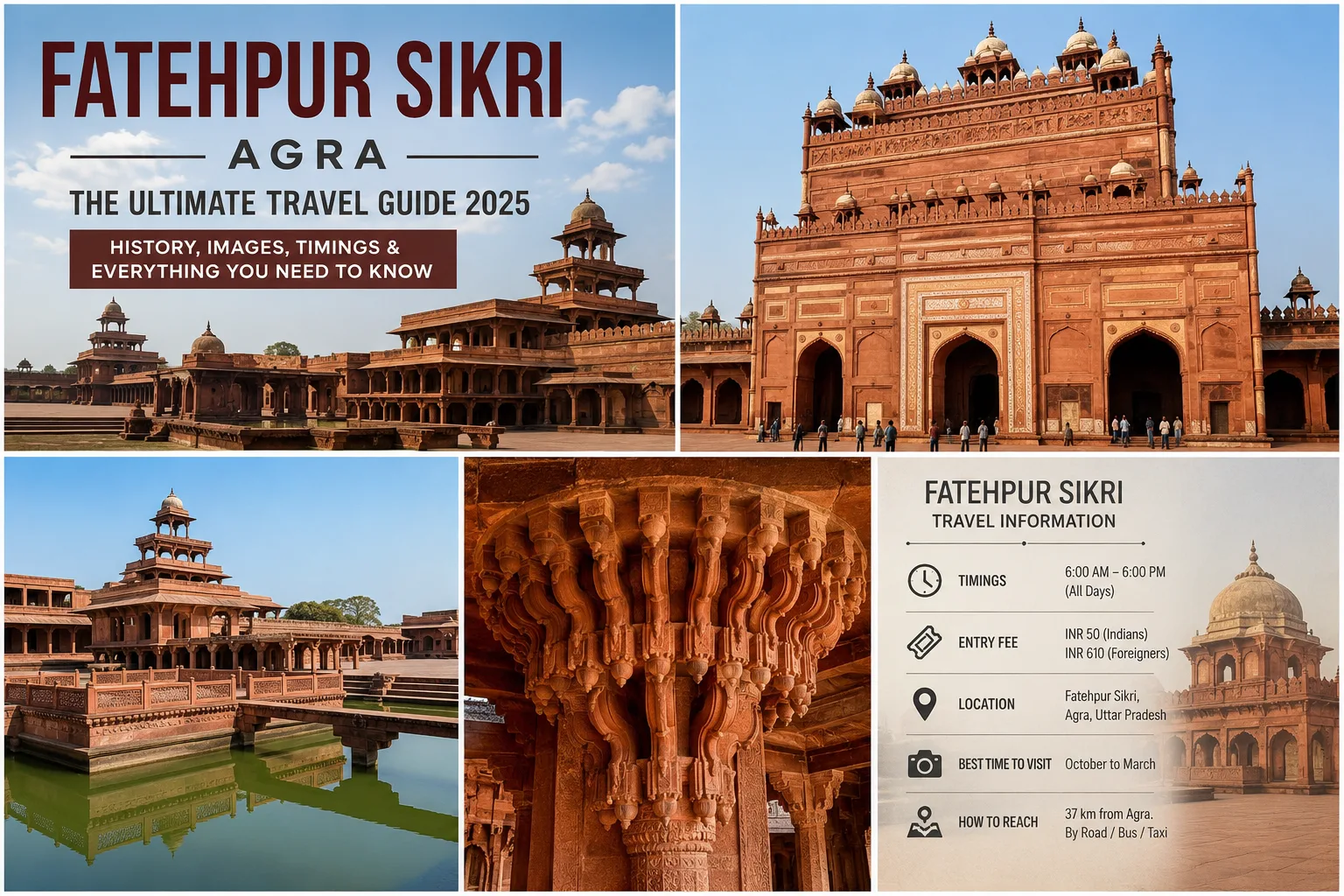
Fatehpur Sikri is a 16th-century UNESCO World Heritage Site located approximately 40 kilometers from Agra, Uttar Pradesh, India. Built by Mughal Emperor Akbar between 1571 and 1585, it served as the capital of the Mughal Empire before being mysteriously abandoned. Famous for its stunning red sandstone architecture — including the iconic Buland Darwaza, Jama Masjid, Panch Mahal, and Tomb of Sheikh Salim Chishti — Fatehpur Sikri is one of India's best-preserved ancient ghost cities. Entry fee: ₹50 for Indian nationals and ₹650 for foreign tourists. Open every day except Fridays, from sunrise to sunset.
Introduction: The Abandoned Capital That Stopped Time
Imagine a city built at the height of one of history's greatest empires — a city with magnificent palaces, a towering mosque, grand audience halls, ornamental pools, and royal gardens — and then imagine that entire city being abandoned after just 14 years, left exactly as it was, silent and perfectly preserved, as though time itself came to a halt the moment its last inhabitants walked away.
That city is Fatehpur Sikri.
Located just 40 kilometers southwest of Agra in the state of Uttar Pradesh, Fatehpur Sikri is one of the most remarkable historical sites on earth. It is frequently overshadowed by its more famous neighbor, the Taj Mahal, but experienced travelers who have visited both will tell you that Fatehpur Sikri offers something the Taj Mahal cannot: the rare experience of walking through an entire royal city exactly as it was built more than four centuries ago.
Every year, millions of people search for Fatehpur Sikri images online and are stopped in their tracks by what they find — vast sandstone courtyards, elaborately carved palaces, an impossibly delicate white marble tomb glowing against warm red stone. And thousands of visitors to Agra combine Fatehpur Sikri with Taj Mahal in a single day, discovering that the two sites together form one of the most extraordinary travel experiences in all of Asia.
This guide covers everything you need to know: the complete history of Fatehpur Sikri, a detailed tour of every major monument inside the complex, the best photography spots, practical advice for combining your visit with the Taj Mahal, current entry fees and timings, transport options, and insider tips that most travel websites never mention.
Fatehpur Sikri History: The Rise, Glory, and Abandonment of a Royal Capital
An Emperor in Search of an Heir
To understand Fatehpur Sikri, you must first understand the man who created it: Emperor Akbar, the third ruler of the Mughal dynasty and widely regarded as the greatest emperor in Indian history.
By the late 1560s, Akbar commanded one of the most powerful empires in the world, stretching from Kabul in the northwest to Bengal in the east, and from Kashmir in the north to the Deccan plateau in the south. He was a brilliant military commander, an enlightened administrator, and a genuinely curious intellectual who spoke multiple languages, engaged with scholars from every religious tradition, and held court debates between Muslim theologians, Hindu priests, Jain monks, Zoroastrian scholars, and Jesuit priests from Portuguese Goa.
Yet despite all of this, Akbar was consumed by a single anxiety: he had no surviving male heir. Two of his wives had lost children at birth. The Mughal succession system was brutal — without a son, the empire could dissolve into civil war the moment Akbar died.
In 1568, Akbar traveled to the village of Sikri, approximately 40 kilometers southwest of his base at Agra Fort, to visit a revered Sufi saint named Sheikh Salim Chishti. The saint lived a life of austerity and prayer in a small stone dwelling on a rocky ridge above the village, and his reputation for spiritual wisdom and miraculous blessings had spread throughout the region.
Akbar visited Sheikh Salim Chishti and sought his blessing for a male heir. Months later, a son was born. The boy was given the name Salim in honor of the saint. He would grow up to become Emperor Jahangir — one of the most celebrated rulers of the Mughal golden age.
Overwhelmed with gratitude, Akbar made a decision that would produce one of history's most extraordinary monuments. He declared that he would build his new imperial capital at Sikri, beside the home of the saint who had blessed his dynasty with its future.
Building a City: 1571 to 1585
Construction began in 1571 on the rocky sandstone ridge above the plains of Uttar Pradesh. Akbar mobilized thousands of craftsmen, stone carvers, architects, painters, and laborers. The building material was the local red sandstone quarried directly from the ridge — warm, durable, and visually magnificent.
What emerged over the following decade was not merely a palace complex but a fully functioning royal city. Fatehpur Sikri contained:
- Royal residential palaces for the emperor and his queens
- The Diwan-i-Aam, or Hall of Public Audience, where Akbar heard petitions from common citizens
- The Diwan-i-Khas, or Hall of Private Audience, for meetings with senior officials and foreign dignitaries
- The Jama Masjid, one of the largest and most beautiful mosques in India at the time of its construction
- The Tomb of Sheikh Salim Chishti, the sacred structure at the heart of the city
- The Panch Mahal, a five-storey open pavilion used by the royal household
- The Zanana, or women's quarters, containing separate palaces for the senior queens
- A treasury, royal stables, workshops, baths, and every infrastructure needed for a self-sufficient imperial capital
The city served as the Mughal capital from 1571 to 1585 — a period that historians often identify as the height of Akbar's golden age, when his empire was at its most powerful, its most cultured, and its most creatively vital.
The architecture of Fatehpur Sikri was also Akbar's most eloquent physical statement of his governing philosophy. He called this philosophy Sulh-e-Kul, meaning "universal peace" or "peace with all." His court was genuinely multicultural — Hindu Rajput nobles held positions of great power alongside Muslim generals, a Jain scholar named Hiravijaya Suri was one of his most valued intellectual companions, and Jesuit priests from Goa were regular guests at court. The architecture of Fatehpur Sikri deliberately combined Persian Islamic forms, Rajput Hindu architectural elements, and Jain decorative traditions in a single unified vision. The buildings were meant to embody the idea that different traditions, far from being incompatible, could create something more beautiful together than any of them could alone.
The Abandonment: An Enduring Historical Mystery
In 1585, Emperor Akbar packed up the imperial court and left Fatehpur Sikri, relocating to Lahore in present-day Pakistan. He never returned. The city was not conquered, not destroyed, not looted. It was simply vacated — left intact, its buildings complete, its courtyards silent.
Historians have debated the reasons for this abandonment for centuries. Several explanations have been proposed, and it is likely that multiple factors combined to produce the decision.
The most widely accepted historical explanation is military necessity. In 1585, the Yusufzai tribes of the northwestern frontier were in open revolt, and Akbar needed to personally lead the military response. This required relocating the imperial court to Lahore, which was far closer to the theater of conflict. The campaign extended for years, and when it finally concluded, Akbar simply did not return to Fatehpur Sikri.
A second explanation, supported by recent archaeological and hydrological research, concerns the city's water supply. Fatehpur Sikri was built on a ridge without a natural river nearby. The city relied on a system of artificial reservoirs, step-wells, and cisterns to supply water to its population. As the population grew to support a full imperial court — potentially tens of thousands of people including soldiers, courtiers, craftsmen, merchants, servants, and their families — the water system became increasingly inadequate. Some researchers believe this water crisis was inevitable from the city's founding and would eventually have forced its abandonment regardless of any other factors.
A third theory points to climate and comfort. The exposed plateau location made Fatehpur Sikri extremely hot in summer and uncomfortably exposed in the cold season. Historical records suggest Akbar found Agra Fort considerably more comfortable as a personal residence.
Whatever the true reasons, the result is one of history's most remarkable accidents. Because Fatehpur Sikri was never repurposed, never substantially rebuilt, and never heavily modified after Akbar's departure, it survives today as a nearly complete 16th-century Mughal royal city. While other historical sites around the world have been altered, reconstructed, converted to new uses, and overlaid with the marks of successive generations, Fatehpur Sikri is essentially frozen in the 1580s. That is the source of its extraordinary photographic power and its unique emotional impact on visitors.
UNESCO World Heritage Recognition
Fatehpur Sikri was designated a UNESCO World Heritage Site in 1986, three years after the Taj Mahal received the same recognition. UNESCO described the site as an "outstanding example of Mughal architecture integrating Hindu, Muslim, and Jain influences" and affirmed its "exceptional universal value" as a complete and remarkably well-preserved royal city of the 16th century.
[caption id="attachment_704" align="alignnone" width="300"] Currently You Are Viewing Fatehpur Sikri Images[/caption]
The Architecture of Fatehpur Sikri: A Fusion Unlike Any Other
Before visiting the individual monuments, it is worth understanding what makes the architecture of Fatehpur Sikri so distinctive and significant.
Most great historical buildings belong clearly to a single architectural tradition. Gothic cathedrals are unmistakably Gothic. Classical Hindu temples follow well-defined canonical rules. Persian mosques conform to established Islamic architectural principles. Fatehpur Sikri, by contrast, synthesizes multiple traditions with such sophistication that it created an entirely new architectural language — one that would go on to define Mughal architecture at its height.
Walking through the complex, visitors encounter:
- Wide overhanging eaves called chajjas, a defining feature of Rajput palace architecture
- Oriel windows known as jharokhas, projecting from the walls in the Rajput palace tradition
- Honeycomb vaulting called muqarnas, borrowed from Persian Islamic architecture
- Intricate pierced stone lattice screens called jaalis, inspired by the stone-carving traditions of Jain temples
- Flat-roofed pavilions crowned with umbrella-shaped kiosks called chatris, typical of Gujarati architecture
- Arabic calligraphy and Quranic inscriptions in the Islamic tradition
- Carved stone motifs of peacocks, elephants, and lotus flowers drawn from Hindu iconography
This was not an accidental mixture. Akbar employed craftsmen from across his empire and beyond — Rajput stone carvers from Gujarat, Persian designers from Khorasan, Hindu craftsmen from the Agra region — and directed them to create a visual language that no tradition could claim as exclusively its own. The result was a physical argument, made in stone, that diversity was not a problem to be managed but a resource to be celebrated.
The warm red sandstone from which nearly the entire city is built gives Fatehpur Sikri its characteristic visual identity. In the first hour after sunrise, the stone glows golden-orange. By midday it is a deep, rich terracotta. At sunset it deepens to amber and copper. This constantly shifting quality of light on stone is one of the primary reasons that Fatehpur Sikri images are so consistently stunning at any time of day.
A Complete Guide to Fatehpur Sikri's Major Monuments
1. Buland Darwaza: The Great Gate of Magnificence
If there is a single image that defines Fatehpur Sikri in the global imagination, it is the Buland Darwaza — the Gate of Magnificence, and by most measurements the tallest gateway in the world.
Standing 54 meters tall from the courtyard level and approached by a broad flight of 42 stone steps, the Buland Darwaza is the southern entrance to the Jama Masjid compound. It was built by Akbar in 1576 to commemorate his military conquest of the Deccan sultanate of Ahmadnagar — though some scholars argue the inscription dates the structure differently.
The gate is constructed from red and buff sandstone, with decorative inlays of white and black marble. Its central arched recess rises to a scalloped point framed by a rectangular border of calligraphy. The flanking surfaces are divided into geometric panels filled with intricate carving. The overall effect, experienced by standing at the base of the steps and looking upward, is one of awe-inspiring scale combined with extraordinary delicacy of detail.
Inscribed across the face of the gateway in Persian is a verse attributed to Jesus Christ — a choice that speaks volumes about Akbar's worldview. The inscription translates approximately as: "Jesus, Son of Mary said: The world is a bridge; pass over it but build no house upon it. He who hopes for an hour may hope for eternity. The world endures but an hour; spend it in prayer, for the rest is unseen."
That the most powerful Muslim emperor of his age chose to inscribe the words of Jesus Christ on the entrance to his royal mosque is perhaps the single most eloquent expression of what Fatehpur Sikri was meant to represent.
Photography Guide: The best Fatehpur Sikri images of Buland Darwaza are captured in the first hour after the site opens, typically between 7:00 and 8:30 in the morning. At this time, the low-angle sunlight hits the face of the gate at a sharp angle, turning the sandstone golden-orange and casting deep shadows in the carved recesses. Use a wide-angle lens and position yourself at the base of the steps, shooting upward to capture the full scale of the facade. In the middle of the day, the light is flat and the gate is crowded with visitors — far less satisfying for photography.
2. Jama Masjid: One of India's Greatest Mosques
The Jama Masjid at Fatehpur Sikri was begun in 1571 and upon its completion was one of the largest mosques on the Indian subcontinent. Its vast rectangular courtyard measures approximately 165 by 175 meters — large enough to hold tens of thousands of worshippers simultaneously.
The prayer hall, aligned with the western wall of the courtyard to face Mecca, is decorated with white marble inlays set into the red sandstone in geometric patterns of considerable elegance. Three ornate gateways provide entry to the courtyard from different directions, with Buland Darwaza serving as the grandest of these.
What makes the Jama Masjid at Fatehpur Sikri historically remarkable beyond its architectural merits is the role it played in Akbar's multicultural court life. This was not a space reserved exclusively for Muslim worship and Muslim courtiers. Akbar actively encouraged people of all religious backgrounds to engage with the intellectual life centered on this complex, and the mosque's courtyard served as a gathering point for the extraordinary diversity of people who made up his court.
3. Tomb of Sheikh Salim Chishti: The Marble Jewel of Fatehpur Sikri
Standing within the open courtyard of the Jama Masjid, the Tomb of Sheikh Salim Chishti presents an immediate and striking visual contrast to everything around it. Where the rest of the complex glows in warm red and ochre sandstone, this tomb is built entirely of pure white Makrana marble — the same stone later used for the Taj Mahal — and it appears almost luminous against the warm stone of the surrounding courtyard.
The tomb was constructed between 1580 and 1581 during Akbar's reign, likely under his personal supervision. It was originally built in sandstone but was later refaced entirely in white marble, possibly during the reign of Akbar's grandson Shah Jahan. The result is one of the finest examples of Mughal marble craftsmanship anywhere in India.
The most celebrated feature of the tomb is its jaali screens — panels of pierced marble lattice that form the walls of the outer corridor surrounding the central burial chamber. These screens are carved to extraordinary delicacy, with geometric and floral patterns cut through solid marble in patterns so fine they appear almost like fabric rather than stone. Natural light passing through the jaali screens creates shifting patterns of light and shadow on the floor within — an effect of quiet beauty that changes throughout the day.
The interior of the tomb contains the grave of Sheikh Salim Chishti beneath a canopy inlaid with mother-of-pearl. The atmosphere inside is one of deep stillness and reverence.
The tomb is also the site of one of the most enduring living traditions at Fatehpur Sikri. For centuries, visitors of all religious backgrounds — not only Muslims — have come to tie colored threads, predominantly red, onto the marble jaali screens while making a wish or offering a prayer, in the belief that the saint's blessing will help their wish come true. The screens are covered with hundreds of these threads at any given time, creating a visual texture of layered color and devotion that is itself a compelling subject for photography.
4. Panch Mahal: The Palace of Five Storeys
The Panch Mahal — literally the Five-Storey Palace — is architecturally one of the most original structures at Fatehpur Sikri and one of the most immediately striking. It is an entirely open, colonnaded pavilion with no solid walls — essentially a stack of diminishing terraces supported by columns and open to the air on all sides.
The ground floor is supported by 84 columns. Each successive floor has fewer columns as the structure tapers upward, culminating in a single chatri at the top. In total, the Panch Mahal contains 176 columns — and every single one of them is carved differently. No two columns in the entire structure share the same decorative pattern. Some are simple and cylindrical, some have elaborate bell-capital carvings, some feature deeply cut geometric work, some are inspired by Persian designs, and others draw on purely Hindu decorative traditions. The overall effect is of extraordinary variety held together by a coherent architectural logic.
The Panch Mahal is believed to have served as a pleasure pavilion for the women of the royal household, providing a cool and breezy retreat where they could observe activities in the courtyards below while remaining in the privacy of the zenana precinct. The open colonnaded design ensured maximum airflow — a practical consideration in the summers of the Uttar Pradesh plains.
Photography Guide: The best photographs of the Panch Mahal are taken from the eastern side of the courtyard in the late afternoon, between approximately 4:00 and 5:30 in the evening. At this time, the setting sun illuminates the western face of the structure, the column shadows create geometric patterns across the lower terrace, and the warm light brings out the texture of the carved stone beautifully.
5. Diwan-i-Khas: The Hall Where Akbar Heard All Voices
The Diwan-i-Khas, or Hall of Private Audience, appears deceptively modest from the outside — a single-storey rectangular structure without the soaring height of Buland Darwaza or the visual drama of the Panch Mahal. But its interior contains one of the most conceptually extraordinary spaces in all of Mughal architecture.
At the exact center of the hall stands a single massive column of carved sandstone. At its summit, the column opens into a circular platform — a throne platform — from which four stone walkways extend diagonally outward to corner balconies in the four walls of the hall.
The architectural arrangement is believed to reflect Akbar's philosophical ambitions directly. The emperor would sit on the central platform, elevated and equidistant from all directions, while advisors and scholars from different religious and intellectual traditions stood on the four walkways leading to him. Muslim theologians, Hindu scholars, Jain philosophers, and Christian scholars could all approach the center from their respective directions — equally close, equally honored, equally heard.
Whether this precise choreography was the actual function of the space or a later interpretation, the design embodies an idea that was radical in the 16th century and remains powerful today: that genuine leadership means placing yourself at the center of all perspectives, not simply at the top of one hierarchy.
The column itself is a masterpiece of stone carving. Its shaft is covered in intricate geometric and floral patterns, and its capital is a complex corbel bracket system of lotus-petal forms unlike anything else in Mughal architecture.
6. Jodha Bai's Palace: A Rajput Queen in the Mughal Capital
The palace known as Jodha Bai's Palace — though the identity of its occupant is a subject of ongoing historical debate — is the largest residential structure in the Fatehpur Sikri complex and one of its most visually compelling.
The building is a genuine architectural hybrid, and intentionally so. Its exterior displays a fascinating interplay of traditions that reflects the multicultural reality of Akbar's court. Flat Rajput-style roofs are crowned with chatris in the Rajput palace tradition. Blue and gold glazed tiles in some sections recall Central Asian Persian influence. Carved stone latticework screens combine both traditions. At the lower levels, carved stone motifs of peacocks, bells, and lotus flowers draw from Hindu iconography; in other sections, geometric Islamic patterns and calligraphic inscriptions assert a different tradition. The building does not attempt to reconcile these elements by erasing their differences — it simply places them together and allows them to coexist.
The interior is organized around a large central courtyard surrounded by interconnected rooms and halls, a spatial arrangement that would have felt familiar and comfortable to any princess from the Rajput courts of Rajasthan, even while the surrounding city was unmistakably Mughal in character.
This palace is consistently one of the finest locations for Fatehpur Sikri photography, especially in the early morning when the horizontal light of the rising sun catches the carved stone details and the courtyard is quiet enough to allow unhurried composition.
7. Birbal's House: The Advisor's Carved Residence
Birbal was one of the most celebrated figures in Akbar's court — a minister of exceptional wit, intelligence, and loyalty who occupies a place in Indian cultural memory comparable to figures like Aesop or Solomon in other traditions. The stories of Akbar and Birbal, in which Birbal invariably outsmarts every challenge through cleverness rather than force, are among the most beloved tales in Indian folklore.
The house attributed to Birbal at Fatehpur Sikri is notable above all for the extraordinary density and quality of its exterior stone carvings. Geometric patterns, floral medallions, figurative panels, and animal motifs cover the stone surfaces in layer upon layer of carefully executed detail. Two storeys, each with intricately carved porches, face the main courtyard.
Some historians have questioned whether this building was actually Birbal's residence, suggesting it may have been the quarters of one of the senior queens of the harem, since its location within the zenana precinct would have been unusual for a male courtier. But the name has remained attached to the building for centuries, and whatever its original occupant, it is one of the most richly decorated structures in the complex.
8. Anup Talao: The Pool Where Music Floated on Water
Anup Talao, meaning the Incomparable Pool or the Peerless Pool, is a square ornamental tank set within the main royal courtyard, featuring a central stone platform connected to the four surrounding edges by four narrow stone bridges — creating the appearance of a small island in a square sea.
According to historical accounts, this platform was used by Tansen — Akbar's legendary court musician and one of the greatest classical vocalists in the history of Indian music — as a performance stage. With water on all four sides, his voice would have carried across the pool and been reflected back, creating an acoustic environment of natural amplification and resonance.
The image is genuinely evocative: an emperor sitting in a pavilion on the edge of the pool in the cool of the evening, listening to the greatest musician of the age sing across still water, with the carved red sandstone walls of his capital glowing around him.
The pool no longer holds water regularly, but after seasonal rain or in the early morning following overnight precipitation, the remaining water creates beautiful reflections of the surrounding architecture that make it a rewarding location for photography.
9. Diwan-i-Aam: The People's Hall
The Diwan-i-Aam, or Hall of Public Audience, was the space where Emperor Akbar conducted regular public court — making himself accessible to petitioners, ordinary citizens with grievances, merchants seeking trading licenses, and anyone else who wished to approach the imperial court with a legitimate request.
The hall is an open colonnaded structure with a richly carved throne niche, called a jharoka, where the emperor would be seated on an elevated platform, visible to the entire assembled gathering but framed and slightly elevated by the architectural setting. The design deliberately balanced accessibility — Akbar was genuinely and regularly visible to large numbers of people — with the symbolic authority conferred by the raised throne and ornate carved frame.
This commitment to regular public accessibility was one of the defining practices of Akbar's administration and a significant reason for the loyalty he commanded from subjects of widely different backgrounds.
10. Hiran Minar: The Elephant Tusk Tower
On the outer edge of the Fatehpur Sikri complex, a short walk from the main palace area, stands one of the site's most unusual and least-visited monuments: the Hiran Minar, or Deer Tower.
The tower is a tapering cylindrical structure approximately 21 meters tall, and its exterior surface is covered with stone projections in the form of elephant tusks arranged in rows. These are not actual ivory but rather ceramic tile and stone carvings designed to create the visual effect of a tower bristling with tusks.
Historical tradition holds that the tower was built as a memorial to Akbar's favorite elephant, named Hiran, who is said to be buried at the base of the structure. The tower was also used as a watchtower and as a starting point for royal hunting expeditions in the surrounding countryside.
Because most visitors to Fatehpur Sikri focus on the main palace complex and do not make the additional walk to Hiran Minar, it is one of the least crowded spots in the entire site. For photographers seeking unusual subjects and undisturbed compositions, it is a worthwhile detour — particularly at sunset, when the tower's silhouette against the western sky is striking.
11. The Khwabgah: The Emperor's Private Chambers
The Khwabgah — literally the House of Dreams — was Emperor Akbar's personal sleeping quarters within the palace complex. Unlike the grand public halls and formal audience spaces, the Khwabgah has the character of a genuinely private space: a spacious veranda above a series of lower rooms, with walls that once bore painted frescoes and decorative artwork in styles more intimate and personal than the monumental carving of the public buildings.
Visiting the Khwabgah offers a rare opportunity to think about the human being behind the imperial image — the man who retired here after the ceremonies and debates and audiences of the day, who lay awake thinking about the problems of governing a vast empire, who perhaps looked out at the stars from the veranda roof on summer nights.
Fatehpur Sikri Images: A Complete Photography Guide
People search for Fatehpur Sikri images in extraordinary numbers — and for entirely understandable reasons. The combination of warm red sandstone, intricate carved detail at every scale, vast open courtyards with strong geometric lines, the brilliant white of the marble tomb, and the sheer emotional weight of a place unchanged for four centuries makes Fatehpur Sikri one of the most photogenic historical sites in all of Asia.
Best Photography Locations
| Location | Best Time of Day | Recommended Shot Type |
|---|---|---|
| Buland Darwaza | 7:00–8:30 AM (golden hour) | Wide-angle from the base of the steps, shooting upward |
| Tomb of Sheikh Salim Chishti — Jaali Screens | Any time; diffused cloud light ideal | Macro detail of carved marble lattice patterns |
| Panch Mahal | 4:00–5:30 PM (late afternoon) | Full five-storey elevation from the eastern courtyard |
| Diwan-i-Khas Central Column | 10:00 AM–12:00 PM | Upward shot capturing the corbel capital |
| Jodha Bai Palace Courtyard | 7:00–9:00 AM | Ambient light, carved archways, empty courtyard |
| Anup Talao | Early morning after rain | Mirror reflections in still water |
| Hiran Minar | Sunset | Silhouette against the western sky |
| Jama Masjid Courtyard | 7:00–8:30 AM | Empty courtyard perspective — vast scale |
Photography Rules and Regulations
- Personal photography is permitted and free in most areas of the complex
- Professional photography and the use of tripods require special permission from the Archaeological Survey of India and may involve additional fees
- Drone photography is strictly prohibited under ASI regulations and Indian airspace rules
- Photography inside the Dargah of Sheikh Salim Chishti is permitted but should be conducted with respect for worshippers — no flash photography inside, and photographs of individuals in prayer should never be taken without explicit permission
- Photography inside the main prayer hall of the Jama Masjid is generally not permitted during active prayer times
The Best Season for Photography
October through February is the best period for Fatehpur Sikri photography by a considerable margin. During November and December in particular, morning fog sometimes drifts across the plateau before the sun burns it off, creating an atmospheric, almost cinematic quality to the light around the sandstone monuments. The combination of cool temperatures, clear skies, low-angle winter light, and occasional morning mist produces the kind of images that stop viewers mid-scroll. The January and February light is equally good, and the mornings are cleaner and crisper.
Fatehpur Sikri with Taj Mahal: India's Greatest One-Day Itinerary
One of the questions most frequently asked by visitors to Agra is: "Can I visit both the Taj Mahal and Fatehpur Sikri in a single day?" The answer is definitively yes — and this combination is not merely logistically possible but genuinely one of the finest single-day travel experiences that India offers.
Between the Taj Mahal's otherworldly white marble and Fatehpur Sikri's warm red sandstone city, you experience the full emotional and aesthetic range of Mughal architectural achievement. The contrast is extraordinary — one built as a monument to personal love, the other as a functioning capital — and visiting both on the same day makes each more vivid by comparison.
The Ideal One-Day Itinerary: Fatehpur Sikri with Taj Mahal
5:00 AM — Depart from your Agra hotel. Arrange pickup with your driver or tour operator the previous evening.
5:45 AM — Arrive at the Taj Mahal's East Gate. Meet your guide.
6:00 AM — Enter the Taj Mahal at sunrise. This is the single best time to visit the monument. Crowds are a fraction of their midday levels, the light is soft and golden, and the reflection in the long central pool is perfectly still. Allow yourself to stand quietly and experience the space before the rush of the day begins.
7:30–8:00 AM — Complete your Taj Mahal visit. Crowds begin building noticeably after 8:00 AM.
8:30 AM — Breakfast at your hotel or at one of the restaurants in the Taj Ganj area near the East Gate.
9:30–10:00 AM — Depart for Fatehpur Sikri. The drive is approximately 40 kilometers and takes 50 to 60 minutes depending on traffic.
11:00 AM — Arrive at Fatehpur Sikri. Purchase your ticket and begin with Buland Darwaza and the Jama Masjid compound, working through the main monuments in sequence.
11:00 AM – 2:00 PM — Explore Fatehpur Sikri with your guide. A well-organized visit with a licensed guide covers all major monuments comfortably in 2.5 to 3 hours.
2:00 PM — Lunch at one of the restaurants near the main entrance of the Fatehpur Sikri complex.
3:00 PM — Drive back to Agra (approximately 1 hour).
4:00 PM — Visit Agra Fort — the third UNESCO World Heritage Site of your day, also built by Emperor Akbar, which closes at 6:00 PM.
6:00 PM — Return to your hotel.
Result: Three UNESCO World Heritage Sites in a single day — Taj Mahal, Fatehpur Sikri, and Agra Fort.
Comparison: Fatehpur Sikri and Taj Mahal
| Feature | Taj Mahal | Fatehpur Sikri |
|---|---|---|
| Built by | Shah Jahan (1632–1653) | Emperor Akbar (1571–1585) |
| Primary material | White Makrana marble | Red Agra sandstone |
| Original purpose | Royal mausoleum | Imperial capital city |
| Entry fee (Indian adults) | ₹50 + ₹200 (main mausoleum) | ₹50 |
| Entry fee (foreign tourists) | ₹1,300 | ₹650 |
| Recommended visit duration | 2–3 hours | 2.5–4 hours |
| Typical crowd level | Very high, especially midday | Moderate |
| UNESCO World Heritage designation | 1983 | 1986 |
| Distance from each other | — | 40 km, approximately 1 hour |
The Golden Triangle Route: Delhi — Agra — Fatehpur Sikri — Jaipur
For travelers doing the classic Golden Triangle circuit, Fatehpur Sikri occupies a near-perfect geographical position. The town lies almost directly on the highway between Agra and Jaipur, making it a natural and sensible stopping point. Rather than driving straight from Agra to Jaipur without stopping, a two-to-three-hour visit to Fatehpur Sikri adds one of India's most significant UNESCO sites to the journey with minimal additional distance.
The distances: Delhi to Agra is approximately 200 kilometers (around 3.5 to 4 hours by road, or 2 hours by the Gatimaan Express train). Agra to Fatehpur Sikri is 40 kilometers (approximately 1 hour). Fatehpur Sikri to Jaipur is approximately 220 kilometers (around 4 hours). A journey from Agra to Jaipur via Fatehpur Sikri adds only 1.5 to 2 hours to the day while delivering an experience that travelers consistently describe as one of the highlights of their entire India trip.
Fatehpur Sikri Entry Fee 2025: Current Rates
| Visitor Category | Entry Fee |
|---|---|
| Indian citizens (adults) | ₹50 |
| Foreign tourists | ₹650 |
| Children under 15 years | Free (all nationalities) |
| SAARC and BIMSTEC country visitors | ₹50 |
| Audio guide (additional) | Approximately ₹100–₹150 |
Note that entry to the Jama Masjid and the Dargah of Sheikh Salim Chishti is entirely free, as these are active religious sites administered separately from the archaeological complex. The paid entry ticket covers the royal palace complex under the Archaeological Survey of India's jurisdiction.
Tickets can be purchased at the counters outside the main entrance to the complex, online through the official ASI website, or through authorized tour operators. The ASI online booking system allows you to skip the physical ticket queue, which can be considerable during peak season.
Fatehpur Sikri Timings 2025
Opening hours: Sunrise to sunset, approximately 6:00 AM to 6:00 PM year-round
Open: Every day of the week
Closed: Fridays — the Jama Masjid holds Friday prayers, and tourist access to the complex is restricted on this day. This is easy to overlook when planning and can cause significant disappointment on arrival, so mark it clearly in your itinerary.
Best windows for visiting:
Morning, from 7:00 to 10:00 AM: The finest combination of photographic light, cooler temperatures, and smaller crowds. This window is particularly valuable in summer, when the midday heat in the open sandstone courtyards can be genuinely extreme.
Late afternoon, from 4:00 to 6:00 PM: The returning golden light of the late afternoon creates long shadows between columns and archways and warms the sandstone to deep amber and copper. Crowd levels tend to drop after 4:00 PM as day-trippers begin heading back to Agra.
Sound and Light Show: Fatehpur Sikri hosts an evening Sound and Light Show at Buland Darwaza that narrates the history of the site through music, narration, and illumination of the monuments. Show timings vary by season — confirm locally or with your hotel before planning an evening visit. The show runs in both Hindi and English on alternating evenings.
Recommended visit duration: 2.5 to 4 hours for a comprehensive visit with a licensed guide. A self-guided walk covering the main monuments can be done in approximately 2 hours, but the experience without historical context is significantly less rewarding.
How to Reach Fatehpur Sikri: Complete Transport Guide
From Agra
Distance: 37 to 40 kilometers
Travel time: 45 to 60 minutes
The most practical and comfortable way to travel from Agra to Fatehpur Sikri is by private taxi or hired car. Most Agra-based drivers and tour operators offer full-day packages that combine Taj Mahal, Agra Fort, and Fatehpur Sikri, with pickup and drop-off at your hotel. Expect to pay approximately ₹1,000 to ₹1,800 for a round-trip private taxi, depending on the vehicle type and whether you negotiate a full-day rate.
Government-operated UP Roadways buses run regularly from Agra's Idgah Bus Stand to Fatehpur Sikri, with one-way tickets costing approximately ₹40 to ₹60. This is a considerably more economical option but requires more time and flexibility with schedules.
A limited number of train services connect Agra Cantonment Station to Fatehpur Sikri Railway Station (station code FTS), which is located about one kilometer from the main entrance. Verify current schedules on the Indian Railways website, as services are infrequent.
From Delhi
Distance: Approximately 200 kilometers
Travel time: 4 to 5 hours by road
By road, the most efficient route is via the Yamuna Expressway to Agra, then NH-19 westward toward Fatehpur Sikri. Total driving time from central Delhi is typically 4 to 5 hours depending on traffic conditions.
By rail, the Gatimaan Express from Hazrat Nizamuddin Station reaches Agra Cantonment in approximately 1 hour 40 minutes and is the fastest and most comfortable train option. The Shatabdi Express from New Delhi Station is also excellent. From Agra Cantonment, a taxi to Fatehpur Sikri takes approximately 50 to 60 minutes.
From Jaipur
Distance: Approximately 220 kilometers
Travel time: 4 to 5 hours
Fatehpur Sikri lies almost exactly on the highway route between Jaipur and Agra, making it a natural stopping point for travelers moving between these two cities. A brief 2 to 3 hour visit en route adds one of India's most significant UNESCO sites to the journey at minimal extra cost.
Nearest Airports
Agra Airport (Kheria Airport, code AGR): Located approximately 45 kilometers from Fatehpur Sikri, with limited domestic connections primarily to Delhi and Mumbai.
Indira Gandhi International Airport, Delhi (code DEL): The most practical option for international travelers, with worldwide connectivity. From Delhi airport, reaching Fatehpur Sikri typically involves traveling first to Agra by train or road.
Best Time to Visit Fatehpur Sikri: Month-by-Month Guide
| Month | Temperature Range | Conditions | Recommendation |
|---|---|---|---|
| January | 8–20°C | Clear, cool, occasional morning fog | Excellent |
| February | 12–24°C | Pleasant, clear skies | Excellent |
| March | 18–32°C | Warming, light winds | Very Good |
| April | 26–40°C | Hot, strong midday sun | Not Ideal |
| May | 30–45°C | Very hot, harsh | Avoid if Possible |
| June | 28–42°C | Very hot, humid, pre-monsoon | Avoid if Possible |
| July–August | 28–38°C | Monsoon rains, humidity | Limited |
| September | 26–36°C | Post-monsoon, clearing | Decent |
| October | 20–34°C | Cooling, pleasant | Good |
| November | 12–26°C | Cool, clear, ideal | Excellent |
| December | 8–22°C | Cool to cold, occasional fog | Excellent |
The overall best period is October through February, with November, December, and January representing the absolute peak for all categories — weather comfort, photography quality, and overall visitor experience. If you have any flexibility in your travel dates, prioritize this window.
Summer warning: Between April and June, temperatures at Fatehpur Sikri regularly exceed 40°C and can reach 45°C on the exposed sandstone plateau. The open courtyards offer very little shade, and the heat radiates from the stone surfaces intensely. If a summer visit is unavoidable, arrive precisely at the site's opening time, carry at least two liters of water per person, wear a hat, apply sunscreen, and plan to leave by 10:30 AM.
10 Surprising Facts About Fatehpur Sikri
1. Akbar could not read or write — yet built a library of 24,000 manuscripts. Emperor Akbar was illiterate throughout his life. Yet the palace complex at Fatehpur Sikri contained one of the largest libraries in the Mughal world. Akbar had scholars read to him daily in multiple languages, and historical accounts attest to his extraordinary memory, which allowed him to retain and discuss what he heard with impressive depth.
2. No two columns in the Panch Mahal are identical. All 176 columns in the five-storey Panch Mahal are individually carved in distinct decorative patterns. The claim that no two are the same is not poetic exaggeration — it has been verified by architectural survey. This is almost certainly unique among major historical structures anywhere in the world.
3. The red city was originally far more colorful. Fatehpur Sikri is now celebrated for its warm red and ochre sandstone palette, but historical and archaeological evidence suggests that much of the complex was originally covered in painted plaster — vivid blues, greens, and whites applied over the stone surface. The bare sandstone we see today represents a stripped-down version of what Akbar's contemporaries experienced.
4. Fatehpur Sikri has nine original gateways. The walled city of Fatehpur Sikri was accessed through nine gates: Agra Gate, Delhi Gate, Gwalior Gate, Tehra Gate, Chor Gate (historically known as the Thieves' Gate), Ajmeri Gate, Birbal Gate, Lal Gate, and Chandanpal Gate. Several are still standing but poorly marked — searching for them all is an adventure for determined explorers.
5. Akbar ordered the construction of a Christian chapel within the complex. To accommodate the Jesuit priests he had invited from Goa to participate in his religious debates, Akbar had a small chapel built near the Fatehpur Sikri complex. A Muslim emperor building a Christian place of worship in 16th-century India was an act of radical religious tolerance with few parallels in world history at that time.
6. Birbal did not die peacefully at Fatehpur Sikri. The famous minister died in military disaster in 1586, just one year after the court abandoned Fatehpur Sikri, when the army under his command was ambushed in the Khyber Pass by the Yusufzai tribes. Akbar reportedly mourned publicly for days and was devastated by the loss of his most trusted advisor and friend.
7. Tansen's music was said to cause natural phenomena. The legendary court musician Tansen, who performed at Anup Talao, is associated in historical and folk tradition with remarkable stories: that his singing of Raga Deepak could cause lamps to ignite spontaneously, and that his Raga Megh Malhar could summon rain. These traditions, whatever their basis in fact, attest to the extraordinary impression his talent made on everyone who heard him.
8. The water crisis was probably inevitable from the beginning. Modern hydrological studies of Fatehpur Sikri's water management infrastructure show that even the most optimistic assessment of the city's storage and collection capacity was insufficient to sustain a large imperial court for extended periods. The decision to build on a ridge without a nearby river may have made abandonment unavoidable from the start.
9. Fatehpur Sikri remained largely unknown in the West until the 19th century. While the site was never entirely forgotten — it served various administrative functions under the Mughals' successors and was home to a small permanent population — it did not come to international scholarly attention until British colonial-era archaeologists began systematic documentation in the 1800s.
10. Rudyard Kipling was profoundly affected by Fatehpur Sikri. Kipling visited the site during his time in India and later wrote about it with great emotional intensity. The mood and imagery of abandoned grandeur in several of his works reflect the impression that Fatehpur Sikri made on him — a magnificent city returned to silence.
Practical Travel Tips: The Complete Insider Guide
Before You Arrive
Book a licensed guide in advance, particularly if visiting during peak season (October through February). Licensed Archaeological Survey of India guides are stationed near the main ticket counter and can be arranged through your hotel. A guided tour of the main complex typically costs between ₹300 and ₹600 and is among the best investments you can make for this visit. Without historical context, Fatehpur Sikri is an impressive collection of old buildings. With a knowledgeable guide, it becomes one of the most compelling places you will ever stand.
Confirm the day of your visit is not Friday. Tourist access to the complex is restricted on Fridays due to Friday prayers at the Jama Masjid. This detail is easy to overlook in the planning stage.
Check ASI's official website for online ticket booking, which allows you to skip the physical ticket queue. During peak season, queues at the entrance can be substantial.
What to Wear
Wear comfortable closed shoes with good grip. The complex covers approximately 3 to 4 kilometers of walking on uneven stone surfaces, steps, and ramps. Sandals are manageable but less safe than closed walking shoes.
Dress in loose, breathable, light-colored clothing. The open courtyards offer minimal shade, and the sandstone surfaces radiate heat. Light clothing is both more comfortable and more appropriate for entering religious spaces.
Women and men should carry a scarf or light covering for entering the Dargah of Sheikh Salim Chishti and the Jama Masjid. Dress modestly in these spaces as an act of respect for their sacred character.
Apply sunscreen generously before entering and reapply during your visit, particularly from October onward and absolutely in any warmer month.
What to Carry
Carry at least 1.5 liters of water per person. Water is sold by vendors outside the complex, but options inside are limited. In summer months, carrying 2 liters per person is essential.
Bring cash. Parking fees, guide tips, the sound and light show, and many of the food vendors near the complex do not accept digital payments. An ATM is available in the town nearby.
Bring a camera or ensure your phone is fully charged. Fatehpur Sikri rewards patient photography, and most visitors take significantly more photographs than they anticipate.
What to Avoid
Do not engage with unofficial "guides" who approach you immediately outside the main gate claiming to be official. Licensed ASI guides carry a photo identity card issued by the Archaeological Survey of India — always ask to see it before engaging anyone as your guide.
Do not visit between 11:00 AM and 3:00 PM during the warmer months. The heat in the open courtyards during this period is severe enough to cause genuine physical distress, and the light is also the least flattering for photography.
Do not rush. Visitors who spend less than 90 minutes at Fatehpur Sikri almost invariably leave feeling they have checked a box rather than had an experience. The rewards of this site are cumulative — the longer you stay and the more carefully you look, the more extraordinary it becomes.
Nearby Attractions: Extending Your Visit
Taj Mahal, Agra (40 km from Fatehpur Sikri)
The most famous building in the world and one of the genuine wonders of human civilization. If you are visiting Fatehpur Sikri, visiting the Taj Mahal is not optional — it is the single most important complement to your visit. The two sites together tell the complete story of Mughal architectural achievement: Fatehpur Sikri represents Akbar's vision of a multicultural empire expressed in red sandstone; the Taj Mahal represents Shah Jahan's devotion to individual love expressed in white marble. Together, they are incomparable.
Agra Fort (40 km from Fatehpur Sikri)
Built by Akbar beginning in 1565 and significantly expanded by Jahangir and Shah Jahan, Agra Fort is a UNESCO World Heritage Site in its own right. Its red sandstone walls enclose an extraordinary array of palaces, halls, and gardens that span the full range of Mughal architectural development. The Musamman Burj octagonal tower, where Shah Jahan spent the last eight years of his life imprisoned by his son Aurangzeb, offers a direct view of the Taj Mahal across the Yamuna River — one of the most emotionally charged views in India.
Itmad-ud-Daula's Tomb — the Baby Taj (37 km from Fatehpur Sikri)
Often called the Baby Taj or the Jewel Box, this exquisite marble mausoleum in Agra was built by Empress Noor Jahan for her father, Mirza Ghiyas Beg. It was the first Mughal structure to be built entirely in white marble and to employ pietra dura — the technique of inlaying precious and semi-precious stones into marble in intricate patterns — which was later used to breathtaking effect in the Taj Mahal.
Mehtab Bagh — the Moonlit Garden (43 km from Fatehpur Sikri)
Located directly across the Yamuna River from the Taj Mahal, Mehtab Bagh is a formal Mughal garden from which the Taj Mahal is visible perfectly framed across the water. The view of the Taj at sunset from Mehtab Bagh, with the monument reflected in the Yamuna and the sky turning gold and pink behind it, is widely considered one of the finest views of any single building anywhere in the world.
Chand Baori Stepwell, Abhaneri, Rajasthan (approximately 100 km from Fatehpur Sikri)
For travelers heading from Fatehpur Sikri toward Jaipur, a detour to Abhaneri village is strongly recommended. The Chand Baori is one of the deepest and most architecturally extraordinary stepwells in the world — a symmetrical geometric marvel of approximately 3,500 steps descending 30 meters to a small pool at the bottom. The visual effect, particularly when photographed from above, is genuinely astonishing.
Food and Accommodation Near Fatehpur Sikri
Dining Options
Several restaurants are clustered near the main entrance of Fatehpur Sikri and the surrounding town, offering primarily North Indian food at accessible prices. The Hotel Gulistan Tourist Complex, a government-run property near the site, has a restaurant that is reliable if not remarkable.
For a more complete and comfortable dining experience, most visitors return to Agra for lunch or dinner, where options range from excellent local thalis at modest prices to world-class fine dining at luxury hotels like The Oberoi Amarvilas and ITC Mughal.
Accommodation
While Fatehpur Sikri town has a small number of guesthouses for visitors who wish to stay overnight, Agra is the recommended base for most travelers. Staying in Agra allows flexible access to both Fatehpur Sikri and the full range of Agra's UNESCO sites.
Luxury: The Oberoi Amarvilas (with Taj Mahal views from most rooms), ITC Mughal Agra, and Taj Hotel and Convention Centre Agra are the leading luxury options.
Mid-range: Crystal Sarovar Premiere and Mansingh Palace Hotel offer solid mid-range accommodation with good service and central locations.
Budget: The Taj Ganj neighborhood near the Taj Mahal's East Gate has dozens of clean, well-run budget guesthouses and the Zostel Agra hostel, popular among independent travelers and backpackers.
[caption id="attachment_705" align="alignnone" width="300"] Currently You Are Viewing Fatehpur Sikri Images (Sun Set View)[/caption]
Frequently Asked Questions About Fatehpur Sikri
Where is Fatehpur Sikri located?
Fatehpur Sikri is located in the Agra district of Uttar Pradesh, India, approximately 37 to 40 kilometers southwest of Agra city.
Who built Fatehpur Sikri and when?
Fatehpur Sikri was built by Mughal Emperor Akbar, beginning in 1571. The city served as the Mughal imperial capital from 1571 to 1585.
Why was Fatehpur Sikri abandoned?
The most widely accepted reasons are that Akbar relocated the court to Lahore in 1585 to lead a military campaign in the northwest, and that the city's water supply was chronically insufficient to support a large permanent population. Akbar never returned to Fatehpur Sikri.
What is the entry fee for Fatehpur Sikri in 2025?
Indian citizens pay ₹50. Foreign tourists pay ₹650. Children under 15 years of age enter free regardless of nationality.
What are Fatehpur Sikri's opening hours?
The complex is open from sunrise to sunset, approximately 6:00 AM to 6:00 PM, every day of the week except Friday.
Is Fatehpur Sikri a UNESCO World Heritage Site?
Yes. Fatehpur Sikri was designated a UNESCO World Heritage Site in 1986.
Can I visit Fatehpur Sikri and the Taj Mahal on the same day?
Yes, and this is one of the recommended ways to experience Agra. A sunrise visit to the Taj Mahal followed by a late-morning visit to Fatehpur Sikri, with Agra Fort in the afternoon, covers three UNESCO World Heritage Sites in a single efficiently organized day.
How long does a visit to Fatehpur Sikri take?
A comprehensive visit with a licensed guide takes 2.5 to 4 hours. A self-guided walk of the main monuments takes approximately 2 hours.
What is the best time of year to visit Fatehpur Sikri?
October through February offers the best combination of pleasant temperatures, clear skies, and optimal photographic light. November through January is the absolute peak period.
Is photography allowed at Fatehpur Sikri?
Personal photography is free and permitted throughout most of the complex. Professional photography and tripod use require ASI permission. Drone photography is strictly prohibited.
Conclusion: Fatehpur Sikri Is Not Just a Destination — It Is a Conversation with History
When you stand beneath the arch of Buland Darwaza and look up at its 54-meter height, reading the words of Jesus Christ inscribed on a Muslim emperor's royal mosque, something shifts in your understanding of history. This was not a place built simply to impress. It was built to ask questions — about how different people could live together, about what a ruler owes to the people he governs, about whether beauty and justice can be made from the same materials.
Fatehpur Sikri with Taj Mahal in a single day gives you the full emotional range of Mughal civilization — from the intimate and devoted (the Taj, built for a beloved wife) to the expansive and philosophical (Fatehpur Sikri, built as an argument about how a society should be). Neither site is fully comprehensible without the other.
The Fatehpur Sikri images that circulate across the internet — the golden Buland Darwaza at dawn, the white marble tomb glowing in the courtyard, the column-forest of the Panch Mahal in raking afternoon light — are genuinely extraordinary photographs. But they are also, inevitably, incomplete. No photograph captures the quality of silence in the Jama Masjid courtyard at first light, the feel of the carved marble jaali screens against your fingertips, or the vertigo of standing in the Diwan-i-Khas and realizing that Akbar once sat in this exact room, listening to the greatest philosophers and musicians of the age.
You Also Like: Taj Mahal Tour For Honeymoon Couple, Golden Triangle With Udaipur Tour, Same Day Agra Tour By Gatimaan Express