
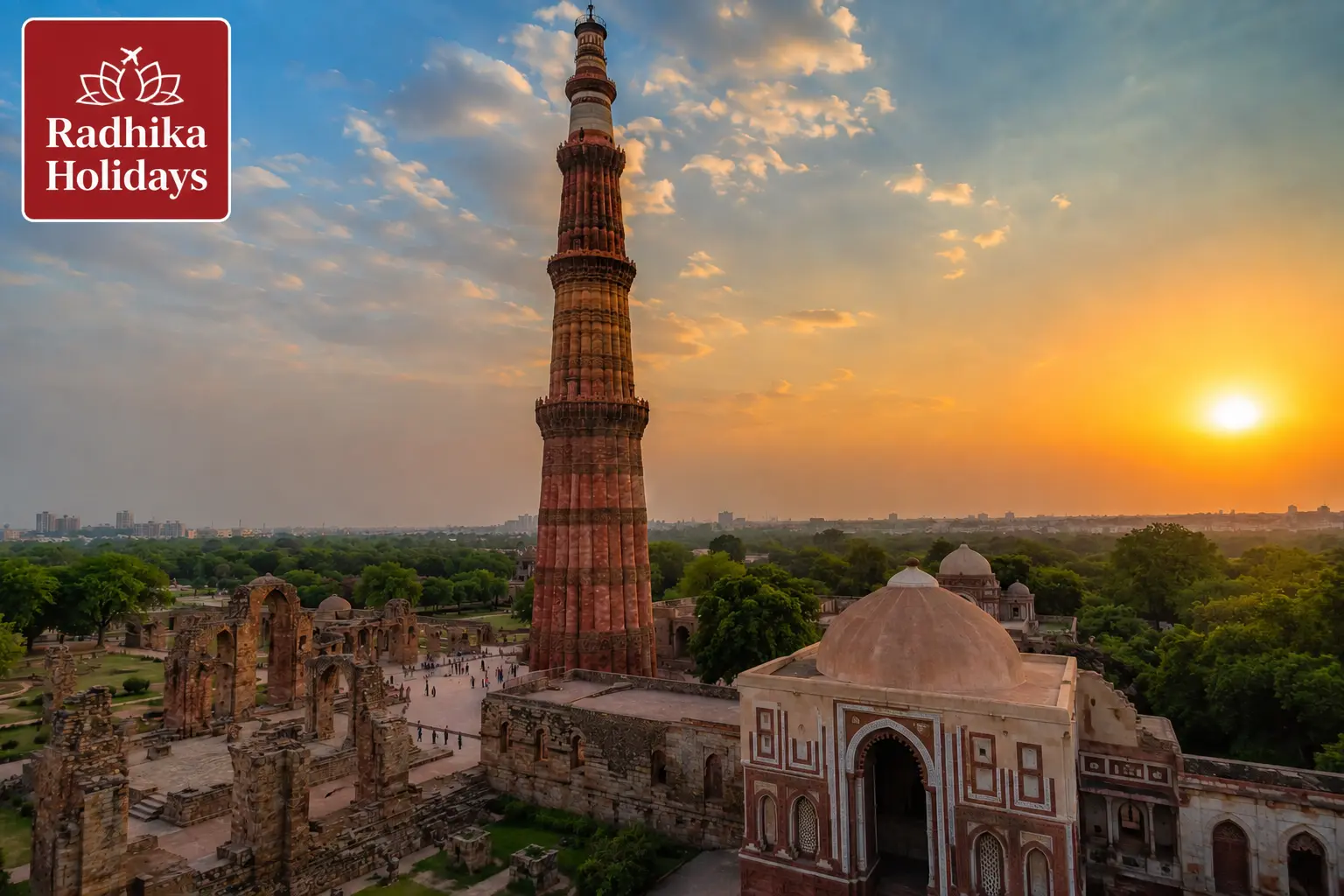
Qutub Minar Seth Sarai Mehrauli New Delhi Delhi is the most visited heritage monument in South Delhi and one of the most iconic UNESCO World Heritage Sites in all of India. Rising 72.5 metres above the ground at Seth Sarai, Mehrauli, this 800-year-old brick minaret stands as the tallest of its kind anywhere in the world — and every year, more than 3 million visitors make their way to this address in New Delhi, Delhi to witness it in person.
Whether you are planning your first visit or returning after years, this guide covers everything you need — exact address, 2025 ticket prices, opening hours, directions, the full history, every monument inside the complex, photography tips, nearby food options, and a ready-to-use itinerary.
Quick Facts — Qutub Minar Seth Sarai Mehrauli New Delhi Delhi
Full Address: Qutub Minar, Baba Sri Chand Marg, Seth Sarai, Mehrauli, New Delhi, Delhi — 110030
GPS Coordinates: 28.5245° N, 77.1855° E
Opening Hours (Summer, April–September): 7:00 AM to 6:00 PM, all 7 days
Opening Hours (Winter, October–March): 7:00 AM to 5:00 PM, all 7 days
Entry Fee 2025 — Indians: ₹35 (cash) / ₹30 (online)
Entry Fee 2025 — Foreign Nationals: ₹550 (cash) / ₹500 (online)
Children under 15 years: Free
Nearest Metro Station: Qutub Minar Metro Station, Yellow Line
UNESCO World Heritage Site since: 1993
Height: 72.5 metres (238 feet)
Built: 1199 to 1220 CE
What Is Qutub Minar Seth Sarai Mehrauli New Delhi Delhi?
Qutub Minar at Seth Sarai, Mehrauli, New Delhi, Delhi is not simply a tower. It is a living monument to over 800 years of Indian history — a five-storey minaret built from red and buff sandstone that changed hands across three ruling dynasties and survived lightning strikes, earthquakes, and centuries of Delhi's turbulent past.
The Qutub complex that surrounds the minaret at Seth Sarai, Mehrauli contains some of the oldest surviving Islamic architecture in the Indian subcontinent, including the earliest mosque built by the Delhi Sultanate, a 1,600-year-old iron pillar that has never rusted, an unfinished rival minaret, and masterpiece gateways of medieval Indo-Islamic craftsmanship.
What makes Qutub Minar Seth Sarai Mehrauli New Delhi Delhi unique among all heritage monuments in India is that it sits on the site of Delhi's oldest fortified city — Lal Kot — originally built by the Tomar Rajputs in the 8th century CE. The ground beneath your feet at Seth Sarai is one of the oldest continuously settled urban sites anywhere in the Indian subcontinent.
Full Address and Location — How to Find Qutub Minar Seth Sarai Mehrauli New Delhi Delhi
Full Postal Address: Qutub Minar, Baba Sri Chand Marg, Seth Sarai, Mehrauli, New Delhi, Delhi — 110030
The complex sits inside the Mehrauli Archaeological Park in South Delhi. Seth Sarai is the specific locality within Mehrauli where the main entrance gate on Baba Sri Chand Marg is located. When using Google Maps, Ola, Uber, or any navigation app, search for "Qutub Minar Complex, Seth Sarai, Mehrauli" to reach the correct entrance — not the metro station, which is 2 km away.
How to Reach Qutub Minar Seth Sarai Mehrauli New Delhi Delhi
By Delhi Metro — Recommended Route to Seth Sarai Mehrauli New Delhi
The easiest and most reliable way to reach Qutub Minar Seth Sarai Mehrauli New Delhi Delhi is by the Delhi Metro Yellow Line.
Take the Yellow Line to Qutub Minar Metro Station and exit from Gate 1. From the station, take an auto-rickshaw or e-rickshaw to the Seth Sarai entrance — the ride costs approximately ₹30 to ₹50 and takes 7 to 10 minutes.
From Connaught Place (Rajiv Chowk): Yellow Line southbound — approximately 30 to 35 minutes to Qutub Minar Metro Station.
From New Delhi Railway Station: Yellow Line southbound — approximately 35 to 40 minutes.
From IGI Airport Terminal 2 or 3: Take the Airport Express Line to New Delhi station, then Yellow Line southbound — total travel time approximately 50 to 60 minutes to Seth Sarai, Mehrauli.
From Gurugram / Gurgaon: Yellow Line northbound from HUDA City Centre — approximately 20 to 25 minutes.
By Car, Taxi, or Ride-Hailing App to Seth Sarai Mehrauli
From Connaught Place: Approximately 14 km via Aurobindo Marg — 30 to 45 minutes depending on traffic.
From Paharganj: Approximately 16 km via NH 48 through Dhaula Kuan — 35 to 50 minutes.
From Aerocity (Airport area): Approximately 8 km — 20 to 30 minutes.
On Ola and Uber, set your destination as "Qutub Minar Complex, Mehrauli, Seth Sarai" and confirm with your driver that they are heading to the Baba Sri Chand Marg entrance at Seth Sarai.
Paid parking is available adjacent to the complex on Baba Sri Chand Marg — approximately ₹20 to ₹50 for two-wheelers and ₹50 to ₹100 for cars.
By DTC Bus to Mehrauli New Delhi
DTC bus route 505 connects Mehrauli with central Delhi. Route 517 connects from Gurugram areas. The HOHO (Hop-On Hop-Off) tourist bus, route 894CL, also stops at Qutub Minar. Ask the conductor for the "Qutub Minar / Mehrauli" stop.
Entry Ticket Price 2025 — Qutub Minar Seth Sarai Mehrauli New Delhi Delhi
Updated and verified ticket prices for 2025 at Qutub Minar Seth Sarai Mehrauli New Delhi Delhi are as follows:
Indian Citizens: ₹35 per person at the counter / ₹30 per person online
SAARC and BIMSTEC Nationals: ₹35 per person at the counter / ₹30 per person online
Foreign Nationals: ₹550 per person at the counter / ₹500 per person online
Children under 15 years: Free entry
SAARC countries covered under the Indian rate include Bangladesh, Nepal, Bhutan, Sri Lanka, Pakistan, Maldives, and Afghanistan. BIMSTEC countries include Bangladesh, Nepal, Bhutan, Sri Lanka, Thailand, and Myanmar.
Online tickets can be purchased through the official ASI (Archaeological Survey of India) portal at asi.payumoney.com. Buying online saves money and lets you skip the ticket queue entirely — on weekends this queue can run 20 to 30 minutes.
Carry a valid photo ID such as an Aadhaar card or passport when visiting. Indian citizen pricing requires proof of identity.
Opening Hours 2025 — Qutub Minar Seth Sarai Mehrauli New Delhi Delhi
Qutub Minar Seth Sarai Mehrauli New Delhi Delhi is open all seven days of the week, including Sundays and most national holidays.
Summer hours (April through September): 7:00 AM to 6:00 PM
Winter hours (October through March): 7:00 AM to 5:00 PM
The best time to arrive is between 7:00 AM and 9:00 AM. At this hour, the complex is at its quietest, the light is ideal for photography, and the temperature is comfortable even in summer months.
Complete History of Qutub Minar Seth Sarai Mehrauli New Delhi Delhi
The Ground Beneath Seth Sarai — 2,000 Years of History
Long before the minaret rose at Seth Sarai, Mehrauli, New Delhi, this ground was one of the most important urban sites in northern India. The Tomar Rajputs built Lal Kot — Delhi's first fortified city — here in the 8th century CE. Prithviraj Chauhan of the Chahamana dynasty later expanded the fortification and renamed it Qila Rai Pithora. Twenty-seven Hindu and Jain temples stood across this area before 1193 CE.
The Founding of the Qutb Complex (1192–1199 CE)
In 1192 CE, Muhammad of Ghor defeated Prithviraj Chauhan at the Second Battle of Tarain. His general, Qutb-ud-din Aibak, was appointed governor of Delhi. In 1193 CE, Aibak established the Qutb complex at Seth Sarai, Mehrauli and began constructing the Quwwat-ul-Islam Mosque — the first mosque built by the Delhi Sultanate — using architectural materials salvaged from the 27 demolished temples. The columns, brackets, and carvings from those temples are still visible in the mosque courtyard today.
In 1199 CE, Aibak laid the foundation of Qutub Minar itself. He completed only the first storey before his death in 1206 CE.
Completion Under Iltutmish (1211–1236 CE)
Aibak's successor and son-in-law, Shamsuddin Iltutmish, added three more storeys to the minaret between 1211 and 1236 CE. He also significantly expanded the Quwwat-ul-Islam Mosque and commissioned the five-arched qibla screen that still stands at the western end of the courtyard. The minaret was now four storeys tall.
The Lightning Strike and Fifth Storey (1369 CE)
A lightning strike in 1369 CE destroyed the fourth storey of the minaret. Sultan Firuz Shah Tughlaq not only restored the damaged storey but added an entirely new fifth storey — giving Qutub Minar Seth Sarai Mehrauli New Delhi Delhi the form it has today. Tughlaq also added a cupola at the top, which was later removed after an earthquake in 1803.
UNESCO World Heritage Inscription (1993)
In 1993, the Qutub Minar and its Monuments at Seth Sarai, Mehrauli, New Delhi were inscribed on the UNESCO World Heritage List under Reference No. 233, in recognition of their outstanding universal value as early Islamic architecture in South Asia.
Architecture of Qutub Minar — Five Storeys, Five Rulers
One of the most fascinating aspects of Qutub Minar Seth Sarai Mehrauli New Delhi Delhi is that each storey was built by a different ruler — and each one differs visibly in material, style, and decorative detail. This makes the minaret a physical timeline of medieval Indian architecture.
Height: 72.5 metres (238 feet)
Base diameter: 14.3 metres (47 feet)
Top diameter: 2.7 metres (9 feet)
Total interior steps: 379
Primary materials: Red sandstone, buff sandstone, and marble
The first storey, built by Qutb-ud-din Aibak between 1199 and 1206 CE, alternates angular and rounded fluted pilasters carved in red sandstone. Its projecting balcony is supported by muqarnas — honeycomb-style stone corbels — in one of the earliest uses of this technique in India.
The second and third storeys, added by Iltutmish between 1211 and 1236 CE, continue in red sandstone with varied fluting patterns and extensive Arabic calligraphic bands recording historical dedications.
The fourth and fifth storeys, built or rebuilt by Firuz Shah Tughlaq after the 1369 CE lightning strike, are noticeably lighter in colour — a combination of marble and sandstone that reflects the aesthetic shift of the Tughlaq period.
Four projecting balconies circle the tower at each storey junction, each supported by muqarnas corbels. These originally served a functional purpose: the muezzin would walk around each balcony to call the prayer in every direction.
All Monuments Inside Qutub Minar Seth Sarai Mehrauli New Delhi Delhi
1. The Quwwat-ul-Islam Mosque — First Mosque of the Delhi Sultanate
Built in 1193 CE, the Quwwat-ul-Islam Mosque ("Might of Islam") is the earliest surviving mosque built by the Delhi Sultanate and one of the oldest in India. Aibak constructed it using 27 pre-existing Hindu and Jain temple columns, and if you look closely at the columns in the courtyard, you will still see the original Hindu carvings — bells, chains, serpents, and floral motifs — left exactly as they were. The mosque was built on top of an existing Jain temple framework.
[caption id="attachment_692" align="alignnone" width="300"]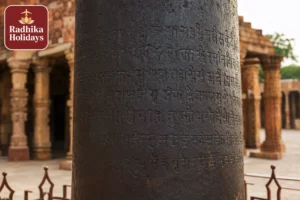 Ancient Iron Pillar inside Qutub Minar complex Mehrauli New Delhi showing Sanskrit inscriptions[/caption]
2. The Iron Pillar of Delhi — 1,600 Years Old and Still Rust-Free
Standing 7.21 metres tall and weighing over 6 tonnes at the centre of the Quwwat-ul-Islam courtyard, the Iron Pillar is one of the most scientifically remarkable objects in the world. Forged during the Gupta period in the 4th to 5th century CE — likely under Chandragupta II — it is composed of 98% pure wrought iron. Despite standing in the open air for over 1,600 years, it has never rusted.
Modern analysis by IIT Delhi confirmed that the pillar's high phosphorus content (approximately 0.25%) created a passive protective layer of crystalline iron hydrogen phosphate on the surface — a corrosion-resistance technology that was not replicated in the West until the 20th century.
A Sanskrit inscription in Brahmi script on the pillar records that it was erected as a Vishnudhvaja — a standard of the god Vishnu — in memory of a king named "Chandra," most likely Chandragupta II of the Gupta Empire.
3. Alai Darwaza — Gateway Masterpiece of Indo-Islamic Architecture
Built in 1311 CE by Sultan Alauddin Khalji, the Alai Darwaza is described by UNESCO as a masterpiece of Indo-Muslim art. Constructed of red sandstone with white marble inlay, it features true arches (among the earliest built in India), intricate geometric marble jali lattice screens, Arabic calligraphic panels, and lotus-bud fringes on the arch interiors — a distinctly Indian decorative touch on an otherwise Islamic gateway.
[caption id="attachment_695" align="alignnone" width="300"]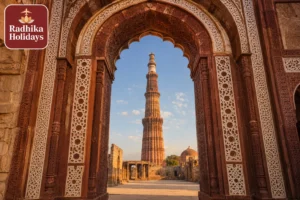 Qutub Minar tower framed through Alai Darwaza gateway arch at Mehrauli New Delhi[/caption]
4. Alai Minar — The Unfinished Giant
In 1296 CE, Alauddin Khalji began building a new minaret that he intended to rise 144 metres — twice the height of Qutub Minar. He called it the Alai Minar. Khalji died in 1316 CE before it could be completed. What remains at Seth Sarai today is the first storey alone — approximately 25 metres of rubble and brick — a massive stump that represents one of the most ambitious unfinished construction projects in medieval Indian history.
5. Tomb of Iltutmish (Built 1235 CE)
The tomb of Shamsuddin Iltutmish — the ruler who completed Qutub Minar — stands within the complex. Built in 1235 CE, it is one of the earliest surviving tombs of a Muslim ruler in India. Its interior contains three different styles of Qur'anic calligraphy carved in geometric arabesque panels considered among the finest 13th-century stone carving in the subcontinent.
6. Tomb of Imam Zamin (Built 1538–1539 CE)
A smaller Mughal-period tomb adjacent to the Alai Darwaza, built during the reign of Humayun. It represents a transitional style between Delhi Sultanate and early Mughal architecture — sandstone with a small whitewashed dome and marble jali screens.
7. Madrasa of Alauddin Khalji
The ruins of an early 14th-century madrasa commissioned by Alauddin Khalji survive within the complex. Khalji himself is believed to have been buried in its courtyard, though no formal tomb marker exists — making it one of the more mysterious burial sites of the Delhi Sultanate.
Mehrauli Archaeological Park — Free Entry Right Next Door
Directly adjacent to the Qutub complex at Seth Sarai, Mehrauli is the Mehrauli Archaeological Park — a wooded area containing dozens of medieval monuments spread across free, open grounds.
Key structures inside the park include the Jamali Kamali Mosque and Tomb (16th century), a strikingly decorated Mughal-era structure with painted interiors that is one of Delhi's most underrated heritage gems. Rajon ki Baoli is a four-storey step-well used by stone masons who worked in this area — atmospheric and almost always deserted. Adham Khan's Tomb, locally known as Bhool Bhulaiya or the maze, is a large octagonal tomb with a complex internal passage. Balban's Tomb (13th century) is historically significant as one of the earliest tombs in India featuring a true arch.
Entry to Mehrauli Archaeological Park is free. Budget an additional 45 to 60 minutes if you wish to explore it after your visit to the main Qutub complex.
Best Time to Visit Qutub Minar Seth Sarai Mehrauli New Delhi Delhi
The best months to visit Qutub Minar Seth Sarai Mehrauli New Delhi Delhi are October through February. During this period, temperatures in New Delhi range from 8°C to 30°C, the skies are clear, and humidity is low. The monument looks its finest in winter morning light.
March is also a very good time to visit — comfortable temperatures and low crowds before the summer heat begins.
April through June should be avoided if possible. Temperatures in Mehrauli, New Delhi can reach 40°C to 45°C, and the open stone surfaces of the complex retain heat. If you must visit in summer, arrive by 7:30 AM and leave before 10:30 AM.
July through September brings the monsoon. The complex is green and lush, the crowds are thin, but expect humidity and occasional rain. Bring an umbrella.
For the best experience on any given day, arrive at 7:00 AM when the gates open. This gives you the golden-hour light for photography, the coolest temperatures of the day, and the smallest crowds. Weekdays (Monday through Thursday) are significantly less crowded than weekends.
Photography Guide — Qutub Minar Seth Sarai Mehrauli New Delhi Delhi
Personal photography at Qutub Minar Seth Sarai Mehrauli New Delhi Delhi is free for all visitors. No permit is needed for mobile phones or regular cameras. Tripods require permission from the ASI site office at the main entrance. Commercial and professional shoots require advance written permission from the ASI Delhi Circle. Drone photography is not permitted within or immediately around the complex — this is restricted airspace in New Delhi.
The best angle for a full tower shot is from the far south end of the main lawn, with the Quwwat-ul-Islam ruins in the foreground. Use the arch of the Alai Darwaza to frame the minaret for a classic composition. The interior of the Tomb of Iltutmish, photographed from the doorway in diffused natural light, shows extraordinary carved detail.
Golden hour from 6:30 to 8:00 AM on a clear winter morning is the ideal time for photography at this location. The low light catches the carved sandstone surfaces and inscriptions dramatically. Overcast days also work very well — diffused light eliminates harsh shadows and reveals the texture of the carvings.
Where to Eat Near Qutub Minar Seth Sarai Mehrauli New Delhi Delhi
A basic canteen near the main entrance of the Qutub complex serves snacks and cold drinks. Outside the gate on Baba Sri Chand Marg, a few mobile stalls sell chai, cold drinks, and light street food.
For proper dining options close to Qutub Minar Seth Sarai Mehrauli New Delhi Delhi, Olive Bar and Kitchen in Mehrauli is a well-known fine-dining restaurant approximately 1.2 km from the complex. Coast Café in Mehrauli offers casual multi-cuisine dining around 0.8 km away. Hauz Khas Village, approximately 3 km from Seth Sarai, has a wide range of rooftop restaurants and cafés across multiple cuisines and budgets.
The recommended plan for most visitors is to spend the morning at the Qutub complex, then head to Hauz Khas Village by 10:30 or 11:00 AM for brunch or lunch.
Nearby Attractions to Combine with Your Visit
Safdarjung's Tomb (approximately 5 km from Seth Sarai, Mehrauli) is the last great Mughal garden tomb in Delhi, built in 1754. It is far less crowded than Qutub Minar and extraordinarily beautiful — an excellent second stop for the afternoon.
Hauz Khas Complex (3 km from Mehrauli) contains medieval step-well ruins, the remains of an Islamic college, and a deer park surrounded by the restaurants and shops of Hauz Khas Village.
Tughlaqabad Fort (approximately 10 km from Mehrauli, New Delhi) is a massive 14th-century fortification with panoramic views across Delhi — ideal for visitors interested in the wider Delhi Sultanate period.
One-Day Itinerary — Qutub Minar Seth Sarai Mehrauli and Surrounding Monuments
7:00 AM — Arrive at the Seth Sarai entrance on Baba Sri Chand Marg. Buy or scan your ticket.
7:05 to 7:45 AM — Quwwat-ul-Islam Mosque courtyard and Iron Pillar. This is your golden hour window — the best natural light of the day.
7:45 to 8:30 AM — Walk the full circumference of Qutub Minar base. Study each storey's changing stonework and inscriptions.
8:30 to 9:00 AM — Alai Darwaza gateway and Alai Minar ruins.
9:00 to 9:30 AM — Tomb of Iltutmish and Tomb of Imam Zamin.
9:30 to 10:30 AM — Walk through Mehrauli Archaeological Park: Jamali Kamali Mosque, Rajon ki Baoli step-well.
10:30 to 11:30 AM — Head to Hauz Khas Village for brunch.
11:30 AM to 1:00 PM — Hauz Khas complex ruins and Deer Park.
1:00 PM onwards — Lunch at a Hauz Khas rooftop restaurant.
Frequently Asked Questions — Qutub Minar Seth Sarai Mehrauli New Delhi Delhi
What is the exact address of Qutub Minar?
The full address is Qutub Minar, Baba Sri Chand Marg, Seth Sarai, Mehrauli, New Delhi, Delhi — 110030. The GPS coordinates are 28.5245° N, 77.1855° E.
Can I climb to the top of Qutub Minar?
No. Climbing inside the minaret has been prohibited since 1981 following a tragic stampede on the interior staircase. All visitors experience the tower from the exterior at ground level.
What are the opening hours of Qutub Minar Seth Sarai Mehrauli New Delhi Delhi in 2025?
Summer (April to September): 7:00 AM to 6:00 PM. Winter (October to March): 7:00 AM to 5:00 PM. Open all seven days including Sundays and most national holidays.
What is the entry fee for Qutub Minar in 2025?
Indian citizens pay ₹35 at the counter or ₹30 online. Foreign nationals pay ₹550 at the counter or ₹500 online. Children under 15 enter free. SAARC and BIMSTEC nationals pay the Indian rate.
Which metro station is closest to Qutub Minar Seth Sarai Mehrauli?
Qutub Minar Metro Station on the Delhi Metro Yellow Line. From Gate 1, take an auto-rickshaw or e-rickshaw to the Seth Sarai entrance — approximately ₹30 to ₹50, 7 to 10 minutes.
How long should I plan to spend at Qutub Minar Seth Sarai Mehrauli New Delhi Delhi?
Allow 60 to 90 minutes for the main Qutub complex. Add 45 to 60 more minutes if you also explore Mehrauli Archaeological Park next door.
Is the Iron Pillar included in the main entry ticket?
Yes. The Iron Pillar is inside the Qutub complex and is fully covered by the standard entry ticket. You do not pay separately.
Is photography free at Qutub Minar?
Yes. Personal photography with mobile phones and cameras is free for all visitors. Tripods require permission from the site office. Commercial shoots need advance ASI approval. Drones are not permitted.
Is Qutub Minar accessible for wheelchair users?
The main paved pathways through the complex are accessible for wheelchairs. An accessible restroom is available — ask site staff for directions. Some areas of the adjacent Mehrauli Archaeological Park have uneven terrain.
Is Qutub Minar open on national holidays?
Yes, the complex is open on most national holidays. In rare cases, specific sections may be temporarily restricted for conservation work. Check the ASI website before visiting on major holidays.
You Also Like: Taj Mahal Tour For Honeymoon Couple, Same Day Agra Tour By Gatimaan Express